RuoYi-Vue Pro Deep Dive: Is This 36,000+ Star All-in-One Framework Actually Worth Using?

An honest deep dive into RuoYi-Vue Pro's strengths as scaffolding and weaknesses as an all-in-one suite.
RuoYi-Vue Pro is a 36,000+ Star open-source Java admin framework offering RBAC permissions, multi-tenancy, and modules spanning CRM, ERP, MES, IoT, and AI. While its Spring Boot + MyBatis Plus + Vue stack provides solid scaffolding for enterprise projects, the all-in-one approach risks delivering demo-level functionality across too many domains. Best used as a foundation for basic admin features, not as a replacement for specialized products.
RuoYi-Vue Pro Deep Dive: Is This 36,000+ Star All-in-One Framework Actually Worth Using?
When an open-source project tries to cram CRM, ERP, MES, IoT, AI, IM, e-commerce, payments, and workflow all into a single repository, is it a Swiss Army knife for enterprise development, or a dull blade that can cut everything but nothing well? Today we're taking a close look at RuoYi-Vue Pro—the homegrown Chinese open-source admin framework that's racked up 36,000+ Stars on GitHub—to see what it's really worth.
What Is RuoYi-Vue Pro? A Constantly Expanding "Super Scaffold"
RuoYi (若依) is one of the most popular open-source admin system frameworks in China, with a name derived from the Chinese phrase meaning "something to rely on." RuoYi-Vue Pro is the officially recommended enhanced version, featuring comprehensive optimizations and refactoring on top of the original RuoYi framework.
On the tech stack side, it adopts the classic Chinese Java full-stack combination of Spring Boot + MyBatis Plus + Vue & Element, covering both a backend admin system and a WeChat Mini Program. As of now, the project has earned 36,921 Stars and 7,976 Forks on GitHub.
These numbers are certainly impressive, but we need to honestly face a fact: the prosperity of the RuoYi ecosystem is, to some extent, a mirror reflecting the "low-level repetitive construction" problem in China's enterprise Java development ecosystem. Countless small-to-medium teams use it as scaffolding, tweak the skin, swap the logo, and deliver it to clients—this is both RuoYi's success and the industry's dilemma.
The Spring Boot + MyBatis Plus + Vue + Element tech stack was absolutely mainstream in 2020; by 2025, it can only be called a "safe bet." It won't go wrong, but it won't excite you either.
At the end of the day, the real question worth pondering is: when you infinitely expand an "admin template" into an "all-in-one suite" covering over a dozen business domains, where are the boundaries of the code? Where is the architectural restraint? Of those nearly 37,000 Stars, how many represent teams deeply using it in production, and how many are just casual bookmarks gathering dust? Between open-source vanity metrics and real value, there's often a bottomless chasm.
RBAC Dynamic Permissions & Multi-Tenancy: The Entry Ticket to Enterprise SaaS
RuoYi-Vue Pro offers a three-pronged approach to permissions and multi-tenancy:
- RBAC Dynamic Permission Management: Role-based access control where permissions can be adjusted in real-time through the admin interface at runtime—no code changes, no service restarts needed. The core idea of RBAC is simple—rather than assigning permissions directly to users, you first define roles (admin, editor, regular user, etc.), attach permissions to roles, then assign roles to users.
- Data Permissions: Fine-grained control over data visibility scope—for example, letting department managers see only their own department's data.
- SaaS Multi-Tenant Architecture: A single system serving multiple enterprises or organizations simultaneously, with tenant data isolated from each other.
These three capabilities are the entry ticket to building enterprise-grade SaaS products, and RuoYi Pro delivers them out of the box—which genuinely deserves recognition.
But the devil is in the details.
How you choose your multi-tenant data isolation strategy—separate databases, separate schemas, or shared tables—directly determines the system's security ceiling and operational complexity. The shared-table-with-tenant-ID approach is easiest to develop, but one SQL statement that forgets WHERE tenant_id = ? becomes a data breach disaster.
And while RBAC's "dynamic permissions" sounds great, the biggest pitfall in real-world implementation isn't the technical architecture—it's that clients themselves can't clearly articulate their own permission models.
More realistically, anyone who's actually built multi-tenant SaaS knows that per-tenant customization demands are the real nightmare—Client A wants an extra field, Client B wants a modified workflow, Client C wants a custom report. RuoYi Pro provides a starting point, but it's absolutely not the finish line. Teams that ship it as a production-grade multi-tenant solution will inevitably get that 3 AM phone call.
The Business Module Matrix: The Temptation and Trap of "Big and Complete"
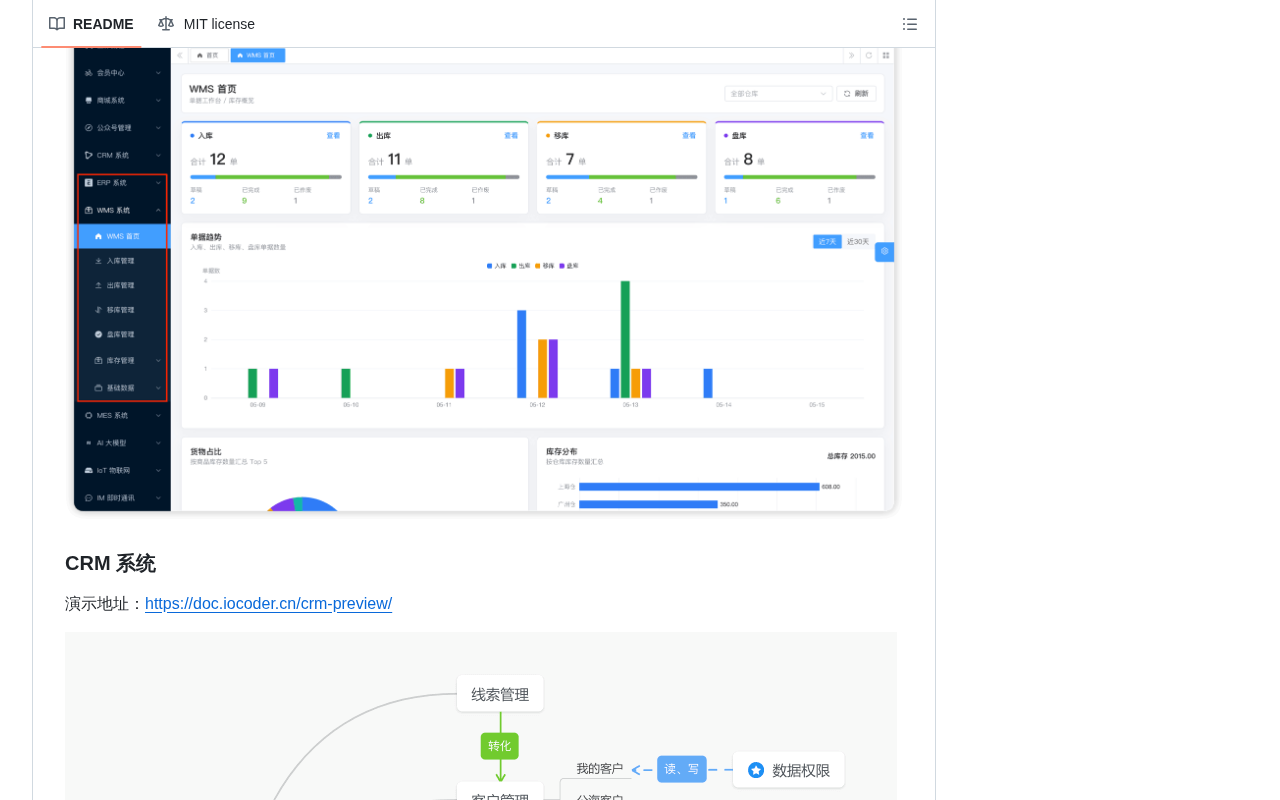
This is the part of RuoYi-Vue Pro that evokes the most mixed feelings. First, look at how long its module list actually is:
- Flowable Workflow Engine: Supports multi-level approval scenarios like leave requests and expense reimbursements. Flowable is a Java process engine forked from Activiti that supports the BPMN 2.0 standard.
- Third-Party Login: Integration with multiple platform social account logins.
- Payment Module & SMS Module: Covering transaction and notification scenarios.
- E-commerce System: Online shopping functionality.
- CRM (Customer Relationship Management): Customer information, sales leads, opportunity management, etc.
- ERP (Enterprise Resource Planning): Integration of core business processes including finance, procurement, inventory, and production.
- MES (Manufacturing Execution System): Shop-floor-level production management, sitting between ERP and industrial control systems.
- IM (Instant Messaging): Real-time messaging based on WebSocket.
- AI Large Model Integration: Connecting to GPT, Tongyi Qianwen, and other large language models.
- IoT Module: Device access and management, supporting MQTT and other protocols.
Workflow, payments, SMS, third-party login—these are reasonable extensions of an admin system, and doing them well is a bonus. But when the module list extends to e-commerce, CRM, ERP, MES, IM, AI, and IoT, things start to go sideways.
Each of these domains—CRM, ERP, MES—represents products that industry giants like Salesforce, SAP, and Siemens have spent decades and thousands of engineers refining. An open-source project attempting to cover them all in "module" form will most likely achieve only demo-level 20% functionality for each, miles away from being truly production-ready.
The addition of AI large models and IoT feels more like trend-chasing "résumé-driven development"—with these keywords, the project description looks omnipotent, but in reality, an IoT module that can't handle millions of concurrent device connections and edge computing is just a toy.
This "big and complete" strategy can attract Stars in the short term, but in the long run it dilutes the project's core competitiveness, exhausts maintainers, and leaves users lost among a pile of half-finished modules.
The Ecosystem Logic Behind the Tech Stack
Setting aside the business modules, the tech stack RuoYi-Vue Pro has chosen is still worth understanding:
- Spring Boot: The de facto standard for Java enterprise development, dramatically simplifying the development process through its "convention over configuration" philosophy, with an embedded Tomcat server ready out of the box.
- MyBatis Plus: A MyBatis enhancement tool developed by the Chinese team baomidou, offering generic CRUD operations, query wrappers, pagination plugins, code generators, and more—eliminating large amounts of repetitive SQL writing.
- Vue.js + Element Plus: Vue is the progressive frontend framework created by Evan You, and Element Plus is the UI component library open-sourced by Ele.me's frontend team. Together they form the standard stack for admin system frontend development in China.
The biggest advantage of this combination is its mature ecosystem, abundant learning resources, and ease of hiring. For most internal systems at small-to-medium enterprises, it's sufficient. But if your business has higher demands for performance, concurrency, or real-time capabilities, you'll likely need to do considerable additional work on top of this foundation.
Final Thoughts: Restraint Is Harder Than Greed
RuoYi-Vue Pro's 36,000+ Stars prove that Chinese developers have an intense demand for out-of-the-box admin frameworks. It genuinely lowers the barrier to enterprise application development, enabling many small-to-medium teams to quickly stand up a system that looks presentable.
But the greatest enemy of an open-source project isn't its competitors—it's its own greed. When you try to be everything to everyone, you ultimately risk becoming nothing special to anyone. Going deep in one domain is far more valuable than going shallow across ten.
If you're planning to use RuoYi-Vue Pro, my advice is: treat it as scaffolding, take the foundational modules you need (permissions, workflow, basic CRUD), and then dig deep in your own business domain. As for those CRM, ERP, MES, and IoT modules—browse them for reference, but don't expect them to replace professional products.
Project repository: https://github.com/YunaiV/ruoyi-vue-pro
Related articles
Deep Dive into AI Agent Skill Design: …
Deep Dive into AI Agent Skill Design: Engineering Practices from Anthropic and Perplexity
A deep dive into Skill design philosophy from Anthropic's Claude Code team and Perplexity's Agent team, covering the Tax Test, Gotchas Flywheel, progressive disclosure, and Eval-First practices for building high-quality AI Agent skill systems.
Deep Dive into OpenAI's Official GPT-5…
Deep Dive into OpenAI's Official GPT-5.6 Prompting Guide: The Shift from Manual to Automatic
A deep dive into OpenAI's official GPT-5.6 Sol prompting guide: conciseness-first, outcome-oriented design, autonomy boundaries, tool routing, and reasoning intensity tuning.
 Deep Dives
Deep Dive into How OpenClaw (Open-Source Crayfish) AI Agent Works
Deep analysis of OpenClaw AI Agent internals: System Prompt, tool calling, SubAgents, Skill system, memory, and Context Engineering explained.