Rust 1.100 Released: A Version Number Milestone and Signals of Language Evolution
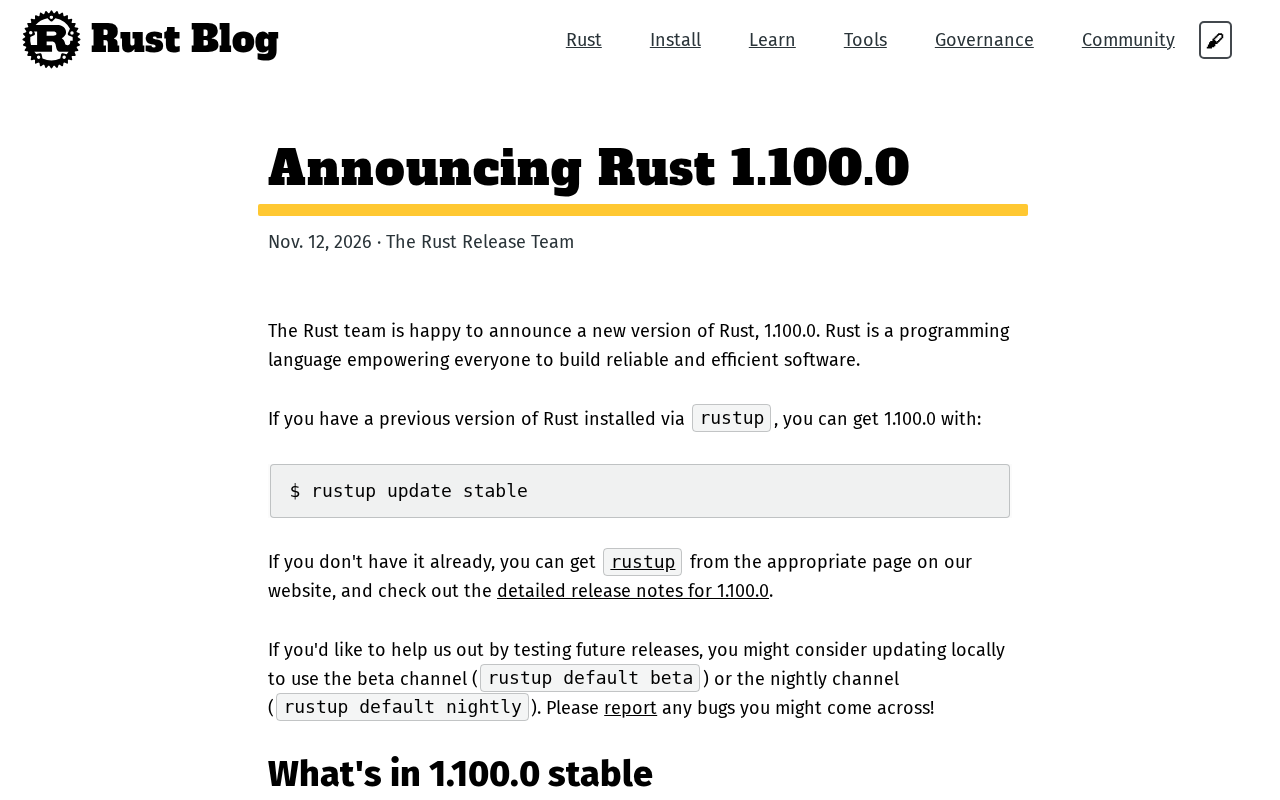
Rust 1.100 is released, and its three-digit version number becomes a symbol of long-term language governance and ecosystem maturity.
Rust 1.100.0 is officially released, with the version number breaking into three digits for the first time, earning 318 points and 137 comments on Hacker News. The article notes that this milestone is itself a routine iteration, but because Rust adheres to releasing a stable version every six weeks, strictly follows semantic versioning, and promises backward compatibility within 1.x, the three-digit version number carries symbolic significance: it is evidence of the long-term effectiveness of Rust's governance model and marks that the language has accumulated more than a decade of engineering practice. Community discussions focus both on specific language features and on the compiler experience, error messages, and crate ecosystem maturity. For developers, a single release usually does not bring disruptive changes; its value lies in cumulative improvements to the toolchain and standard library. For observers, this is a time to reassess Rust's migration costs and adoption barriers.
The release of Rust 1.100 has sparked widespread discussion in the tech community. The official Rust blog published the Rust 1.100.0 release announcement, and the topic quickly rose to prominence on Hacker News, garnering 318 points and 137 comments as of the time of capture. For a systems programming language known for its stability, a three-digit version number is itself symbolic—it marks the fact that Rust has now been through more than a decade of 1.x iteration cycles.
What It Means for the Version Number to Break into Three Digits
Since the release of 1.0, Rust has consistently maintained a release cadence of one stable version every six weeks, strictly following semantic versioning and preserving backward compatibility within the 1.x series. This "never break" commitment makes 1.100 more than just a numerical coincidence—it is direct evidence that Rust's governance model has remained effective over the long term.
In community discussions, many developers treated this milestone as an opportunity to look back on Rust's evolutionary path. From its early focus on memory safety and zero-cost abstractions to its current penetration into embedded systems, WebAssembly, command-line tools, and even operating system kernels, Rust's application boundaries have continued to expand over the past dozens of releases. Breaking the 100 mark in version numbers reminds people that the language has accumulated a sufficiently long history of engineering practice.
Semantic Versioning (SemVer) is the version numbering convention that Rust follows: MAJOR.MINOR.PATCH. Under the SemVer specification, an increment to the major version number indicates incompatible API changes; an increment to the minor version number indicates new functionality added in a backward-compatible manner; and an increment to the patch version number indicates backward-compatible bug fixes. Within the 1.x series, Rust only increments the minor and patch version numbers and promises not to introduce breaking changes—this is the technical foundation of the "never break" commitment.
It is worth noting that Rust's minor version number increments every six weeks, so 1.100 represents the 100th stable release cycle, not 100 major functional overhauls. This "small steps, fast pace" release model is similar to the cadence of large projects such as the Linux kernel and Chrome; the goal is to shorten the delay between a feature becoming stable and becoming usable, while making regressions easier to locate and roll back.
Backward compatibility here is not just a slogan, but an engineering practice continuously verified through infrastructure such as crater (which runs regression tests against a large number of real crates).
Key Focus Areas in the Hacker News Discussion
Judging from the 137 comments on Hacker News, the community reaction shows typical characteristics of Rust discussions—there are both technical explorations of specific language features and debates about the direction of ecosystem development. The 318-point popularity shows that even for a routine release announcement, Rust can still attract a large amount of developer attention, which is uncommon in programming language communities.
The discussions in the comment section often reflect real users' concerns better than the announcement itself. For a language with a steep learning curve like Rust, the community's expectations for each release lie not only in new features, but also in the compiler experience, the quality of error messages, and the maturity of the crate ecosystem.
Practical Significance for Developers
That said, Rust's release mechanism means that a single release usually does not bring disruptive changes. The value of 1.100 is more reflected in cumulative effects: each iteration polishes the toolchain, optimizes compilation performance, and improves the standard library. For teams already using Rust, staying up to date with releases remains the standard way to obtain performance improvements and bug fixes.
For developers who are still watching from the sidelines, this version number milestone may be a good time to reevaluate Rust. The language's stability commitment means migration costs are predictable, while the continued maturation of the ecosystem lowers the barrier to real-world adoption.
Zero-cost abstraction is one of Rust's core design principles, referring to the fact that the high-level abstractions provided by the language (iterators, generics, traits, closures, etc.) compile to machine code comparable to hand-written low-level code without introducing runtime overhead. This principle relies on Rust's trait monomorphization, inlining optimizations, and the LLVM backend; compile-time borrow checking ensures that these abstractions do not sacrifice memory safety. Understanding this helps explain why Rust is attractive in embedded and systems programming scenarios—developers do not need to trade off between expressiveness and performance.
WebAssembly (Wasm) is a portable binary instruction format designed for efficient execution in browsers and in host environments outside the browser. Because of its lack of GC, predictable memory layout, and small runtime footprint, Rust has become one of the mainstream languages for compiling to Wasm, and toolchains such as wasm-bindgen and wasm-pack have lowered the cost of interoperability with JavaScript.
Conclusion
The release of Rust 1.100 is itself a routine version iteration, but the three-digit version number gives it additional symbolic significance. It is both a demonstration of the results of Rust's long-term governance model and a concentrated expression of the community's activity. The highly popular discussion on Hacker News shows that Rust remains one of the most closely watched languages in the systems programming field.
Related articles

Nvidia CEO Removal Saga: Trump Intervenes Over the Weekend, Jensen Huang Reinstated Monday
Vergecast podcast reveals Nvidia CEO drama: earnings call said he wouldn't return and a new CEO was being sought; Trump intervened over the weekend, with J.D. Vance brokering a security guarantee to the board; Jensen Huang reinstated at 9 a.m. Monday.

Semantic Caching Explained: Reusing the Same Answer for Similar Questions
Semantic caching uses embeddings to judge whether queries are similar in meaning and reuses cached results for similar prompts. This article explains how it works, the difficulty of threshold tuning (such as the risk of misjudging negations), and its applicable boundaries.

How Did Trump Personally Turn Nvidia into the "Twelfth Board Member"?
A YouTube political commentary offers a sharp view: behind Nvidia's market cap milestone, Trump's deep involvement earns him the title of "twelfth board member." The article breaks down the commentator's logic on stock market achievements, the break from small-government tradition, and power display.