Rust's New Contribution Policy Explained: How Open Source Communities Coexist with LLM-Generated Code

Rust adopts a nuanced LLM contribution policy, balancing AI tool usage with code quality and reviewer autonomy.
The Rust project has introduced a new contribution policy addressing LLM-generated code in open source collaboration. Rather than banning AI code outright, it grants reviewers explicit exemption from reviewing LLM content. The policy reflects deeper tensions around code quality, developer skill atrophy, and the growing proportion of code that no human fully understands—challenges facing the entire open source ecosystem.
Rust Community's Difficult Choice
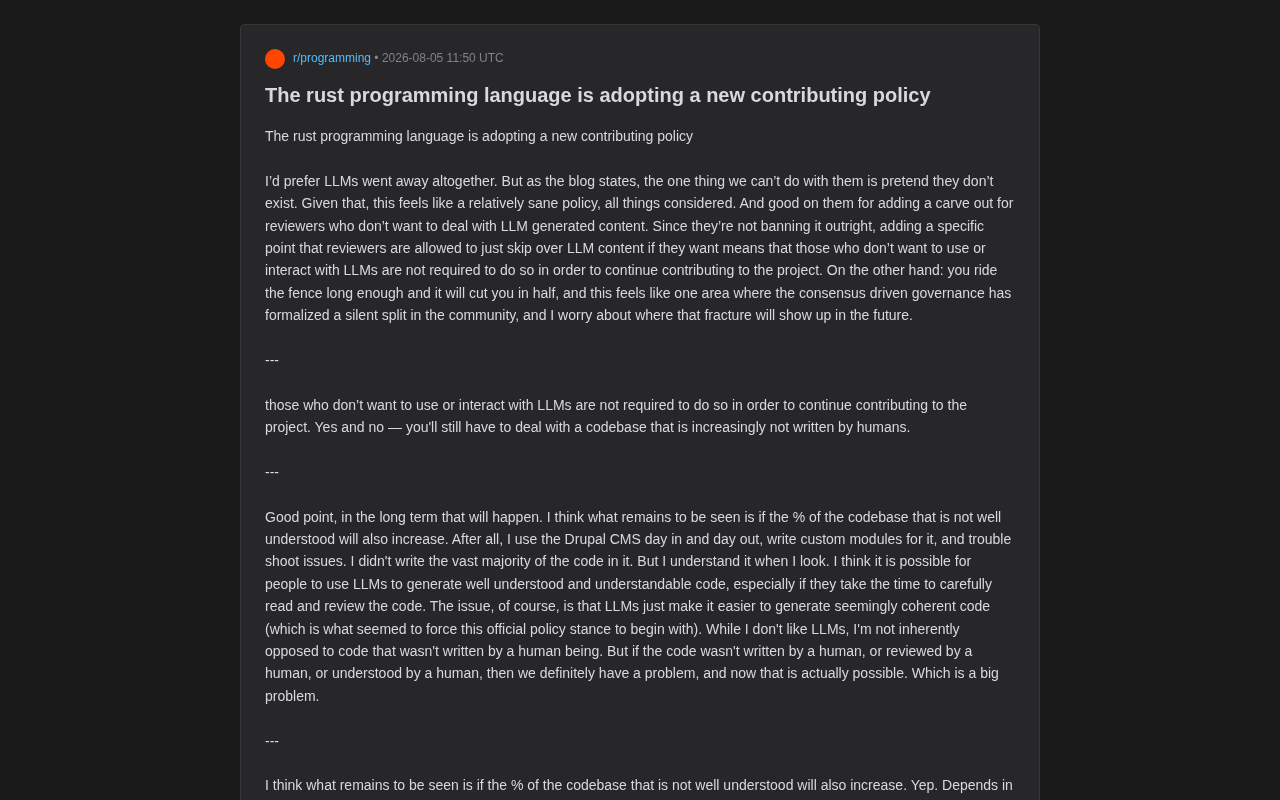
The Rust programming language project recently announced a new contribution policy specifically addressing the role of Large Language Model (LLM) generated content in open source collaboration. This policy didn't emerge in a vacuum—it's a reality that open source communities must face under the wave of AI. As the official blog stated, "The one thing we cannot do is pretend they don't exist."
Based on community discussions, this policy is widely regarded as a "relatively sane" compromise. Rather than outright banning LLM-generated code, it takes a more pragmatic approach—acknowledging that AI tools have already deeply penetrated the software development workflow, and attempting to find a balance between embrace and caution.
Notably, the Rust project uses an RFC (Request for Comments) process for major decisions, managed collaboratively by multiple governance teams. After the Rust Foundation experienced a governance crisis in late 2022 that led to a core team restructuring, the project has placed greater emphasis on transparent decision-making and consensus mechanisms. This "consensus-driven governance" model originates from the traditions of internet standards organizations like the IETF, requiring major policy changes to undergo public discussion and multi-party agreement—but this also makes it easy to get caught in dilemmas on controversial issues.
The Reviewer's "Exemption": No Obligation to Review AI Code
The most praised aspect of the new policy is the clear "exemption clause" established for code reviewers who don't want to deal with LLM-generated content. Since AI content isn't completely banned, explicitly stating that reviewers have the right to skip LLM-generated content means that contributors who don't want to use or engage with LLMs aren't forced to deal with them and can continue contributing to the project.
To understand the importance of this clause, you need to recognize the critical role of code review in open source collaboration. In large projects like Rust, every Pull Request must be approved by at least one reviewer with merge permissions before it can be merged into the main branch. Reviewers don't just check functional correctness—they also evaluate code style consistency, performance impact, security implications, and architectural fit. An experienced reviewer typically needs months or even years of project participation to accumulate sufficient contextual knowledge, making review capacity one of the scarcest resources in open source communities. When these valuable reviewers are forced to spend time on low-quality AI-generated PRs, the entire project's progress is affected.
This design reflects Rust's consistent "consensus-driven governance" philosophy, attempting to accommodate every stakeholder in the community. But some community members have pointed out bluntly: "You ride the fence long enough and it'll split you in two." This attempt to please everyone effectively institutionalizes a "silent rift" within the community.
The Core Controversy: Code Quality and Developer Understanding
The real anxiety behind this policy isn't whether AI participates, but code quality and maintainability.
The Triple Risk: "Nobody Wrote It, Nobody Reviewed It, Nobody Understands It"
One developer raised a critical argument: code not being written by humans isn't inherently a problem. Take Drupal CMS as an example—many developers use it daily, write custom modules, and troubleshoot issues without having written the vast majority of its code. The key is that when they look at the code, they can understand it.
The real problem lies in a triple failure: "If the code wasn't written by a human, wasn't reviewed by a human, and isn't understood by a human, then we really have a problem. And right now, that's actually becoming possible." LLMs make generating "seemingly coherent" code extremely easy, and this is precisely the fundamental reason forcing the Rust team to take a stance.
This "seeming coherence" is LLM's core characteristic and its biggest trap. Traditional auto-generated code (from template engines or snippet generators) may be mechanical, but its patterns are predictable and bounded. Code generated by LLMs based on statistical probability can appear human-written in syntax, naming, comments, and other aspects—which makes it harder for reviewers to quickly identify potential issues, because the code's "surface quality" masks logical deficiencies.
Will the "Incomprehensible Proportion" of Codebases Keep Rising?
A thought-provoking question in the discussion: will the proportion of code that isn't fully understood in a codebase increase as LLMs become more widespread? This depends on two key variables:
- The quality of LLM-generated code — where "quality" means not just functional correctness, but also whether it fits the existing codebase's style, patterns, and architectural conventions;
- How much developer skills will atrophy — if developers gradually stop writing code by hand, will their judgment and understanding of code shrink accordingly?
The second variable involves the "Generation Effect" in cognitive science: humans gain far deeper understanding by actively creating content than by passively reading the same content. When developers shift from "people who write code" to "people who approve AI code," their cognitive connection to the codebase may gradually weaken, undermining their ability to identify subtle errors. This vicious cycle—the less you write code, the harder it is to understand code, and the harder it is to understand, the more you depend on AI—is the long-term risk that many senior engineers truly worry about.
Neither question has a definitive answer yet, but together they constitute a potential threat to the long-term health of open source projects.
The Right Way to Use LLM-Assisted Programming
It's worth fairly noting that the flood of "AI slop PRs" doesn't represent effective LLM usage. The Rust team clearly understands this, which is why they're unwilling to impose a blanket ban.
The term "AI Slop PR" describes a new phenomenon facing open source communities since 2024. Some users leverage LLMs to batch-generate code changes and submit large volumes of low-quality PRs to open source projects without sufficient understanding. These PRs often appear reasonable on the surface—syntactically correct code, properly formatted commit messages—but may actually introduce logic errors, break existing tests, or solve problems that don't exist. Notable projects like the Linux kernel and Python CPython have reported such issues, and some maintainers have even begun explicitly requiring disclosure of AI tool usage in their contribution guidelines. The root cause is that LLMs lower the barrier to "generating code" without lowering the barrier to "understanding code."
From "Generating Code" to "Understanding Code"
One developer shared a highly instructive experience: LLMs are most useful when you have them query and understand code, rather than generate new code. Writing code is easy; understanding a massive codebase is hard—and the more "junk code" in a codebase, the harder understanding becomes.
This shift in usage is quite insightful. You might receive 100 low-quality PRs from people who can't even figure out that "git diff --check is not a CI tool," but you might also receive a high-value contribution from a security researcher who used an LLM to refine a vulnerability proof-of-concept. The tool itself is neutral; what matters is the user's intent and capability.
In practice, using LLMs as "code comprehension assistants" is rapidly gaining popularity among professional developers. For example, when you need to understand an unfamiliar large codebase, LLMs can help explain complex type signatures, trace data flows, and summarize inter-module dependencies. This usage transforms LLMs from "replacing human thinking" to "expanding human cognitive bandwidth"—a healthier model of human-machine collaboration.
The Real Cost of "AI Hallucinations"
However, LLM-assisted understanding isn't foolproof either. One developer recounted a painful experience: while reviewing a PR, the LLM proposed a theory claiming that it wasn't a correct fix. They spent an entire day following the LLM's logical reasoning, only to discover that the original fix was completely correct, while the LLM's proposed "better solution" was actually a massive and complex race condition.
Race conditions are among the most insidious and dangerous defects in concurrent programming, occurring when a program's output depends on the relative execution timing of multiple threads or processes. One of Rust's core selling points is eliminating data races at compile time through its ownership system and borrow checker, which makes introducing a race condition in a Rust project particularly ironic—it directly contradicts the language's design philosophy. LLM-generated concurrent code often fails to handle these scenarios correctly because it lacks genuine understanding of program runtime state, relying only on pattern matching from training data to generate "plausible-looking" solutions.
An entire day wasted, accompanied by terrible frustration. This case reveals a hidden danger of LLMs—they can "gaslight" you with an extremely confident tone, making you believe incorrect conclusions.
The LLM "Hallucination" phenomenon stems from its underlying architecture—Transformer models are essentially performing probabilistic token prediction, not logical reasoning. When the model encounters scenarios insufficiently covered in training data, it generates "the most probable next token" based on statistical distribution, rather than "the correct answer." More dangerously, model confidence calibration is often poor—its tone when outputting incorrect content is virtually indistinguishable from when it outputs correct content. In the code domain, this means LLMs might recommend an implementation with serious security vulnerabilities in an extremely authoritative tone, and developers who lack the ability or habit of independent verification could be misled.
When Will the Community Rift Surface?
A premonition permeates the community: all it takes is one botched LLM PR that ruins someone's entire day getting merged, and the rift will begin to show—even if it's a mistake that a non-LLM user could equally have made or overlooked.
But cooler voices suggest such an event would only bring the rift "to the surface," not create it. In fact, the rift already exists—otherwise there would be no need for those exemption clauses serving people on "both sides" of the fence.
This community division isn't unique to Rust. The entire open source world is experiencing a values divide over AI tool usage: one side views AI as an inevitable productivity trend and rejecting it means rejecting progress; the other side sees uncritical acceptance of AI output as a betrayal of engineering rigor. The deep root of this divide lies in two fundamentally different software development philosophies—"output-oriented" versus "understanding-oriented." The Rust community, with its extreme emphasis on safety and correctness, happens to sit at the eye of this storm.
A Sharper Take
At the end of the discussion, someone offered the most direct summary: "All those words just to not piss off the AI boosters rather than just saying 'the quality isn't there yet.' If the quality were actually there, none of this discussion would matter."
This remark perhaps strikes at the heart of the entire debate. All the complex discussions about exemptions, review processes, and usage patterns are essentially avoiding a simple fact: current LLM-generated code quality has not yet reached a level of stable reliability that warrants unconditional trust. And it's precisely this "quality uncertainty" that forces engineering-rigorous projects like Rust to respond with an elaborate but slightly awkward policy.
From a broader perspective, this "quality uncertainty" is itself an inherent characteristic of LLM technology's current development stage. Unlike traditional software tools, LLM outputs have no deterministic guarantees—the same input may produce outputs of varying quality, and error patterns are difficult to systematically predict and prevent. This means any quality assurance process built around LLMs must assume "every output could be wrong"—an extremely high trust cost in engineering practice.
Conclusion: A Mirror Reflecting the Open Source Industry's Dilemma
Rust's new contribution policy, rather than being a solution to any specific problem, is a microcosm of the collective anxiety across the open source world in the AI era. It attempts to safeguard the code quality and collaborative trust that communities depend on while not rejecting technological progress.
This debate about "whether humans understand their own codebases" won't end with any single policy. For every open source project and the entire software industry, how to balance efficiency with maintainability, and innovation with rigor, will be an inescapable core challenge for years to come. As LLM capabilities continue to improve and their reach expands, policy explorations like Rust's—whether successful or not—will serve as important reference points along the industry's evolutionary path.
Related articles

How AI Data Centers Are Reshaping Electricity Pricing: Cost Allocation and Energy Market Transformation
Surging AI data center power demand is reshaping electricity pricing. This article analyzes grid impacts, three pricing pathways, and implications for consumer bills and energy transition.

Chiplab: AI Tests Firmware on Virtual Chips Without Physical Development Boards
Chiplab enables AI coding assistants to compile, run, and debug embedded firmware on high-fidelity virtual chips via MCP protocol, supporting STM32 and Nordic platforms without physical hardware.

Muse Glimmer Local Testing: Meta's Open-Source 30B Multimodal Model Runs on a Single GPU
Meta releases Muse Glimmer, a 30B open-source multimodal model running on a single 24GB GPU. Tested at 233 tokens/sec with speculative decoding on RTX 5090, Apache 2.0 licensed with GGUF support.