RuView: Camera-Free Spatial Awareness and Vital Sign Monitoring Using Ordinary WiFi Signals

RuView uses WiFi CSI signals to enable camera-free spatial sensing and vital sign monitoring in Rust.
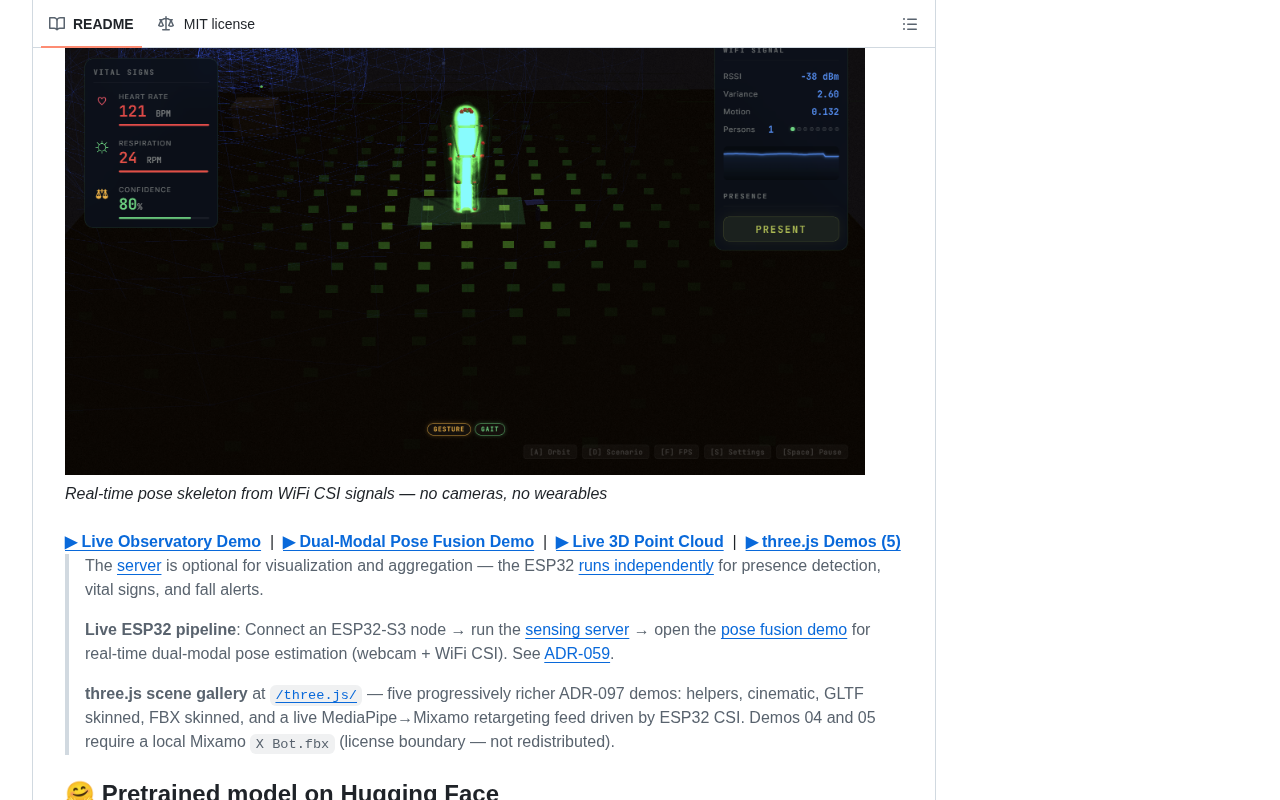
RuView is an open-source Rust project that leverages Channel State Information (CSI) from ordinary commercial WiFi signals to deliver real-time spatial intelligence, presence detection, and vital sign monitoring — all without any camera or video capture. With 76,500+ GitHub stars, it represents a compelling approach to privacy-friendly passive sensing for smart homes and edge computing.
When WiFi Becomes More Than a Network: A Camera-Free Spatial Revolution
As IoT and smart home technologies rapidly proliferate, enabling spatial awareness while preserving user privacy has remained a persistent challenge for the industry. Traditional solutions rely on cameras, infrared sensors, or dedicated radar — devices that either pose privacy risks or come with high deployment costs. The open-source project RuView (ruvnet/RuView) offers a fundamentally different answer: use the commercial WiFi signals already in your home to enable real-time spatial intelligence, vital sign monitoring, and presence detection — all without capturing a single frame of video.
Built with Rust, the project has already earned over 76,500 stars and 10,000+ forks on GitHub, with more than 133 new stars added in a single day — a clear signal of intense developer interest in this direction.
RuView's Three Core Capabilities
Spatial Intelligence Without Video
RuView's most distinctive feature is its complete independence from visual sensors. As the project's official description explicitly states, its functionality is achieved "without a single pixel of video." This means the system is physically incapable of "seeing" users, fundamentally eliminating the privacy risks associated with camera-based approaches.
For privacy-sensitive areas like bedrooms and bathrooms, or use cases such as elderly care monitoring, this camera-free sensing approach offers a clear advantage — users gain full spatial awareness capabilities without worrying about image data being leaked or misused.
It's worth noting that WiFi sensing can be divided into two main approaches based on signal origin: active sensing and passive sensing. Active sensing systems emit their own detection signals (e.g., dedicated UWB or millimeter-wave radar), offering high control but requiring specialized hardware and spectrum licensing. Passive sensing reuses existing wireless signals in the environment (WiFi, cellular, digital TV signals, etc.), requiring no additional hardware — though since these signals weren't designed for sensing, they are significantly harder to process. RuView operates in a semi-active mode: it leverages transmission signals from an existing WiFi network, but requires NIC firmware support for CSI extraction on the receiver side. Representative chipsets include Intel 5300, Atheros AR9380, and select Broadcom solutions.
CSI-Based Vital Sign Monitoring
Beyond basic presence detection, RuView can perform vital sign monitoring. The technical core is Channel State Information (CSI) — subtle movements like breathing and heartbeat create tiny perturbations in the propagation path of wireless signals. By collecting and analyzing these perturbations, the system can infer physiological metrics such as respiratory rate.
CSI is the physical foundation of WiFi sensing technology, and its operating principles deserve a closer look. The core modulation technology in modern WiFi standards is OFDM (Orthogonal Frequency-Division Multiplexing), introduced as early as 802.11a and widely used in 802.11n/ac/ax (WiFi 4/5/6). The core idea of OFDM is to divide a wideband channel into dozens to hundreds of mutually orthogonal narrowband subcarriers for parallel transmission, improving spectral efficiency while combating multipath fading. Within this framework, CSI describes the amplitude attenuation and phase shift of each subcarrier as the signal travels from transmitter to receiver, providing precise complex-valued quantitative information. Compared to RSSI (Received Signal Strength Indicator), which only reflects overall signal strength, CSI captures far more granular multipath propagation characteristics. With information density far exceeding RSSI's single scalar value, CSI is highly sensitive to millimeter-level physical disturbances — chest expansion during breathing spans roughly 1 to 12 mm, while heartbeat-induced body surface displacement is approximately 0.1 to 0.5 mm. These subtle movements leave identifiable periodic signatures in CSI time-series data, forming the physical basis for vital sign extraction.
Academic research in WiFi sensing dates back to the early 2010s. Dina Katabi's team at MIT CSAIL published a series of results including WiTrack and RF-Capture, achieving through-wall human tracking and pose estimation. Stanford, Carnegie Mellon, and other universities have also published CSI-based research on respiratory detection and fall recognition. However, a significant engineering gap exists between published papers and deployable systems: academic experiments are typically conducted in controlled environments using custom hardware and specific firmware (such as CSI extraction patches for OpenWRT with Atheros chipsets), while the multipath interference, occlusion, and hardware heterogeneity of real home environments significantly reduce accuracy. RuView's value lies precisely in engineering these cutting-edge research findings into a practically deployable open-source tool — an attempt to bridge this gap.
Real-Time Presence Detection
Presence detection is a fundamental requirement for many smart home scenarios. RuView can determine in real time whether a room is occupied, roughly how many people are present, and sense their location and movement. Compared to infrared or ultrasonic sensors, WiFi-based solutions require no additional hardware — they directly reuse existing network equipment to cover an entire space, dramatically lowering the deployment barrier.
Why Rust?
The choice of Rust for RuView was deliberate. CSI data processing is a classic real-time streaming computation task: commercial WiFi NICs in monitor mode can generate hundreds to thousands of CSI data frames per second, each containing complex values across dozens to hundreds of subcarriers — placing extreme demands on latency and throughput.
The traditional choice would be C/C++, but memory safety vulnerabilities (such as buffer overflows) are especially dangerous in concurrent data stream processing. Rust eliminates data races and dangling pointer issues at compile time through its Ownership system and Borrow Checker. Specifically, Rust's ownership model requires that each value has exactly one owner at any given time, with the value's lifetime statically tracked by the compiler — no garbage collector needed. The borrow checker enforces the rule that "at any given moment, there can be either one mutable reference or multiple immutable references" at compile time, fundamentally eliminating data races — one of the most persistent problems in concurrent programming. For CSI data stream processing — a scenario requiring multi-threaded, high-throughput operation — this means developers can write lock-free or fine-grained concurrent code without worrying about runtime crashes or difficult-to-reproduce race conditions. At the same time, Rust preserves zero-cost abstractions, delivering runtime performance comparable to C/C++ alongside memory safety guarantees. Additionally, Rust's async/await model paired with the Tokio runtime makes it possible to handle data streams from multiple WiFi interfaces simultaneously, without complex thread locking mechanisms.
Rust's strong cross-platform characteristics also make it easy to deploy RuView flexibly across diverse hardware environments, from edge devices to servers. This technical choice reflects the project's commitment to engineering reliability and is one of the reasons it has attracted such significant developer attention.
Technical Prospects and Real-World Challenges
Market Value of Privacy-Friendly Sensing
The "passive sensing" direction that RuView represents is increasingly becoming an important trend in smart home and health monitoring. It transforms ubiquitous WiFi infrastructure into a sensing network, requiring no additional dedicated hardware costs while naturally sidestepping the privacy controversies associated with image capture. This "infrastructure reuse" approach opens up broad possibilities for smart homes, eldercare, energy management, and many other scenarios.
Technical Limitations to Acknowledge Realistically
Despite its promise, WiFi-based sensing still faces real challenges. Channel state information is susceptible to environmental interference — furniture layout, wall materials, and other wireless devices can all affect detection accuracy. The accuracy of vital sign monitoring often shows a significant gap between laboratory settings and real home environments, and the technology remains far from medical-grade applications.
Furthermore, while WiFi sensing avoids the image privacy problem, it introduces new privacy dimensions with a uniquely covert character. Unlike cameras, WiFi signals penetrate walls and are omnipresent — users cannot protect themselves through physical blocking. Research published by Carnegie Mellon University in 2022 demonstrated that WiFi signals from a home router alone can reconstruct the 3D poses of people indoors, with accuracy approaching that of camera systems. Even more concerning is that this sensing can be conducted by a completely uninformed third party — a neighbor's router or a public hotspot in a hallway can serve as a collection endpoint, inferring the activity patterns of occupants without their knowledge.
From a regulatory perspective, WiFi signals are treated as "public signals in the air" in most legal systems, meaning their collection and analysis faces far fewer legal constraints than video surveillance. The applicability of the EU's GDPR remains debated: if CSI data can be linked to a specific natural person (e.g., through device MAC address or behavioral pattern recognition), it theoretically constitutes personal data processing and must satisfy a lawful basis requirement; but if individuals cannot be directly identified, it may fall into a regulatory blind spot. This legal ambiguity, combined with WiFi signals' inherent ability to penetrate walls, creates a tension between technical feasibility and ethical compliance that warrants ongoing attention. The EU's General Data Protection Regulation (GDPR) currently has no explicit rules for this type of "RF profiling," leaving a regulatory gray area. This ethical boundary between "sensing as surveillance" is equally worth careful consideration by developers and users alike.
Conclusion
RuView demonstrates the possibility of passive sensing technology moving from the laboratory into open-source practice, with the compelling premise of "turning ordinary WiFi signals into real-time spatial intelligence." Its more than 76,000 GitHub stars confirm the enthusiasm for this direction within the developer community. For engineers focused on privacy protection, smart homes, and edge computing, RuView is undoubtedly a project worth studying in depth. That said, bridging the gap from proof-of-concept to a mature, reliable product still requires resolving a substantial number of engineering and ethical questions — maintaining interest while calibrating expectations remains equally important.
Related articles

OpenAI Partners with Shield: How the Astra Agent Revolutionizes IT Troubleshooting
OpenAI and Shield launch the Astra agent, which autonomously logs into computers and legacy systems to fix IT issues in real time, 35-40% faster than traditional models, with humans involved only when judgment is needed.

iPhone Duo Battery Life Tested: One Charge a Day Is Unavoidable, and the Large Screen Is the Culprit
iPhone Duo battery test: heavy use needs at least one charge a day, and about 30% remains after 6.5 hours of screen-on time. How often the large screen is unfolded is key; a MagSafe battery pack helps, and long-term degradation is also worth watching.

Kimi K3.1 Pro Open-Sourced: 2.8 Trillion Parameters Close In on Opus
Moonshot releases the open-source MoE model Kimi K3.1 Pro, with 2.8T total parameters and 104B activated, trailing Opus 5.5 by under 1 point on Terminal Bench 4.0.