SafeRoute-MAS: A New Message Routing Approach for Multi-Agent Reasoning

SafeRoute-MAS routes expert messages with coverage awareness and risk calibration, but gains are limited, labels are unstable, and validation is retrospective.
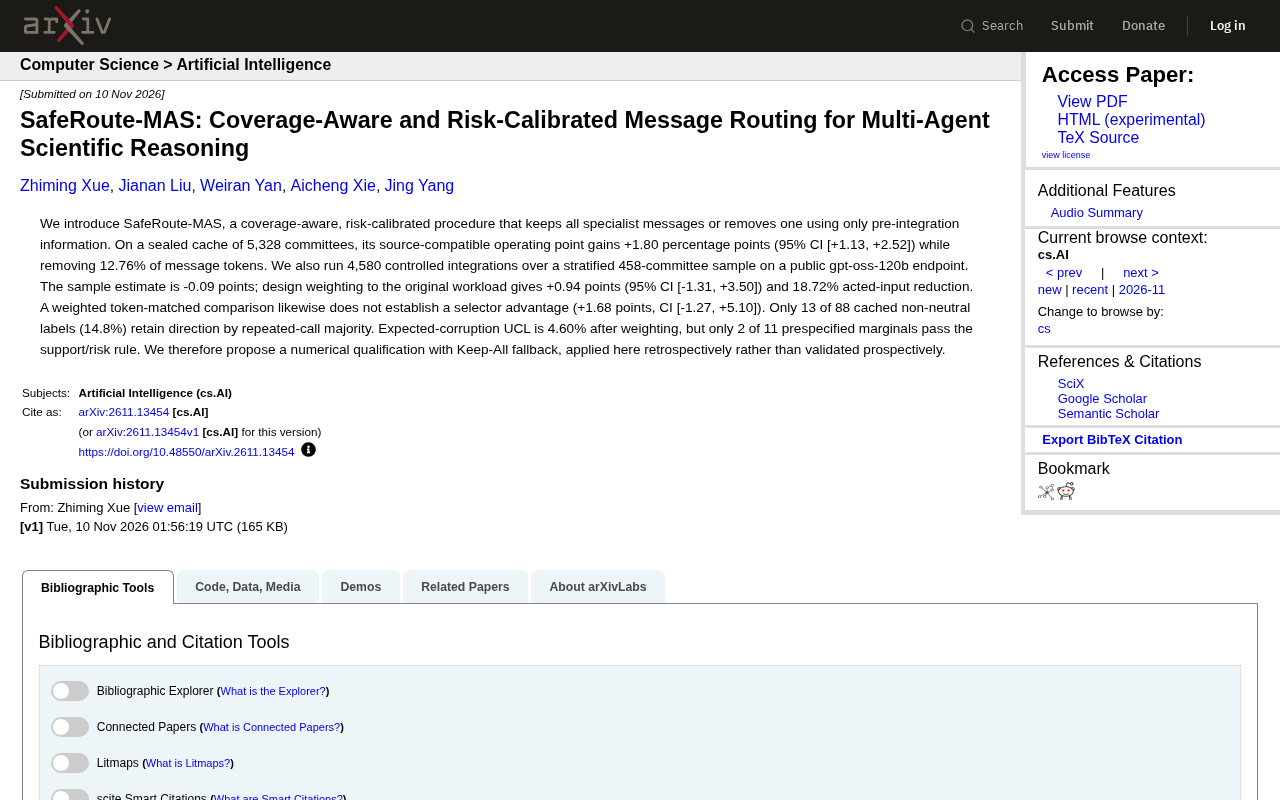
This article reviews SafeRoute-MAS, a message routing method for multi-agent scientific reasoning. It uses a two-stage decision: evaluate each expert message's coverage contribution to the current task, then use a risk model to decide whether to keep or remove it, relying only on pre-integration information to ensure decision independence. On 5,328 sealed-cache committees, it achieves +1.80 percentage points and reduces message tokens by 12.76%; but in 4,580 controlled experiments on the gpt-oss-120b endpoint, the sample estimate is only -0.09 points, and after design weighting +0.94 points, with a wide confidence interval crossing zero. For label reliability, only 13 of 88 non-neutral labels (14.8%) remain directionally consistent under majority voting. On risk, the weighted expected corruption UCL is 4.60%, only 2 of 11 preset margins pass, and numerical qualification is retrospective. Overall, the framework is theoretically attractive, but gains are unstable, labels are noisy, and prospective validation is lacking, leaving it far from deployment.
Multi-agent systems show great potential in scientific reasoning, but the redundancy and error propagation of expert messages have also become bottlenecks. The recently proposed SafeRoute-MAS attempts to preserve key information while removing redundant content through coverage-aware and risk-calibrated message routing. Based on publicly available preprint information, this article reviews its method, experimental results, and limitations.
Method Core: Coverage Awareness and Risk Calibration
The core of SafeRoute-MAS is a two-stage decision process: first evaluate each expert message's coverage contribution to the current reasoning task, then combine it with a risk model to decide whether to keep or remove the message. Crucially, this process uses only information available before message integration and does not depend on subsequent reasoning results, thereby ensuring the independence of routing decisions.
This design attempts to address a common tension in multi-agent collaboration: the more expert messages there are, the more comprehensive the information coverage, but noise and conflicts also increase. SafeRoute-MAS quantifies the unique value of each message through coverage awareness and controls the error risk that may result from removing messages through risk calibration.
Coverage-aware is a term borrowed from set coverage and coverage evaluation in information retrieval: for a given reasoning task, it measures whether a message introduces key arguments, evidence, or reasoning steps not yet covered by other messages. Common quantification methods include deduplication counting based on semantic similarity, hit rates based on task keywords, or model judgment of whether a message provides "new information." The value of coverage awareness lies in distinguishing "redundancy" from broad repetition—two messages with different wording may be highly redundant, while a short message may carry a unique key fact.
Risk calibration refers to estimating, before deciding to remove a message, the probability that the removal action will cause the final answer to be wrong, and aligning this estimate with the true error rate. Calibration is typically tested using reliability diagrams on historical data or methods such as temperature scaling. If risk scores are systematically low, routing will remove too many messages; if they are high, it will conservatively retain redundancy. SafeRoute-MAS makes joint decisions based on coverage contribution and calibrated removal risk precisely to avoid aggressive pruning that "looks only at redundancy and not at cost."
Experimental Results: Limited Gains and Statistical Uncertainty
On 5,328 committees in a sealed cache, SafeRoute-MAS achieved a +1.80 percentage point improvement at the source-compatible operating point (95% confidence interval [+1.13, +2.52]) while removing 12.76% of message tokens. This result appears positive, but it needs to be interpreted cautiously in light of subsequent experiments.
The researchers also conducted 4,580 controlled integration experiments on the public gpt-oss-120b endpoint, with samples drawn from a stratified sample of 458 committees. The sample estimate was -0.09 percentage points, i.e., almost no improvement; after design weighting to the original workload, the improvement became +0.94 percentage points (95% confidence interval [-1.31, +3.50]), while reducing input by 18.72%. The weighted token-matched comparison also failed to establish a selector advantage (+1.68 percentage points, confidence interval [-1.27, +5.10]). These results indicate that the gains of SafeRoute-MAS are not stable across different evaluation settings, and the confidence intervals are wide, raising doubts about statistical significance.
Sealed cache refers to a fixed set of reasoning traces and messages pre-established by the experimenters and no longer updated with changes to the model or prompts, usually used for reproducible offline evaluation. Its advantage is controlled evaluation conditions and repeatable results; its disadvantage is that it may deviate from the distribution of fresh inputs in real deployment, easily overestimating method gains.
Source-compatible operating point refers to a working point selected for hyperparameters such as routing thresholds, such that the method runs under the same message sources and budget constraints as the baseline, thereby ensuring a fair comparison. Different operating points correspond to different retention rates and risk trade-offs, and a single-point improvement cannot represent the entire trade-off curve.
Design weighting is used to correct the distribution shift caused by stratified sampling: if the experiment samples by committee strata, each stratum has a different probability of being selected, and direct averaging would deviate from the original workload; inverse probability weighting according to the sampling design is needed to restore the population estimate. The wider confidence interval after weighting precisely indicates a decrease in effective sample size and an increase in estimation uncertainty.
Label Reliability Is Worrying: Only 14.8% of Non-Neutral Labels Are Directionally Consistent
A finding worth noting with caution is that among 88 cached non-neutral labels, only 13 (14.8%) maintained directional consistency under repeated-call majority voting. This means that the indicated direction of most labels is unstable, which may affect the reliability of routing decisions. Label inconsistency may stem from randomness in model outputs or uncertainty in evaluation criteria, posing a fundamental challenge to SafeRoute-MAS, which relies on labels for risk calibration.
Non-neutral labels refer to annotations that are not "no tendency/neutral," such as marking a message as "beneficial" or "harmful," "should keep" or "should remove." Such labels directly determine the positive and negative samples for the risk model, so their directional stability is crucial.
Repeated-call majority voting is a commonly used test of label stability: call the model multiple times on the same input and have multiple reviewers vote; if the direction of the majority result remains consistent across repetitions, the label is considered reliable. A directional consistency rate of 14.8% means that the vast majority of labels flip under repeated sampling, indicating that labels reflect random fluctuations in model outputs rather than stable signals. For SafeRoute-MAS, which relies on labels to train a risk calibrator, this is equivalent to fitting on noisy labels; the calibration curve may be severely distorted, making routing decisions untrustworthy at deployment.
Risk Control and Qualification: Retrospective Rather Than Prospective Validation
On the risk side, the weighted upper confidence limit (UCL) for expected corruption was 4.60%, but only 2 of 11 preset margins passed the support/risk rule. Therefore, the researchers proposed a numerical qualification with a Keep-All fallback, but this qualification was applied retrospectively rather than validated prospectively. This means that the actual deployment risk of SafeRoute-MAS has not yet undergone rigorous prospective testing, and its reliability still requires further validation.
Upper confidence limit (UCL) for expected corruption is a one-sided confidence upper bound on the corruption rate of "removing messages causes wrong answers": at a given confidence level, the true corruption rate does not exceed this value with high probability. A UCL of 4.60% means that a corruption rate close to this level cannot be statistically ruled out; it is not a point estimate.
Support/risk rule is a preset acceptance criterion, usually requiring both "positive support for effectiveness" and "risk below the margin." Only 2 of 11 margins passed, indicating that under most risk budgets the method did not meet the acceptance standard.
The difference between retrospective validation and prospective validation is that retrospective validation selects thresholds and evaluates after the fact on existing data, making it prone to overfitting; prospective validation locks in rules in advance and evaluates on new data not involved in tuning, which is the only way to reflect real deployment performance. Keep-All fallback means that when risk cannot be qualified, all messages are retained by default, providing a safe but inefficient fallback. If numerical qualification is applied only retrospectively, its conclusions cannot be directly generalized online.
Summary and Outlook
SafeRoute-MAS provides a new idea for message routing in multi-agent scientific reasoning, and its framework of coverage awareness and risk calibration is theoretically attractive. However, the experimental results reveal the limited nature of the gains and statistical uncertainty, and the low label reliability and the retrospective nature of risk validation both suggest that the method is still far from practical deployment. Future work needs to continue exploring prospective validation, improved label stability, and more robust risk control mechanisms.
One-line Summary
SafeRoute-MAS routes expert messages using coverage awareness and risk calibration, but gains are limited, labels are unstable, and validation is retrospective.
Paragraph Summary
This article reviews SafeRoute-MAS, a message routing method for multi-agent scientific reasoning. The method uses a two-stage decision: first evaluate each expert message's coverage contribution to the current task, then combine it with a risk model to decide whether to keep or remove it, using only pre-integration information to ensure decision independence. On 5,328 committees in a sealed cache, it achieved a +1.80 percentage point improvement and reduced message tokens by 12.76%; however, in 4,580 controlled experiments on the gpt-oss-120b endpoint, the sample estimate was only -0.09 percentage points, and after design weighting it was +0.94 percentage points, with a wide confidence interval crossing zero. In terms of label reliability, only 13 of 88 non-neutral labels (14.8%) were directionally consistent under majority voting. On risk, the weighted expected corruption UCL was 4.60%, only 2 of 11 preset margins passed, and numerical qualification was applied retrospectively. Overall, the method's framework is theoretically attractive, but gains are unstable, label noise is high, and prospective validation is lacking, so it is still far from practical deployment.
Related articles

Lewis's Scoring Completely Out of Control: An Absurd Observation of Gaming Entertainment
Lewis's scoring rules completely out of control in gameplay, switching from rewards to penalties at will, even offsetting deductions and additions to zero. This article analyzes the entertainment logic and rule transparency issues behind such absurd scoring.

The Democrats' Leftward Path for 2028: Blurry Labels and Backroom Games
Using Florida candidate Angie Nixon's case, this analysis examines the Democrats' leftward path for 2028: the mismatch between national media label wars and local voter perception, and how elite donations, polls, and endorsements will decide candidates' fates before the 2027 primary.

One Glass of Orange Juice Contains a Shocking Amount of Sugar: How Continuous Glucose Monitoring Changes Dietary Perception
A glass of orange juice contains up to eight teaspoons of sugar. Continuous glucose monitoring reveals individualized dietary responses. This article explores the link between blood sugar and brain health and how CGM helps ordinary people make smarter dietary choices.