SAG-Mem: No Graphs, No Summaries — How Did It Break the Long-Conversation Memory Retrieval Record?
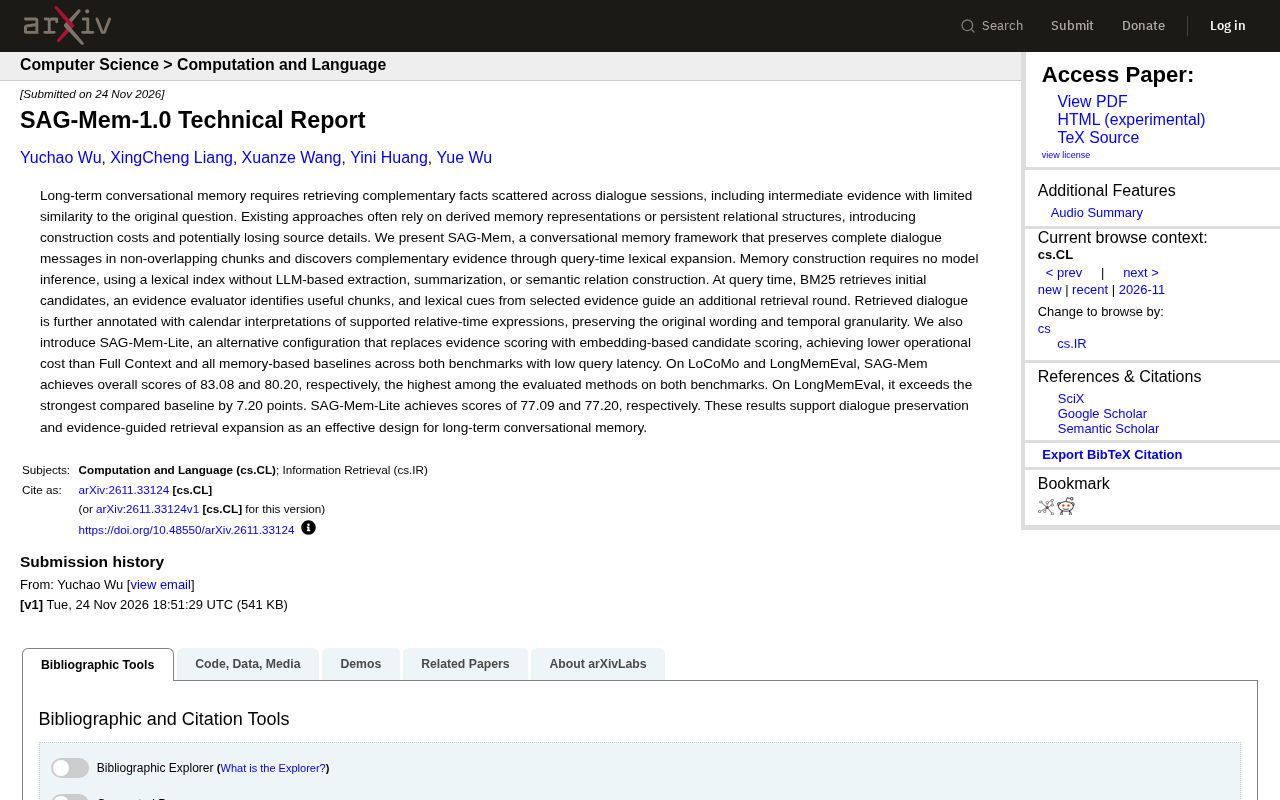
SAG-Mem breaks long-conversation memory retrieval records with chunked raw text plus query-time lexical expansion — no graphs, no summaries.
SAG-Mem-1.0 proposes a counterintuitive long-term conversation memory approach: during construction, no LLM extraction, summarization, or semantic relationship graphs — it only stores complete conversations in chunks and builds a lexical index, achieving zero-model-inference writes. At query time, BM25 first recalls candidate chunks, an evidence evaluator filters those that truly contain answers, and lexical cues from them drive secondary retrieval that pulls in intermediate evidence weakly related to the question. Results include calendar interpretations of relative time expressions while preserving original wording. It scores 83.08 and 80.20 on LoCoMo and LongMemEval, leading the strongest baseline by 7.20 points on the latter; the Lite version replaces evidence scoring with embedding scoring for lower cost and latency, scoring 77.09 and 77.20.
SAG-Mem: No Graphs, No Summaries — How Did It Break the Long-Conversation Memory Retrieval Record?
Long-term conversational memory has always been a pain point for deploying dialogue systems: user information is scattered across multiple sessions, and key evidence often has only a weak semantic connection to the current question. The recently released technical report SAG-Mem-1.0 proposes a counterintuitive approach — no relationship graphs, no summaries, no LLM extraction — relying solely on chunked storage of complete conversations and query-time lexical expansion to achieve the highest scores among currently evaluated methods on both LoCoMo and LongMemEval.
The Hidden Costs of Existing Memory Solutions
Most long-term conversational memory solutions follow a "compress-then-retrieve" path: using LLMs to extract conversations into fact triples, generate summaries, or build persistent relational structures. These methods do reduce the input length for a single retrieval, but the costs are equally significant. The technical report points out that derived memory representations introduce construction costs and may lose original details during compression. For questions requiring "intermediate evidence" — where the answer doesn't directly appear in the segment most similar to the question, but is hidden in a seemingly unrelated statement several turns earlier — summary-based memory is especially prone to failure, because summaries themselves are filtered by semantic importance.
SAG-Mem's choice is to preserve complete conversation messages in non-overlapping chunks, without any model-inference-level processing. The memory construction phase only builds a lexical index — no LLM extraction, summarization, or semantic relationship construction. This is significant from an engineering perspective: zero model inference during construction means that the latency and cost of writing new sessions are both controllable.
Query-Time Expansion: Bringing Weakly Related Evidence to the Surface
SAG-Mem's core innovation lies on the query side, not the storage side. The entire retrieval pipeline has three steps:
- BM25 recalls initial candidates: using classic lexical retrieval to obtain the first round of chunk sets, without relying on vector models;
- Evidence evaluator filters useful chunks: identifying chunks from candidates that truly contain supporting evidence;
- Lexical cue-driven secondary retrieval: extracting lexical cues from selected evidence chunks to guide additional retrieval rounds.
The cleverness of this design lies in turning "finding complementary evidence" into a query expansion: the intermediate evidence retrieved in the first round may not have high similarity to the original question, but the lexical cues it contains can pull in the truly relevant subsequent evidence. Compared to maintaining a persistent relationship graph, this query-time dynamic expansion approach produces no additional construction overhead and won't miss retrieval due to outdated or incomplete graph structures.
The report also mentions a detail: retrieved conversations come with calendar interpretations of relative time expressions, while preserving the original wording and time granularity. This is crucial for questions like "the thing you mentioned last Wednesday" — the system knows the corresponding specific date without losing the ambiguity in the user's original words.
BM25 is a classic sparse retrieval algorithm whose core idea is: the more frequently a word appears in a document and the rarer it is across the entire corpus, the greater its contribution to relevance. BM25 builds on TF-IDF by introducing document length normalization and term frequency saturation mechanisms, preventing long documents from dominating due to their word count and preventing over-weighting of repeated occurrences of a single word. Its key difference from dense vector retrieval is that BM25 only matches terms at the literal level and cannot recognize synonym relationships like "car" and "automobile," but its advantages are that it requires no training, is highly interpretable, provides stable recall for exact terms (such as names and proper nouns), and has extremely low computational overhead for index construction and querying. This is precisely why SAG-Mem can completely avoid model inference during construction and complete the first round of recall using only a lexical index.
Query expansion is a classic technique in information retrieval: original queries often have too few terms or expressions that don't match documents, making it easy to miss relevant results with direct retrieval. Query expansion constructs a richer query by extracting additional terms from initial results, synonym tables, or external knowledge, then retrieves again to improve recall. Traditional approaches rely on pseudo-relevance feedback (treating top-k documents from the first round as relevant documents to extract terms) or manually constructed synonym dictionaries. SAG-Mem's secondary retrieval is a variant of this idea, but its expansion terms don't come from statistical co-occurrence — they're provided by the "chunks that truly contain answers" filtered by the evidence evaluator, essentially replacing blind pseudo-relevance feedback with lightweight evidence discrimination, reducing the risk of query drift.
SAG-Mem-Lite: Trading Embedding Scoring for Lower Cost
In addition to the full version, the report also presents the SAG-Mem-Lite configuration: replacing evidence scoring with embedding-based candidate scoring. According to the report, the Lite version has lower operational costs than Full Context and all memory-based baseline methods on both benchmarks, while also having lower query latency.
The positioning of the two versions is thus clear: the full version pursues the upper limit of accuracy, while the Lite version targets cost-sensitive production environments. For products that need to handle large numbers of concurrent sessions, Lite's low-latency characteristics may be more attractive than a few percentage points in score.
Embedding-based scoring refers to using pre-trained text embedding models to encode queries and candidate chunks into dense vectors separately, then ranking candidates using metrics such as cosine similarity. Compared to having an LLM judge "whether each chunk contains evidence" one by one, embedding scoring requires only a single forward encoding, with much lower latency and cost, and chunk vectors can be pre-computed offline with only vector comparison needed at query time. The trade-off is that dense similarity reflects overall semantic proximity, and is less precise than dedicated evaluators for fine-grained judgments like "whether the evidence truly supports the answer," which is why the Lite version is slightly lower in accuracy than the full version. This also explains why the report positions Lite as a compromise for cost-sensitive scenarios.
Benchmark Results: 7.20 Points Ahead on LongMemEval
On LoCoMo and LongMemEval, SAG-Mem's overall scores are 83.08 and 80.20 respectively, the highest among evaluated methods on both benchmarks. On LongMemEval, it outperforms the strongest comparison baseline by 7.20 points. SAG-Mem-Lite scores 77.09 and 77.20 respectively.
These numbers support the report's core claim: preserving original conversation text + evidence-guided retrieval expansion is an effective design for long-term conversational memory. As a detail, this achievement was obtained without constructing semantic relationship structures, suggesting that the graph construction and summarization steps in previous solutions may not be necessities — at least not in terms of retrieval accuracy.
LoCoMo and LongMemEval are two representative benchmarks for evaluating long-term conversational memory. LoCoMo constructs long conversations spanning multiple sessions, with question types covering single-hop fact recall, multi-hop reasoning, temporal reasoning, and open-domain knowledge, focusing on whether systems can locate scattered evidence in extremely long contexts. LongMemEval emphasizes the multi-dimensional capabilities of "memory," including information extraction, multi-session reasoning, temporal reasoning, knowledge updates, and abstention (whether the system can correctly refuse to answer when there is no answer), with stricter requirements on the temporal order and update relationships of evidence. Both benchmarks use metrics similar to F1 or accuracy to measure answer quality, so a 7.20-point lead represents a relatively significant gap among comparable methods.
Implications for Engineering Practice
SAG-Mem's approach has direct reference value for teams building conversational products. On one hand, it lowers the complexity threshold for memory systems — no need to maintain LLM extraction pipelines or graph databases; the tech stack of lexical indexing plus BM25 is mature and easy to operate. On the other hand, it highlights an easily overlooked design principle: dynamic expansion at query time can replace static structuring at storage time. When construction costs become a bottleneck, putting intelligence on the retrieval side is a pragmatic trade-off.
Of course, the lexical expansion approach has its boundaries. BM25's robustness to synonym paraphrasing and cross-lingual expressions is naturally weaker than dense retrieval, and the accuracy of the evidence evaluator itself also affects the quality of secondary retrieval. The report currently only covers two benchmarks, and how it performs in more open and noisy real-world conversation scenarios still requires more validation. But in terms of "achieving higher scores with a simpler architecture," SAG-Mem has already provided a convincing example.
Related articles

Nothing CMF Buds 2A Drops to $17.89 on Black Friday: A New Low for ANC Earbuds
Nothing CMF Buds 2A wireless earbuds Black Friday deal: just $17.89 on Amazon, about $11 off retail and a record low. ANC earbuds at an entry-level price.

When AI Creation Gets Accused of "Spitting": Hacker News Heats Up Over the Glaude Controversy
A Hacker News post, "Spitting in the Face of Glaude," sparks debate on AI creation transparency and attribution ethics. This analysis examines the blurred creator identity behind the controversy and offers practical advice for AI content production.

Akai Embraces Custom Firmware: MPC Sample 1.4 Lets Users AI-Program Their Sampler
Akai embraces the modding community with MPC Sample 1.4 firmware, supporting vibe-coded custom firmware and effects. We analyze the impact of this open strategy on music hardware and AI-assisted programming.