Sam Altman Champions DRAM: A Bet on Memory

A viral Reddit post uses the DRAM debate to satirize Altman: right on tech, questioned on resource allocation.
The article centers on a satirical Reddit post discussing Sam Altman's judgment that DRAM (especially HBM) is a key bottleneck in AI development. Technically, the judgment is well grounded: GPU compute growth far outpaces memory bandwidth gains, creating a "memory wall," making HBM a core technology for breaking the bottleneck, with Samsung and SK Hynix expanding production aggressively. But the post ironically notes that while Altman emphasizes foundational technology, his fund allocation neglects global livelihood issues, highlighting the conflict between technological idealism and social responsibility. The article also notes DRAM's strong cyclicality and the uncertainty of short-term capex and capacity ramp-up, framing the debate as an open question about AI-era development priorities.
Introduction
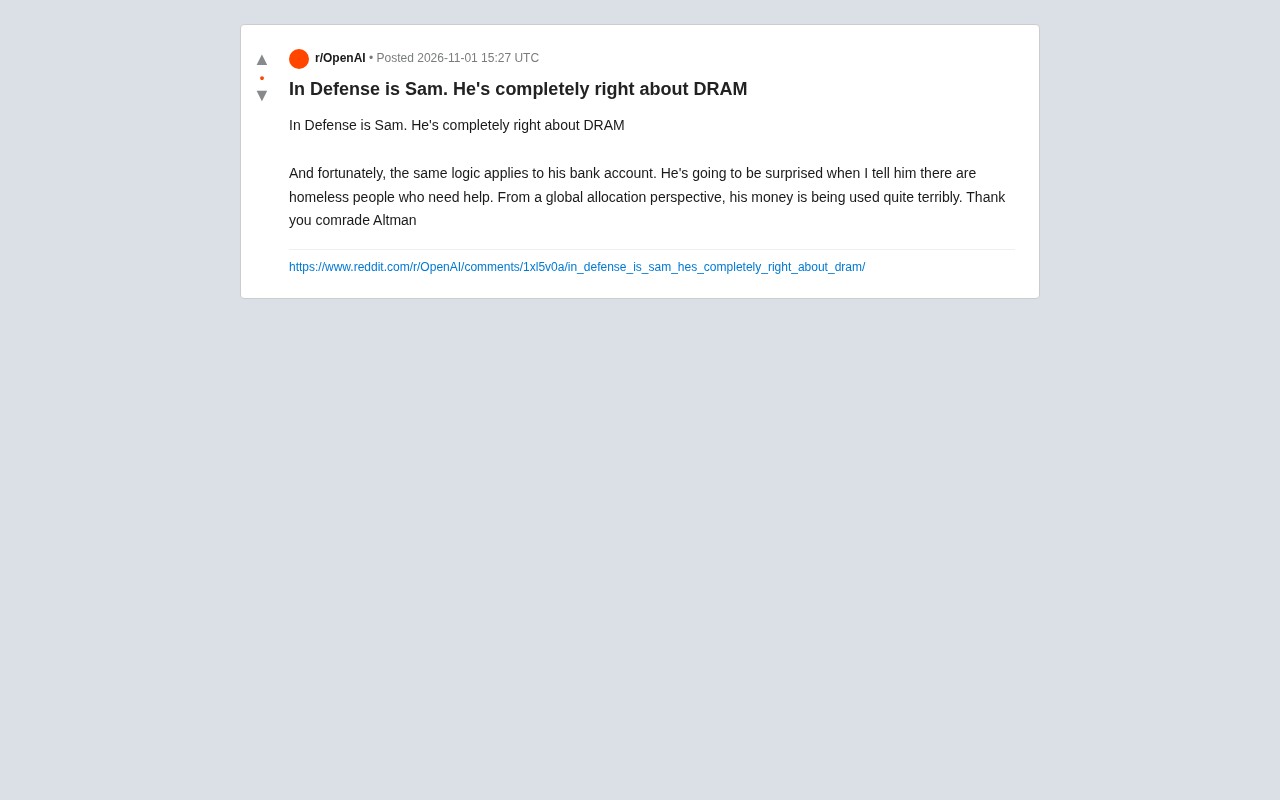
Recently, a Reddit post titled "In Defense is Sam. He's completely right about DRAM" sparked discussion. The title points directly at OpenAI CEO Sam Altman's stance on DRAM (Dynamic Random Access Memory), but the body is full of irony—the poster seems to agree with Altman's judgment on DRAM, yet uses "homeless people need help" to poke fun at his allocation of funds. What technical logic and controversy lie behind this?
Why Has DRAM Become a Focus?
DRAM is a core component of computer memory and directly affects the efficiency of AI training and inference. As the parameter counts of large models grow exponentially, demand for high-bandwidth memory (HBM) has surged, and HBM is precisely based on DRAM stacking technology. Sam Altman has publicly emphasized multiple times that one of the bottlenecks in AI development is memory bandwidth and capacity. Against this backdrop, he is "completely right" to point out the importance of DRAM.
But the poster's irony lies in this: Altman calls for attention to foundational technologies like DRAM while pouring large sums of money into other areas (such as his personal investments or OpenAI's compute expansion), even as more urgent livelihood issues persist around the world. This contradiction between "technological optimism" and "unequal resource allocation" is exactly why the post resonates.
HBM (High Bandwidth Memory) is an advanced packaging form of DRAM. Its core idea is to vertically stack multiple DRAM chips, use through-silicon via (TSV) technology for high-speed interconnects between layers, and then package them together with a GPU/accelerator via a wide interface. Compared with traditional DDR memory, HBM can deliver several times to more than ten times the memory bandwidth at extremely low power, making it standard equipment for GPUs in large-model training and inference scenarios. Mainstream products have now iterated to HBM3/HBM3E, with SK Hynix, Samsung, and Micron occupying the vast majority of the market share. HBM capacity expansion is constrained by yield, advanced packaging capacity, and customer qualification cycles, which is also one of the important links in the tight supply of AI compute.
Technical Perspective: Is DRAM Really Undervalued?
From a technical perspective, Altman's judgment has solid grounds. The compute growth of current AI chips (such as GPUs) far outpaces improvements in memory bandwidth, creating the "memory wall" problem. Advanced DRAM technologies represented by HBM have become key to breaking through compute bottlenecks. Manufacturers such as Samsung and SK Hynix are aggressively expanding HBM production, and the U.S. government is also promoting domestic DRAM manufacturing through chip legislation.
However, the DRAM industry is highly cyclical, with volatile prices. Altman's "correctness" may be more strategic—he sees the long-term demand for memory from AI, but short-term capital expenditure and capacity ramp-up remain uncertain. The poster's remark that "his bank account will benefit too" sarcastically hints at Altman's investment acumen, perhaps suggesting he had already positioned himself in related assets.
The "Memory Wall" refers to the long-term trend in which processor compute grows faster than improvements in memory bandwidth and latency, causing system performance to be limited by data movement rather than computation itself. In AI workloads, this problem is especially prominent: during large-model inference, each generated token requires repeatedly reading weights, and memory access overhead can far exceed computational overhead. A common metric for measuring this bottleneck is "arithmetic intensity" (the number of floating-point operations per byte of memory access). When arithmetic intensity falls below the "turning point" of the hardware platform, the system is memory-bandwidth-bound. HBM, processing-in-memory, and larger on-chip caches are all technical paths to alleviate the memory wall.
The strong cyclicality of DRAM stems from its nature as a capital-intensive, standardized product: manufacturers must continuously invest huge capital expenditure to build fabs, while capacity release lags by several years; when demand is strong, prices soar and manufacturers expand capacity, followed by oversupply and price crashes. Historically, the DRAM market has experienced multiple severe price cycles, and Samsung established its leading position precisely through a "counter-cyclical investment" strategy of expanding capacity during downturns. For AI, although HBM is a high-end customized product with weaker cyclicality than general-purpose DRAM, it is still constrained by upstream wafer capacity and packaging capability, and short-term supply elasticity is limited.
The Debate Over Fund Allocation: Technological Idealism vs. Social Responsibility
The sharpest part of the post is this: the poster claims that "from a global distribution perspective, his money is spent rather badly," and thanks "Comrade Altman." This is clearly irony, pointing to the indifference of tech leaders like Altman toward social issues while accumulating wealth.
This criticism is not isolated. In recent years, debate has intensified over how tech giants allocate resources (for example, investing in AI R&D vs. solving poverty and climate problems). Altman himself has proposed ideas such as "universal basic income," but critics see this as little more than charity from tech elites. The DRAM debate is essentially a question about the priorities of technological development: should we direct more resources toward foundational hardware innovation rather than short-term applications?
Conclusion: A Debate With No Standard Answer
Sam Altman's emphasis on DRAM is technically defensible, but the poster's sarcasm reminds us that technological decisions are never purely technical. In the era of runaway AI, how to balance innovation investment and social responsibility is a question every tech leader must face. As for Altman's bank account, perhaps as the post says—"he will be surprised to find that homeless people need help too."
(This article is based on a Reddit discussion; the views are for reference only.)
Related articles

VERS: Editing Activation Explanations to Halve Reasoning Model Tokens
VERS guides reasoning models by editing activation explanations, cutting 45.8% of tokens on GSM8K with only a 0.82 pp accuracy drop and transferring to larger models, but losing accuracy on competition problems.

Finding Errors Is Not Enough: Selective Model Escalation for Entity-Targeted Sentiment Analysis
This study explores selective model escalation for entity-targeted sentiment analysis, comparing data collection ordering, uncertainty-driven re-examination, and model routing—finding that minority-class priority only helps at very small data volumes, the oracle upper bound far exceeds actual gains, and escalation must be tailored to each dataset.
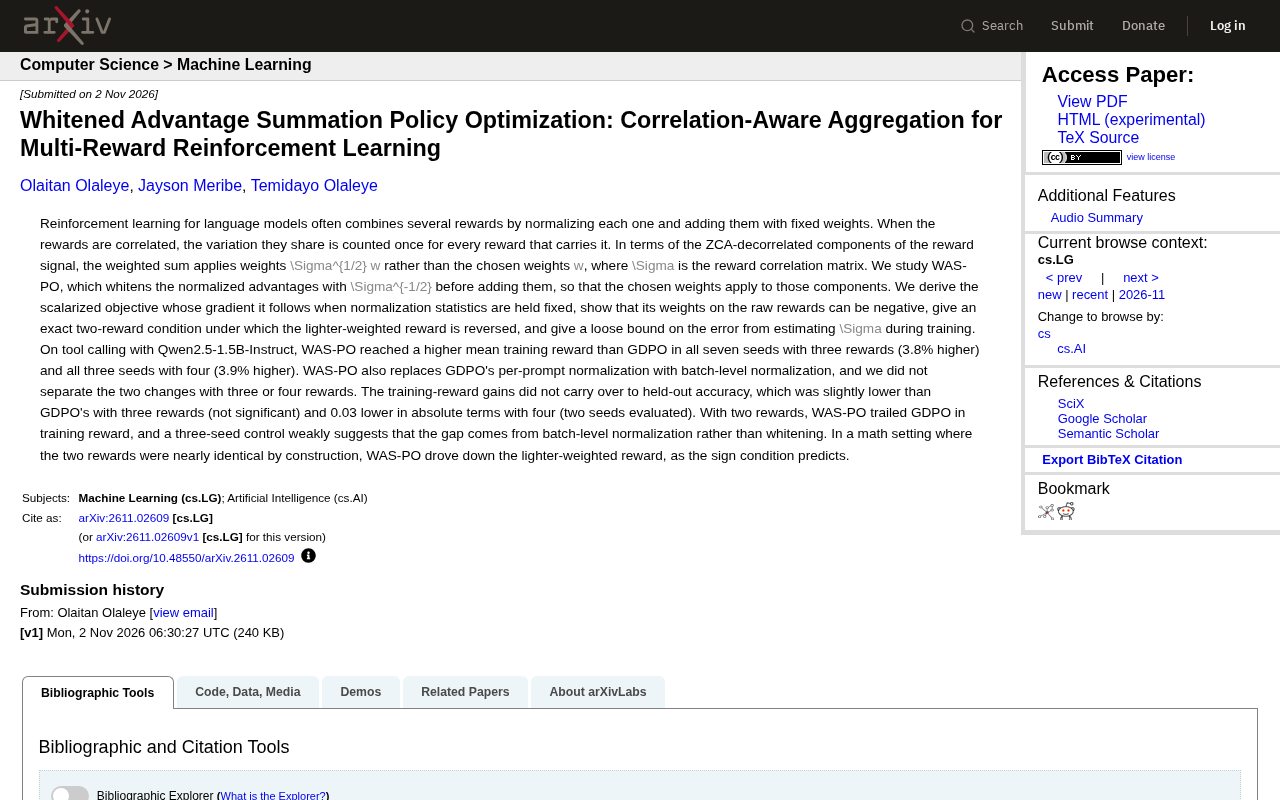
WAS-PO: Using Whitened Advantages to Solve the Correlation Trap in Multi-Reward Reinforcement Learning
WAS-PO paper proposes whitening advantages to correct correlation bias in multi-reward RL: when rewards are correlated, naive weighted summation effectively applies Σ^{1/2}w instead of w. Experiments show training reward improves steadily, but held-out accuracy does not improve in sync, and under two rewards it actually falls behind.