Sam Altman Clarifies RAM Remarks: Wants Everyone to Have Plenty of Memory
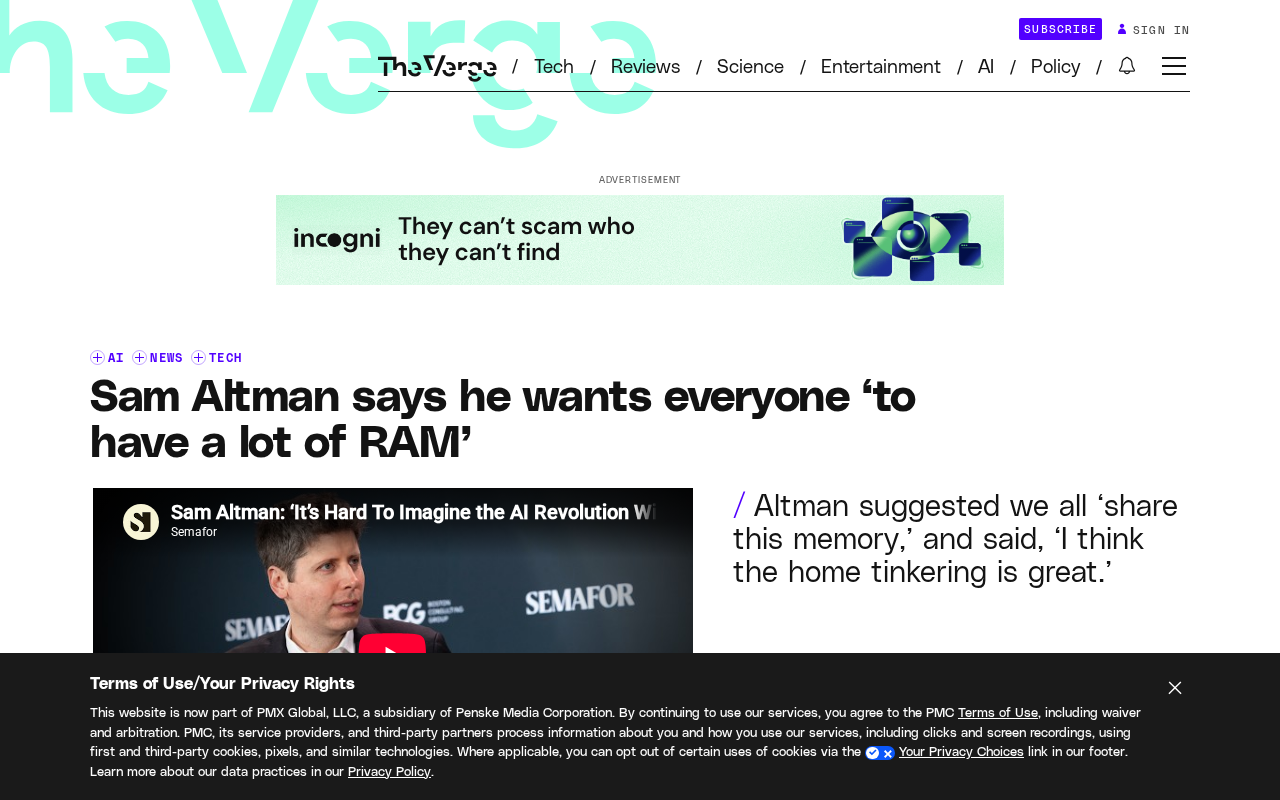
Altman clarifies RAM remarks again: supports users adding memory to personal computers and endorses home hardware tinkering.
The article reviews OpenAI CEO Sam Altman's second clarification of his remarks on RAM purchases for personal computers. He made clear he is not opposed to users adding their own memory—rather, he hopes everyone can buy enough RAM for their computers—and spoke positively of "home tinkering" and DIY practices. The article analyzes why the sentence keeps being discussed: as the head of an AI company, Altman talking about memory is easily linked to AI compute, on-device inference, and local model deployment, turning a hardware preference into a debate over technological paths. It notes that the statement's actual point is individuals' freedom to buy memory for their own devices, not a rejection of any technological path; its significance lies in eliminating the misreading that he opposes users adding memory and reflecting posture management amid sensitive relations between AI companies and user communities.
OpenAI CEO Sam Altman has once again responded to the controversy over his remarks about RAM purchases for personal computers. This time, he tried to state his position more clearly: he is not opposed to users adding their own memory—quite the opposite, he wants everyone to buy as much RAM as they need for their computers.

The Backstory of the Controversy
Altman's earlier comments on RAM purchasing sparked discussion in the community. The specific wording was repeatedly reinterpreted as it spread, forcing him to clarify once again. In his latest statement, he emphasized that his actual intent was the opposite of how some had interpreted it.
"I want to be clear, I want people to have a lot of RAM, I think everybody should be able to buy a lot of RAM for their own computer," Altman said today. "I think the home tinkering is great."
This statement sends two signals. First, he explicitly supports users configuring large amounts of memory in their personal computers. Second, he takes a positive view of "home tinkering," endorsing the hands-on practice of DIY hardware enthusiasts.
home tinkering: The term comes from the personal computing and maker culture tradition, referring to enthusiasts disassembling and assembling hardware, flashing firmware, building servers, and modifying devices in their own homes. Early PC clubs and later Raspberry Pi and HomeLab communities all belong to this lineage. It emphasizes hands-on work, trial and error, and complete control over one's devices. In an era increasingly dominated by cloud services and closed hardware ecosystems, "home tinkering is great" carries a positional meaning: it assumes users have the right to upgrade memory and replace components themselves, rather than accepting manufacturer designs that are soldered shut and non-expandable. By using this term, Altman is effectively echoing users' demands for "repairable, expandable devices."
Why One Sentence Keeps Being Discussed
Altman's identity means any statement involving hardware resources gets amplified. As the head of OpenAI, when he talks about RAM, it's easily associated with topics like AI compute, model deployment, and local inference—and in the current context of AI applications extending to the edge, memory capacity directly determines whether users can run models locally and process larger-scale data.
When the CEO of an AI company talks about memory, listeners naturally connect it to questions like "should AI stay more in the cloud" and "how much room is left for local compute." This explains why a seemingly simple hardware preference evolved into a public topic requiring a second clarification.
On-device AI and local inference: On-device AI refers to moving model inference from cloud servers to edge devices like phones and PCs. Compared with cloud inference, on-device inference offers advantages in low latency, keeping private data from leaving the device, and offline availability; the cost is being limited by the device's memory capacity and compute power. The parameter count of a large language model directly determines the memory needed to load it—for example, a 7-billion-parameter model stored at 4-bit quantization requires about 4GB of memory, and with KV Cache and runtime overhead during inference, actual usage is often higher. Therefore, "how much RAM a computer can hold" currently directly defines the boundary of how large a model an ordinary user can run locally, which is why Altman talking about memory is quickly linked to on-device AI discussions.
What the Statement Actually Points To
Taken literally, Altman's clarification is quite direct: what he supports is individuals' freedom to purchase memory for their own devices, not a rejection of any particular technological path. The phrase "home tinkering is great" is especially noteworthy—it brings the discussion back to personal computing and DIY culture itself, rather than elevating it to the strategic level of AI infrastructure.
For ordinary users and hardware enthusiasts, this statement has limited practical impact, but it at least eliminates the room for misreading that "Altman opposes users adding memory." In an era where the relationship between AI companies and user communities is increasingly sensitive, this kind of clarification is itself a form of posture management.
Summary
Altman's second response re-anchors the focus on personal computing freedom: add memory if you want to, and home tinkering is worth encouraging. The controversy surrounding this sentence reflects more the outside world's sensitivity to the hardware stance of AI giants than any complexity in the statement itself.
Related articles

How Does Chemotherapy Damage Ovarian and Bone Health?
Alkylating agents like cyclophosphamide in chemotherapy can cause ovarian toxicity, affecting bone health in breast cancer patients. Learn about baseline DEXA scans, biennial follow-up, and monitoring for aromatase inhibitor, tamoxifen, and GnRH agonist users.
USMLE Radiology 12-Question Challenge: Core Imaging Diagnosis Points Explained
Using a 12-question USMLE radiology quiz, this article explains key imaging points for pneumothorax, pleural effusion, intussusception, bowel obstruction, Salter-Harris classification, gout, SAH, and ischemic stroke, plus MRI in pregnancy and multiple myeloma.

Hot Flashes and Menopausal Symptoms After Cancer: A Guide to Non-Hormonal Management
How to manage menopausal symptoms after cancer? This article reviews guideline-recommended non-hormonal options: water-based lubricants, SNRIs/SSRIs, gabapentin, plus psychological support and environmental adjustments.