Same Prompt, Three AI Models: Carbon vs Neon vs Codex — Who Wins?

Bilibili creator side-by-side tests three AI models generating human short films, comparing speed, tokens, and quality.
A Bilibili creator had three AI models — Carbon, Neon, and Codex — create short films about human society from the same prompt, comparing first-round response speed, token consumption (under both de-cached new additions and cache-inclusive totals), and final film quality. Codex was fastest in the first round (19m43s) with the lowest de-cached new tokens (277K); Neon had the lowest cache-inclusive total (4.016M) and the richest audiovisual layering; Carbon had concise imagery but higher tokens. Codex used multi-agent collaboration with a 97.5% cache hit ratio and a distinctive cost structure, but its film missed a key action. The conclusion: each model makes trade-offs, with no all-around champion.
What happens when you give three AI models the same prompt and ask each to create a short film about human society? A Bilibili creator ran a side-by-side test comparing Carbon, Neon, and Codex, delivering fairly detailed dual-metric data on generation speed, token consumption, and final film quality.
Test Design: One Prompt, Three Approaches
The task was to have all three models create a short film depicting human society based on the same single sentence. The three works were Carbon's Stranger's Arch, Neon's Fragile Miracle (produced at its highest thinking tier), and a Chinese-dubbed short from Codex by GPT-6.2 Astra. After playing all three complete films, the creator cross-referenced the original window screen recordings and excerpts from the Codex conversation transcript, timing uniformly from prompt submission to the first round of film footage replies.
The advantage of this design is controlled variables — same prompt, same task type, with differences attributable only to the models themselves. That said, it's worth noting that each model's thinking tier and interaction mode aren't fully equivalent, and Codex also involves multi-agent collaboration, which affects the comparability of the final data.
Speed and Tokens: Winners Under Two Metrics
First, the first-round reply speed. Codex was fastest, delivering its first round of film footage replies in 19 minutes 43 seconds; Neon and Carbon both took 20 minutes 32 seconds; while Codex in another conversation round took 26 minutes 27 seconds. The creator didn't explain the specific contextual differences between the two Codex times, but speculates it relates to whether collaborative agents were enabled.
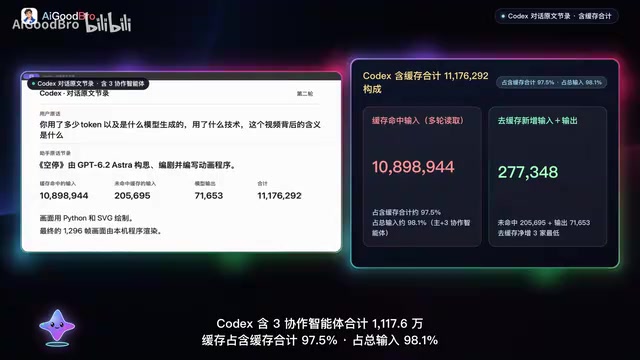
Token consumption needs to be viewed under two metrics. De-cached new additions (counting only input plus output): Codex was lowest at 277K, Neon was nearly tied at 278K, and Carbon was clearly higher at 396K. Cache-inclusive totals flip the picture: Neon was lowest at 4.016M, Carbon was in the middle at 5.483M, and Codex — due to multi-round context reads involving the main agent and three collaborative agents — was highest at 11.173M.
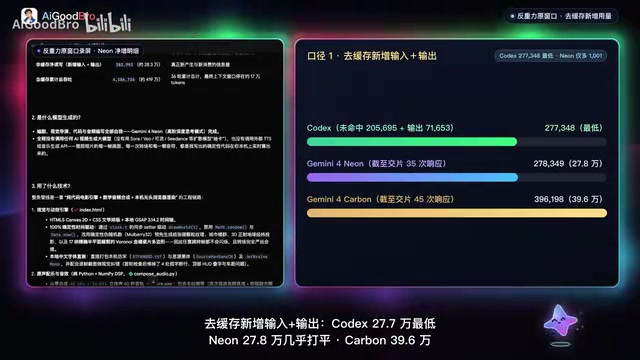
Codex's cache hits accounted for 97.5% of its cache-inclusive total and 98.1% of total input. This ratio shows that its consumption comes mainly from cache reads rather than new computation, a fundamentally different cost structure from the other two.
De-cached new additions vs. cache-inclusive totals are two common token accounting metrics. De-cached new additions refer to the sum of input tokens newly processed by the model plus output tokens, reflecting actual computation volume; cache-inclusive totals include all cache-read tokens, reflecting total interaction scale. Caching allows the model to reuse encoded results from historical conversations, reducing computation cost, but the cache hit rate affects the difference between the two metrics.
Multi-agent collaboration refers to an architecture where a main agent coordinates multiple sub-agents to divide and complete tasks. In video generation, the main agent might handle planning while sub-agents separately handle visuals, voiceover, and other modules, achieving complex creation through multi-round context passing. This architecture can improve task quality but increases context read counts, causing cache-inclusive total tokens to rise significantly.
Film Performance: Code Generation vs. Hand-Drawn Narrative
Carbon and Neon both relied entirely on code-generated visuals and music. Carbon used 9 blocks leaning and 10 blocks forming an arch, a concise visual metaphor; Neon used elements like taking a detour at a traffic light to watch the sunset and a golden fan, creating a complete 60-second short with the richest audiovisual layering, while also having the lowest cache-inclusive total.
Codex took a different path — boldly drawing characters and adding local Chinese voiceover, telling the story of a girl on the second floor who gives up the elevator for a repairman heading to the 17th floor. But when questioned in the original window, Codex admitted it had missed filming the action of pressing the second-floor button, making the ending hard to figure out.

This exposes a key difference: the code-generation route offers greater visual controllability, while when it comes to character performance and narrative logic, the model still has shortcomings in grasping details.
The code generation route refers to the model constructing visuals and music frame by frame by writing program code (e.g., using graphics libraries or animation frameworks). This approach offers strong controllability over geometric shapes and motion trajectories, making precise adjustments easy, but it struggles to express complex character expressions and natural movements. In contrast, directly drawing characters relies on the model's visual detail generation capability — flexible but difficult to keep consistent.
Conclusion: No All-Around Champion
Codex was lowest in de-cached new additions, while Neon was lowest in cache-inclusive total and had the highest completion level. On speed, Codex was fastest in the first round but was overtaken after multiple conversation rounds. Each model makes trade-offs: Carbon has concise imagery but higher tokens, Neon is audiovisually complete with optimal cache efficiency, and Codex is narratively bold but has detail gaps.
The value of this comparison isn't in picking a winner, but in revealing the cost structures and capability boundaries of different models on video generation tasks. For creators, the choice depends on whether you care more about generation speed, token cost, or narrative completeness of the final film.
Which one do you prefer? Feel free to chat in the comments.
Related articles

Tano: A Korean Vocabulary App That Skips Words You Already Know
Tano is an iPhone Korean vocabulary app that skips words you already know via a short placement test, delivers a few new words daily with spaced review, and offers scenario-based categories, three practice modes, and gamified avatar growth—free to start, no account needed.

overads.io: Let Marketing and GTM Run on Autopilot While You Sleep
overads.io tops Product Hunt with conversational workflows that automate multi-platform content publishing, Meta and Google ad monitoring, and GTMgenie email outreach for founders—$59/month.

The Two Key Decisions of an AI Agent Router: Whether to Reply and Who Should Reply
How does an AI agent router work? This article covers two core routing decisions: whether a post needs a reply, and which agent should reply. Includes examples of conditional decision flow to improve multi-agent system efficiency.