Samsung Innovation Campus 2026: An AI/ML Learning Journey Begins

A full-stack developer joins Samsung Innovation Campus 2026 to start learning AI/ML through hands-on practice and public learning.
This article describes a B.Tech IT student and full-stack developer joining Samsung Innovation Campus 2026 to systematically learn AI and ML. His goals emphasize hands-on coding, project building, and learning from mistakes rather than theory alone. The program is supported by Samsung, ESSCI, and Mapping Skills Technology, reflecting collaborative AI education. It also notes that learning in public may matter more than choosing specific tools for AI/ML beginners.
A Full-Stack Developer's Choice to Get Started with AI/ML
For every developer, learning a new technology always starts from somewhere. A B.Tech IT student and full-stack developer recently shared on his blog that he has joined Samsung Innovation Campus (SIC) 2026. Through this program, he hopes to systematically explore artificial intelligence and machine learning, and turn theory into real projects.
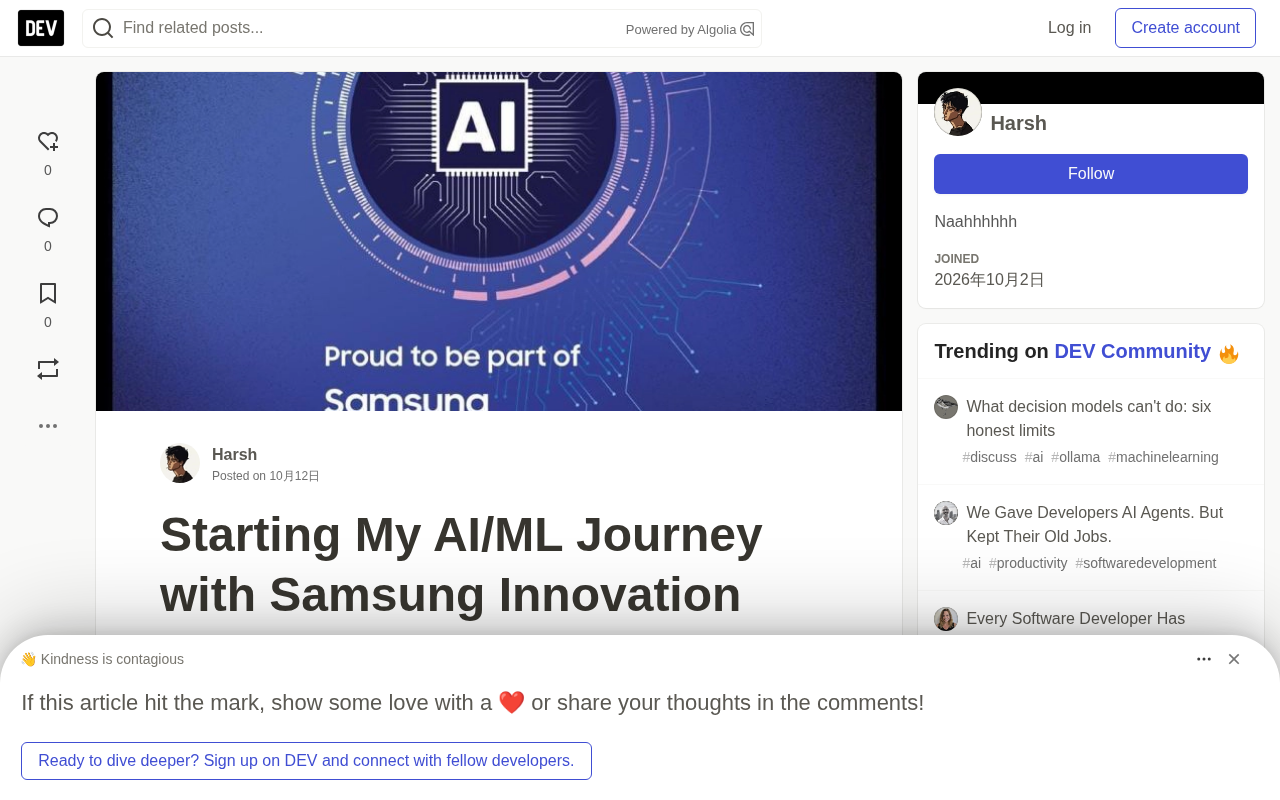
This developer's background is quite representative: he already has full-stack development skills, but is deeply curious about how intelligent systems work. The questions he cares about are very specific—how can technology truly solve real-world problems? This kind of progression from "knowing how to use tools" to "understanding the principles" is exactly the turning point many developers encounter in mid-career.
A full-stack developer typically refers to an engineer with both front-end (user interface, interaction logic) and back-end (server, database, API) development capabilities, able to independently build a complete application. These developers usually have a good understanding of overall system architecture, but when shifting to AI/ML, they often need to fill two gaps: mathematical foundations (linear algebra, probability and statistics, calculus) and model thinking (training, evaluation, tuning).
Artificial intelligence (AI) and machine learning (ML) are often used interchangeably, but they differ in scope: AI is the overall goal of making machines exhibit intelligent behavior, while ML is a class of methods for achieving AI—allowing models to automatically learn patterns from data rather than having humans write rules one by one. Deep learning is a branch of ML that uses multi-layer neural networks to handle complex data such as images, speech, and text. Understanding the hierarchy among these three helps beginners avoid getting lost in terminology.
Five Dimensions of Learning Goals
In the blog post, he listed several goals he hopes to achieve through the SIC program:
- Build a solid foundation in artificial intelligence and machine learning
- Apply theoretical concepts through hands-on coding and real projects
- Learn from challenges, mistakes, and experiments
- Build projects that turn ideas into usable solutions
- Continuously improve technical skills and problem-solving abilities
These goals reveal a pragmatic learning attitude. He does not stop at the level of "understanding AI," but emphasizes "hands-on building" and "learning from mistakes." He wrote: "The best way to learn technology is not just to study concepts, but to experiment, to build, and to learn from the process."
The Supporting Organizations Behind It
This learner specifically thanked three organizations: Samsung Innovation Campus (SIC), Electronics Sector Skills Council of India (ESSCI), and Mapping Skills Technology Pvt. Ltd.
SIC is Samsung's global skills training program aimed at helping young people master cutting-edge technologies such as AI, IoT, and big data. ESSCI, as India's electronics industry skills council, is responsible for setting and certifying skill standards. This combination of a company, an industry council, and a training institution reflects the current trend of multi-party collaboration in the AI education ecosystem—companies provide technical resources and brand endorsement, industry bodies ensure training quality and alignment with standards, and local training institutions handle implementation.
For developers considering an AI learning path, programs like this that are led by industry and supported by clear skill standards may offer more structural advantages than purely online courses.
The Electronics Sector Skills Council of India (ESSCI) is one of the industry skill councils under India's Ministry of Skill Development and Entrepreneurship, responsible for occupational standard setting, course certification, and skills assessment in the electronics and information technology fields. It connects with the NSDC (National Skill Development Corporation) system to ensure that training content meets the actual hiring needs of industry.
Mapping Skills Technology Pvt. Ltd., meanwhile, belongs to the implementation layer of training partners, usually responsible for course delivery, learner management, and assessment organization. This three-party structure of "global company + national-level industry council + local training institution" is fairly typical in Indian skills education programs: companies provide course content and technical platforms, industry councils ensure unified standards and certification credibility, and local institutions solve implementation and operational issues. For learners, this means that behind the completion certificate there is a set of competency standards recognized by employers, rather than merely a record of study.
Learning Mindset Matters More Than Tools
Although the blog post does not cover specific tech stacks or project details, between the lines it reveals a learning mindset worth noting. He mentions "documenting his progress, sharing what he learns, and connecting with others exploring AI/ML." This approach of learning in public is becoming increasingly common in developer communities.
For developers who are also at the introductory stage of AI/ML, this mindset may be more important than choosing which framework or which course. Knowledge in the AI field updates extremely quickly, and maintaining the habit of continuous learning and public sharing often has more long-term value than mastering a particular tool once.
He finally asked readers: "Are you also learning AI/ML, or working on interesting projects? I'd love to hear your experience." This open-ended attitude toward exchange also echoes his belief in "learning from the process."
Learning in Public refers to learners continuously documenting their learning process and sharing code and insights on public channels such as blogs, GitHub, and social media. This practice brings three benefits: first, output forces input, as writing and explaining expose blind spots in understanding; second, it accumulates a visible learning trail, which is more persuasive than a list of skills on a resume; third, it attracts like-minded people and forms a feedback loop, accelerating error correction.
In the AI/ML field, tools and frameworks iterate extremely quickly, and today's popular library may be replaced two years later. Therefore, transferable abilities—mathematical intuition, data processing approaches, experimental design methods, and the patience to debug models—are more important than memorizing a particular API. Making the learning process public is essentially training this kind of transferable ability while also building one's technical identity in the community.
One-line Summary
A full-stack developer joins Samsung Innovation Campus 2026 to get started with AI/ML through hands-on practice and learning in public.
Paragraph Summary
This article describes the experience of a B.Tech IT student and full-stack developer who joined Samsung Innovation Campus 2026 to systematically learn artificial intelligence and machine learning. His learning goals emphasize hands-on coding, project building, and learning from mistakes rather than staying at the theoretical level. The program is jointly supported by Samsung, ESSCI, and Mapping Skills Technology, reflecting an AI education model built on collaboration among a company, an industry standards body, and a training institution. The article also points out that publicly documenting the learning process, sharing what one learns, and participating in community exchange may be more crucial at the introductory stage of AI/ML than choosing specific tools, and it encourages readers to share their own learning experiences.
Related articles

Should U.S. College Fraternities Be Banned? A Researcher's Incisive Observations
Why not just ban U.S. college fraternities? A researcher finds the key resistance comes from decision-makers' own fraternity identities and schools' "willful ignorance."

Microsoft Discovery: Accelerating Scientific Discovery with AI Agents
Microsoft's Discovery platform runs specialized AI agents to help researchers screen and prioritize the most promising compounds and experimental paths, reducing experiments and accelerating scientific discovery.

Cambridge Heavy Industries Secretly Develops Desktop-Scale Nuclear Fusion Device
Cambridge Heavy Industries is secretly developing a desktop-scale laser-driven nuclear fusion device, targeting the equipment supply market for fusion power plants. This article analyzes its miniaturization technology path, commercialization logic, and unique positioning in the fusion startup wave.