SatisDive: A New Approach to Balancing Satisfaction and Diversity in Text-to-Image Diffusion

SatisDive reframes text-to-image generation as a satisficing problem to balance per-image quality and batch diversity.
Text-to-image models face an inherent tension between quality and diversity in batch generation. SatisDive reframes the process as a satisficing problem by imposing a reward floor (minimum quality per image) and a diversity cutoff (minimum variation across the batch), tracing a Pareto frontier between satisfaction and diversity. Using a training-free, batch-relative reward cutoff at inference time, it improves worst-candidate rewards by up to 0.43 (FLUX.1-dev + HPSv3) and 0.70 (SANA-1.6B + ImageReward) over FK steering on Pick-a-Pic, with its satisfaction–diversity curve Pareto-dominating the baseline in all settings.
The Core Tension in Text-to-Image Generation: Satisfaction vs. Diversity
When you feed the same prompt to a text-to-image model and want a batch of candidate images, truly useful results must meet two conditions: each image should align with user preferences (as measured by a learned reward model), while the images should remain visually distinct from one another to preserve diversity. These two goals are often in conflict — over-optimizing for reward scores leads to homogeneous outputs, while prioritizing diversity alone can produce a flood of low-quality images.
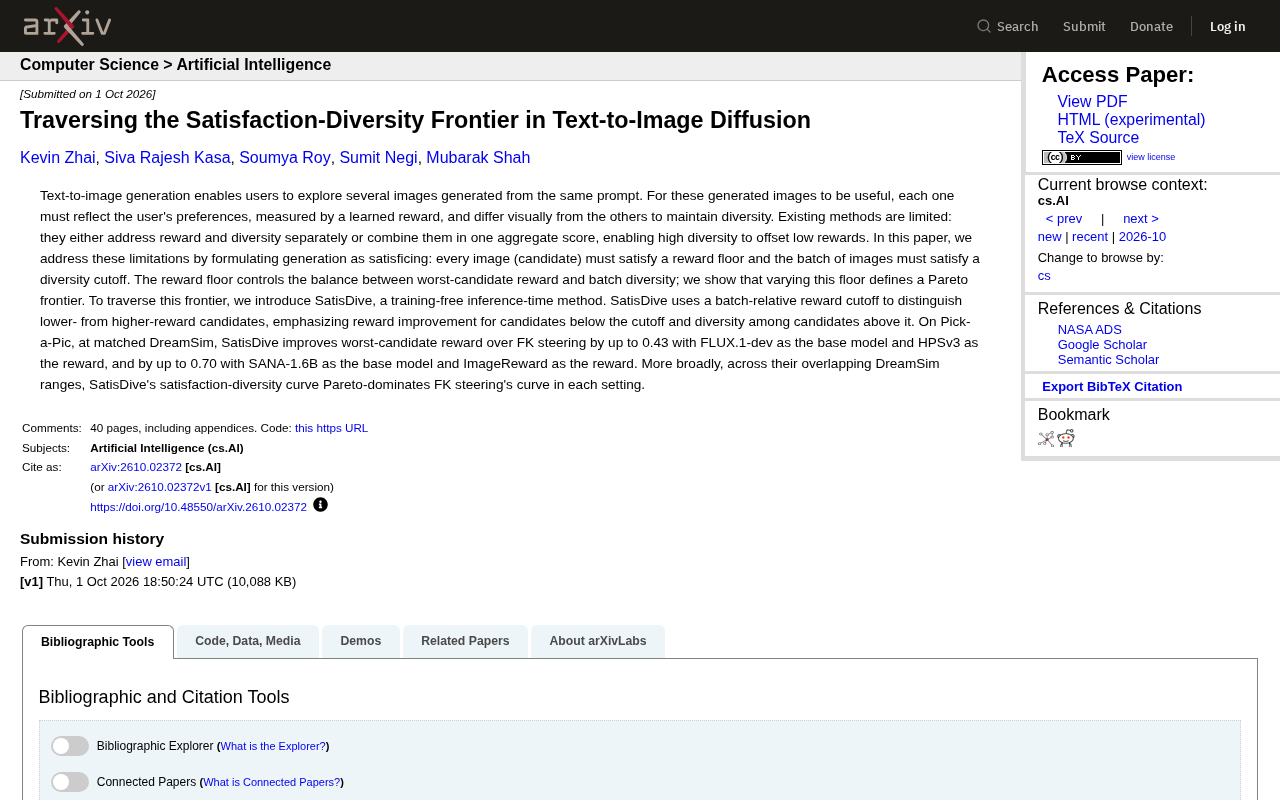
A new paper on arXiv, Traversing the Satisfaction-Diversity Frontier in Text-to-Image Diffusion, targets exactly this pain point by proposing a method called SatisDive.
Limitations of Existing Approaches
The paper identifies two clear shortcomings in current methods for handling reward and diversity. One class of methods treats reward and diversity as entirely separate concerns, with no unified coordination mechanism. Another class collapses both into a single aggregated score for joint optimization. The problem with the latter is that high diversity can directly compensate for low reward — meaning a batch of images might look good on aggregate while still containing a few candidates that clearly miss the mark on user preferences.
In other words, aggregated scoring masks the true quality of the worst candidates. From a user's perspective, even one or two images in a batch that completely miss expectations degrades the overall experience.
The baseline FK steering compared in the paper is a family of diffusion guidance-based generation control methods. Their core idea is to inject reward signal gradients during the denoising process, steering the generation trajectory toward high-reward regions. These methods often incorporate diversity regularization terms (e.g., repulsion mechanisms that push different noise trajectories apart), but these terms are combined with the reward via a weighted sum, making the weight hyperparameters difficult to map to user-interpretable quality thresholds. High reward or high diversity from a few images in the batch can compensate for deficiencies in others at the aggregate score level — and that is precisely the fundamental problem SatisDive aims to solve.
Reframing Generation as a Satisficing Task
SatisDive's core innovation is to reframe the generation process as a satisficing problem rather than a pure optimization problem. Concretely, it imposes two hard constraints:
- Reward floor: A minimum reward threshold that every candidate image must meet;
- Diversity cutoff: A diversity threshold that the entire batch, as a set, must satisfy.
The reward floor acts as the key control lever — it governs the trade-off between the worst-case candidate reward and batch-level diversity. The paper shows that by varying this floor, a Pareto frontier can be traced: the optimal trade-off curve along which satisfaction and diversity can no longer be simultaneously improved.
Batch-Relative Reward Cutoff Mechanism
To move freely along this frontier, SatisDive employs a strategy that requires no training and takes effect purely at inference time. It introduces a batch-relative reward cutoff to distinguish low-reward from high-reward candidates: for candidates below the cutoff, the algorithm focuses on improving their reward; for candidates above the cutoff, it focuses on maintaining diversity among them.
This divide-and-conquer approach ensures no candidate falls below the floor (all images clear the reward threshold) while maximizing variation among qualified candidates — mechanically preventing diversity from being used to mask low quality.
Satisficing is a concept introduced in 1956 by Nobel Prize-winning economist Herbert Simon. It is a portmanteau of "satisfy" and "suffice." It describes a decision-making logic where, rather than exhaustively searching for the optimal solution (optimizing), one seeks a solution that is "good enough" — stopping once a pre-set threshold condition is met. This idea is widely used in artificial intelligence and operations research, and is often more practical than pure optimization when the search space is too large or objective functions are difficult to unify. Applied to text-to-image generation, it means abandoning the single goal of "which image scores highest overall" in favor of requiring every image to clear a quality threshold and the entire batch to clear a diversity threshold — naturally ruling out the "compensate weakness with strength" scenario at the mechanism level.
Experimental Results: Comprehensive Domination of the Pareto Frontier
The paper evaluates on the Pick-a-Pic dataset, using DreamSim as the diversity metric and FK steering as the baseline. Key results:
- When matching DreamSim levels, with FLUX.1-dev as the base model and HPSv3 as the reward model, SatisDive improves the worst-candidate reward by up to 0.43 compared to FK steering;
- With SANA-1.6B as the base model and ImageReward as the reward model, the worst-candidate reward improves by up to 0.70.
More compellingly, across the overlapping DreamSim range between the two methods, SatisDive's satisfaction–diversity curve Pareto-dominates FK steering's curve in every configuration. This means that at any given level of diversity, SatisDive provides a higher satisfaction guarantee — and vice versa.
Pareto-dominates is a core concept in multi-objective optimization: Solution A Pareto-dominates Solution B if A is no worse than B on all objective dimensions and strictly better on at least one. The Pareto frontier (also called the Pareto optimal set) is the collection of all solutions not dominated by any other, representing the best achievable trade-off curve — at any point on the curve, improving one objective necessarily comes at the cost of another. The paper's demonstration that SatisDive's satisfaction–diversity curve globally Pareto-dominates FK steering's means that at any given diversity level, SatisDive's worst-candidate reward is higher; conversely, at the same reward guarantee, its diversity is also stronger. This is a more rigorous, systemic demonstration of superiority than a single-point metric comparison.
DreamSim is a deep learning-based perceptual similarity metric trained to align with human judgments of image similarity. It is closer to subjective visual experience than traditional metrics like LPIPS or FID, and is commonly used to assess the diversity and perceptual variation of generated images. HPSv3 and ImageReward are both human preference reward models, trained on large-scale human-annotated image preference datasets to predict subjective human satisfaction scores for generated images.
Significance and Implications
SatisDive's significance goes beyond benchmark numbers. It offers a generation paradigm more closely aligned with actual user needs — rather than chasing a hard-to-interpret aggregated high score, it explicitly guarantees that "every image clears the bar, and the batch as a whole is diverse enough."
Because the method requires no training and intervenes only at inference time, it is highly plug-and-play in nature, theoretically compatible with different base diffusion models and reward models (the paper validates across multiple combinations including FLUX.1-dev, SANA-1.6B, HPSv3, and ImageReward). For real-world product scenarios that involve batch generation and let users "pick one from many," this approach — which balances a quality floor with result diversity — has considerable practical potential.
Of course, as a preprint just made public, its conclusions still need validation on broader datasets and subjective evaluations, and biases inherent in the reward models may propagate into final results. But the idea of reframing generation as "satisfying constraints" rather than "optimizing a total score" provides a clear and actionable new framework for quality control in text-to-image generation.
Related articles

AgentCore in Practice: Connecting Custom Tools and MCP Servers to Agents
DebuggerCafe tutorial shows how to connect custom tools and MCP servers to Amazon Bedrock AgentCore agents, covering tool contract design, MCP reuse, and production concerns.

816B Parameters Scores Only 39? The Real Cost-Effectiveness of the Open-Source LLM Parameter Race
Meta's 816B Muse Spark Open scores just 39 on Artificial Analysis, while 180B Qwen3.8-Flash-Next scores 40. This article analyzes 11 open-weight models' parameters vs. scores, exploring the real impact of activated parameters, quantized size, and deployment cost.

Aerial Manipulators: The Next Step for Drones from 'Seeing' to 'Changing'
Starting from a Reddit discussion, this article analyzes the technical challenges, potential applications, and deployment bottlenecks of aerial manipulators, exploring the key challenges for drones moving from environmental perception to physical manipulation.