Satlyt Takes a Key Step: Turning Satellites into Space Data Centers

Satlyt completed a key test validating the feasibility of virtualizing satellites into space data centers.
Startup Satlyt completed a key test this month, advancing the goal of turning spacecraft (satellites first) into virtual data centers. Its core idea is to virtualize existing spacecraft resources rather than launch dedicated data center satellites, thereby reusing hardware assets and lowering the deployment threshold. The space environment offers theoretical advantages in heat dissipation, energy, and land use, and on-board compute can reduce downlink bandwidth pressure and support in-orbit preprocessing and low-latency services. However, space heat dissipation relies on inefficient radiation, space-grade hardware is costly and slow to iterate, in-orbit maintenance is difficult, and regulatory and data sovereignty frameworks for on-board data processing remain absent. This test is a milestone technical advance, but commercialization is still some distance away; nevertheless, it offers a noteworthy exploration direction for compute infrastructure moving from ground to air and space.
Moving data centers into space is no longer a sci-fi plot device. Startup Satlyt completed a key test this month, bringing it one step closer to its goal of "turning spacecraft (satellites first) into virtual data centers." Although public technical details are limited, the direction itself is intriguing enough: as compute demand on the ground runs into bottlenecks in energy consumption, heat dissipation, and land, space may become the next infrastructure frontier.
The Logic of Space Data Centers: Why Send Compute into the Sky
The expansion of ground-based data centers is facing increasingly hard constraints. High cooling costs, tight power supply, and lengthy site approval cycles are all being amplified against the backdrop of surging AI compute demand. The space environment offers dramatically different conditions: a near-vacuum low-temperature background is favorable for heat dissipation, solar power can provide continuous energy, and no valuable land resources are occupied.
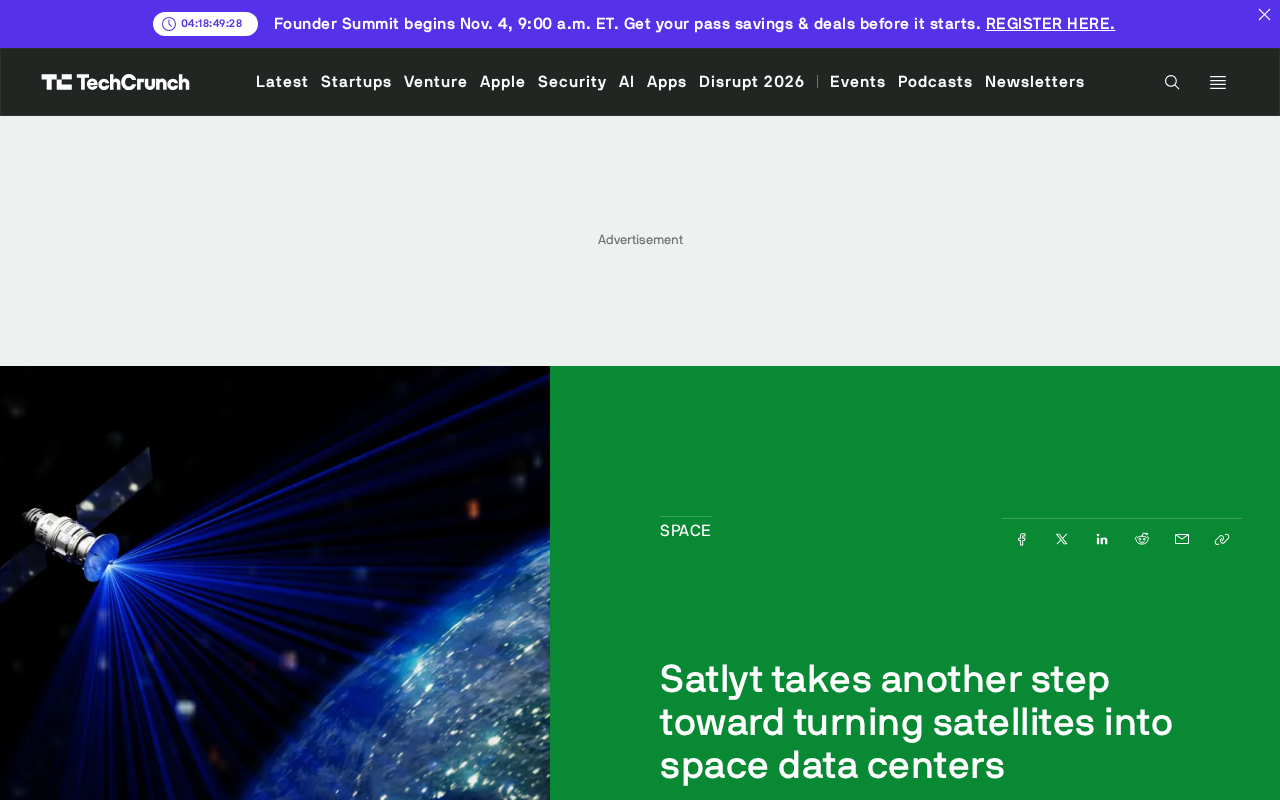
Satlyt's approach is not to launch dedicated data center satellites, but to "virtualize" existing and future spacecraft so they can take on edge computing and data processing roles. The advantage of this approach is reusing existing hardware assets and lowering the deployment threshold. According to the original report, Satlyt's test this month was centered on this virtualization path, and the test's success means a key leap from concept to a verifiable system.
It should be noted that space data centers are not Satlyt's idea alone; multiple teams in the industry are already exploring orbital computing and on-board processing. Satlyt's differentiation lies in its positioning as a "virtual data center"—emphasizing software-defined architecture and resource pooling rather than simply stacking hardware.
On-board Processing refers to satellites completing data collection, filtering, compression, and even preliminary analysis in orbit, rather than downlinking all raw data to ground stations. Traditional satellites are limited by the bandwidth of the satellite-to-ground link and often can only transmit a small amount of high-value data; on-board processing can convert raw telemetry or image data into usable information in orbit, significantly reducing downlink data volume and latency. This concept is in the same lineage as edge computing, except that the "edge" is in space. The "virtual data center" proposed by Satlyt is essentially about turning on-board processing capability into a resource and a service, so that satellites not only complete their designated missions but also provide general-purpose compute externally, thereby improving the utilization of spacecraft assets.
What the Test Means: The Imaginative Space from Single Satellites to Networking
The success of a single test, in engineering terms, usually only shows that a certain link has been connected. But for the proposition of "satellites as data centers," its significance lies in verifying that on-board resources can be abstracted, scheduled, and provided as external services. If this capability can be replicated across more spacecraft, then in theory a distributed orbital compute network can be formed.
Value scenarios for such a network include: on-orbit preprocessing of Earth observation data (reducing downlink bandwidth pressure), low-latency data services in remote areas, and providing compute support for other satellites. In the traditional model, all data collected by satellites must be transmitted back to ground stations for processing, resulting in high link costs and high latency; on-board compute can turn "raw data" into "usable results" before downlinking.
However, from a single test to stable networking, there remains a series of engineering challenges such as reliability, hardware lifespan under radiation, and inter-satellite communication bandwidth. Satlyt's progress is worth watching, but commercialization is still some distance away.
Inter-Satellite Link (ISL) is a key supporting technology for building orbital compute networks. It refers to links for direct data transmission between satellites, typically using laser or radio frequency communication. Without high-speed inter-satellite links, each satellite would still need to rely on ground station relay, greatly reducing the value of networked compute. Laser inter-satellite links offer advantages such as high bandwidth, strong interference resistance, and no spectrum licensing requirements, and have become a standard direction for low-Earth-orbit constellations. However, establishing and maintaining inter-satellite links is sensitive to pointing accuracy, power consumption, and weather conditions, and dynamically changing topology (due to high-speed satellite motion) brings complex routing problems. If Satlyt wants to move from single-satellite validation to a distributed orbital compute network, the bandwidth and stability of inter-satellite communication will be an engineering threshold it must overcome.
Challenges and Uncertainties: A Sober View of the "Space Compute" Narrative
The concept of space data centers is sexy, but the real-world constraints are equally obvious. Although the vacuum environment has theoretical advantages for heat dissipation, in practice heat can only be dissipated through radiation, which is far less efficient than convective cooling on the ground; the cost and iteration speed of space-grade hardware also cannot compare with commercial servers. In addition, in-orbit maintenance and fault repair are extremely difficult, and a single hardware failure may mean the compute resources of an entire satellite are scrapped.
There are also regulatory gaps. The storage and processing of on-board data involve cross-border data sovereignty issues, and there is currently no mature framework for who regulates it and which country's laws apply. Satlyt's successful test is a technical advance, but validation of the business model will take longer.
Objectively speaking, this test is a milestone on Satlyt's roadmap, not the endgame. It proves one thing: turning satellites into virtual data centers is at least technically explorable. How far this path can go depends on whether the cost curve can come down and whether the market is willing to pay for orbital compute.
Space-grade hardware and radiation effects are fundamental constraints facing space data centers. High-energy particles in space (protons, heavy ions, etc.) can cause radiation effects such as single-event upsets (SEU) and single-event latch-up, leading to memory bit flips or device burnout. Therefore, space-grade chips usually adopt radiation-hardened designs or redundant fault-tolerant architectures, and their process nodes are often several generations behind commercial chips, with disadvantages in both compute density and energy efficiency. In addition, the vacuum environment lacks air convection, so heat dissipation can only rely on thermal radiation, requiring large heat dissipation surfaces or heat pipe systems, further increasing weight and cost. These physical constraints determine that in the short term, "space compute" will find it difficult to compete with ground data centers in general-purpose computing and is more likely to focus on specific edge scenarios.
Outlook: The Next Stop for Compute Infrastructure
If we take a longer view, Satlyt's attempt is part of a larger trend—compute infrastructure is moving from centralized to distributed, and from ground to air and space. Ground data centers will remain the absolute mainstay, but demand from edge scenarios and special scenarios will give rise to new forms of supply.
For practitioners focused on AI infrastructure, Satlyt is worth adding to the watchlist. Its progress will not immediately change the industry landscape, but the questions it raises are valuable: when compute becomes a basic resource like electricity, what should the supply network look like? Satellites may be only the first answer to that question.
One-line Summary
Satlyt completed a key test validating the feasibility of virtualizing satellites into space data centers.
Paragraph Summary
Startup Satlyt completed a key test this month, advancing the goal of turning spacecraft (satellites first) into virtual data centers. Its core idea is to virtualize existing spacecraft resources rather than launch dedicated data center satellites, thereby reusing hardware assets and lowering the deployment threshold. The space environment offers theoretical advantages in heat dissipation, energy, and land use, and on-board compute can reduce downlink bandwidth pressure and support in-orbit preprocessing and low-latency services. However, space heat dissipation relies on inefficient radiation, space-grade hardware is costly and slow to iterate, in-orbit maintenance is difficult, and regulatory and data sovereignty frameworks for on-board data processing remain absent. This test is a milestone technical advance, but commercialization is still some distance away; nevertheless, it offers a noteworthy exploration direction for compute infrastructure moving from ground to air and space.
Related articles

Claude Code v2.1.316 Update Analysis: Enterprise Gateway and Multiple Stability Fixes
Claude Code v2.1.316 released: new enterprise gateway pooled group budgets, layered policy mode, subagent effort control, dozens of Shell, network, and session recovery fixes, and Opus 4.8 fast mode deprecated.

17th-Century British Floods and Doomsday Panic: A New Perspective on Weather History
Based on a Hacker News discussion of '17th-Century British Floods and Foreboding,' this piece explores how extreme weather was given divine and political significance, and what weather history teaches us about contemporary climate communication.

Salesforce Acquires Rune for $375M: AI Logistics Tech Bolsters Defense Business
Salesforce reportedly acquires defense tech startup Rune for $375M. Rune's AI logistics tech will strengthen Salesforce's Missionforce defense platform, continuing its M&A spree.