Savannah Officer Fired for Sharing Flock Login Access with ICE Agent Husband

A Savannah officer was fired for sharing Flock login access with her ICE agent husband, sparking data-sharing and privacy controversy.
Former Savannah Police Department officer Amber Harpe was fired in August after sharing Flock automatic license plate recognition system login credentials with her husband, ICE agent Tyler Harpe. An SPD investigation found the action violated security protocols and emphasized that its Flock data is not shared with ICE, in order to maintain local policing independence and community trust. The incident highlights the sensitivity of data access controls within law enforcement and the controversy over the information firewall between local and federal immigration enforcement. Community advocates worry the move could undermine immigrant communities' trust in police, while privacy experts stress the importance of access permission management and call for stronger internal audits and the principle of least privilege.
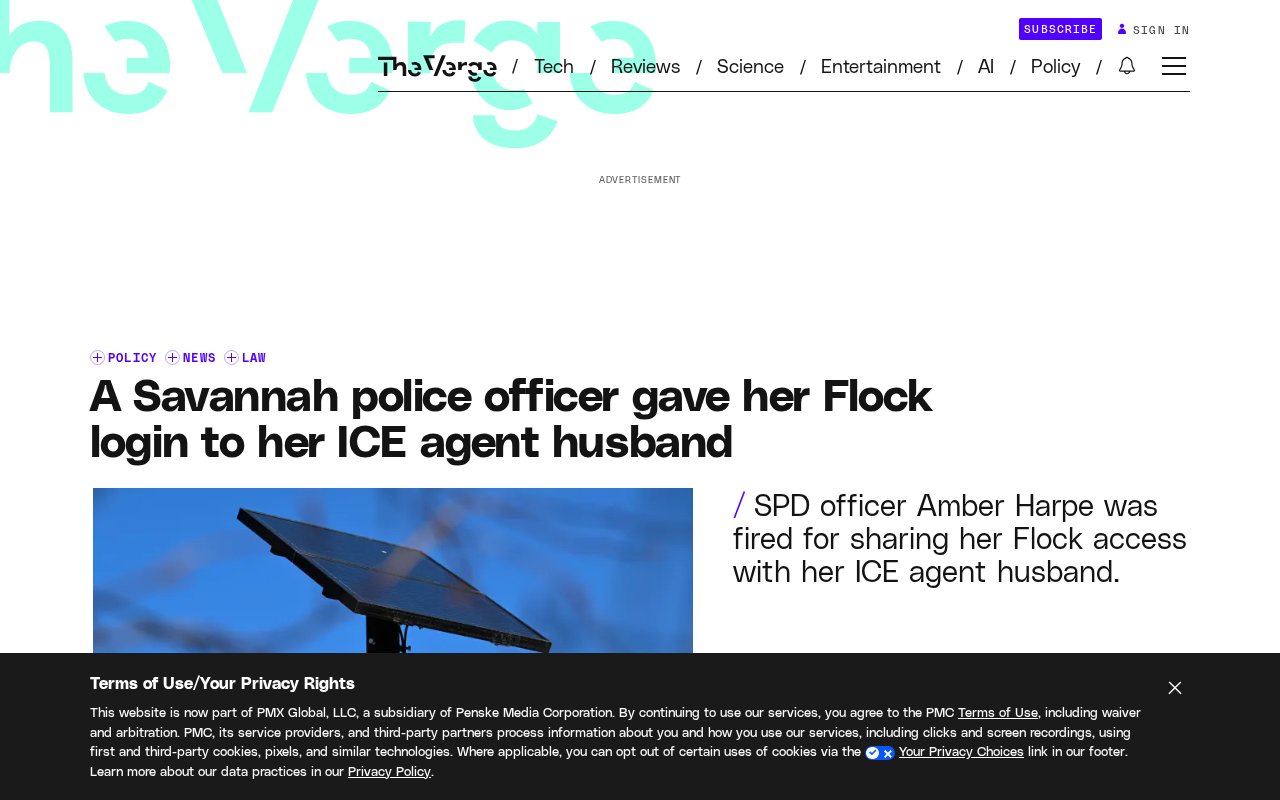
Event Overview
Former Savannah Police Department (SPD) officer Amber Harpe was fired in August after a department investigation found she had shared Flock system login credentials with her husband, Tyler Harpe, an Immigration and Customs Enforcement (ICE) agent. The SPD stated unequivocally that it does not share Flock data with ICE and that sharing system access violated the department's security protocols.
This incident reveals the sensitive boundaries of data sharing within law enforcement agencies. The Flock system generally refers to automatic license plate recognition (ALPR) technology, which is widely used for police surveillance. The SPD's position is clear: data is not shared externally, especially not with federal immigration enforcement agencies. Amber's actions not only violated internal rules but also sparked discussion about the information firewall between local law enforcement and federal immigration enforcement.
U.S. Immigration and Customs Enforcement (ICE) is a federal law enforcement agency under the Department of Homeland Security, primarily responsible for enforcing immigration and customs laws, including deporting undocumented immigrants and combating transnational crime. In recent years, data sharing between ICE and local law enforcement agencies has become a focal point of political and community controversy. Many local jurisdictions have enacted "sanctuary city" policies that restrict local police cooperation with ICE on immigration enforcement, so that community members are not afraid to report crimes or cooperate with police for fear of deportation. Against this backdrop, local law enforcement agencies' autonomous control over data sharing is seen as key to maintaining community trust. The Savannah Police Department's explicit refusal to share Flock data with ICE is a manifestation of this policy orientation.
Security Protocols and Internal Investigation
According to the SPD investigation, Amber Harpe's actions were determined to be a violation of security protocols. The department acted swiftly upon discovery and terminated her in August. The investigation report indicated that Tyler Harpe had used the login credentials to access the system, but the specific frequency and purpose of access have not been disclosed. The SPD emphasized that its Flock data is not open to ICE, a policy aimed at preserving the independence of local policing and community trust.
Details of the internal investigation suggest that the Harpes' actions may not be an isolated case. Controls over access to sensitive data within law enforcement agencies are becoming increasingly stringent, especially amid escalating controversies over immigration enforcement. The SPD's rapid response also sends a clear signal to other officers: security protocols are non-negotiable.
The principle of least privilege is one of the core principles in information security, requiring that systems grant users only the minimum access necessary to perform their work. In law enforcement agencies, this means officers should only access data directly relevant to their current tasks, and access should be logged and audited. Sharing login credentials with outsiders—even if the other party is an agent of another law enforcement agency—severely violates this principle because it bypasses role-based access controls and allows unauthorized personnel to access sensitive data. Such behavior is a classic insider threat, a security risk posed by individuals within the organization, and its prevention relies on strict technical controls and management systems such as multi-factor authentication, access log reviews, and periodic permission audits.
Impact on Community Trust
This incident may have a profound impact on trust in the Savannah community. Data sharing between local law enforcement agencies and federal immigration enforcement has always been a sensitive topic. The SPD's explicit refusal to share Flock data with ICE is partly to prevent community members from being deterred from cooperating with police due to immigration concerns. Amber's actions could undermine this foundation of trust.
Community advocates point out that such incidents highlight the importance of managing data access permissions. If officers can easily share login credentials with outsiders, the security of sensitive data is at serious risk. The SPD needs to strengthen internal audits and permission management to prevent similar incidents from recurring.
Technical Background: The Flock System and Data Privacy
The Flock system is an automatic license plate recognition technology that captures vehicle information through cameras and cross-references it with databases to help police track suspect vehicles. The data collected by the system includes license plate numbers, times, and locations, and is highly sensitive. The SPD uses the Flock system for routine policing but explicitly limits the scope of data sharing.
Data privacy experts note that access to such systems should be strictly limited to necessary personnel. Sharing login credentials not only violates protocols but may also break the law. The Amber case reminds law enforcement agencies that the use of technical tools must be accompanied by strict access controls and oversight mechanisms.
Automatic License Plate Recognition (ALPR) is a technology that automatically captures vehicle license plate images through cameras, converts the images into text using optical character recognition (OCR), and then compares them against databases. ALPR systems are typically deployed on police vehicles, light poles, or major traffic arteries, and can record in real time the time, location, and license plate number of passing vehicles, creating large-scale vehicle movement data. Such data is used not only to track suspect vehicles but also to analyze traffic patterns and locate missing persons. However, because it can reconstruct an individual's movement trajectory, ALPR data is considered highly sensitive personal information, and its collection, storage, and sharing are strictly constrained by privacy regulations and internal policies. Flock Safety is one of the leading vendors in the ALPR space, featuring solar-powered wireless cameras and a cloud-based data platform, with customers including numerous local law enforcement agencies.
Aftermath and Lessons
Following Amber Harpe's termination, the SPD may face further scrutiny. It remains unclear whether the department will take legal action against Tyler Harpe. This incident also serves as a warning to other law enforcement agencies: data sharing policies must be clear and strictly enforced.
For the tech industry, this case underscores the importance of access permission management. Whether in law enforcement agencies or enterprises, access to sensitive data should follow the principle of least privilege and undergo regular security audits. The Amber case is a classic example of an insider threat and deserves reflection by any organization that relies on sensitive data systems.
One-line Summary
A Savannah officer was fired for sharing Flock login access with her ICE agent husband, sparking data-sharing and privacy controversy.
Paragraph Summary
Former Savannah Police Department officer Amber Harpe was fired in August after sharing Flock automatic license plate recognition system login credentials with her husband, ICE agent Tyler Harpe. An SPD investigation found the action violated security protocols and emphasized that its Flock data is not shared with ICE, in order to maintain local policing independence and community trust. The incident highlights the sensitivity of data access controls within law enforcement and the controversy over the information firewall between local and federal immigration enforcement. Community advocates worry the move could undermine immigrant communities' trust in police, while privacy experts stress the importance of access permission management and call for stronger internal audits and the principle of least privilege. The case serves as a warning about insider threat management for law enforcement agencies and the tech industry.
Related articles

Gemini 4 Argon Hands-On: AI Builds Board Games, Constructs Temples, and Trains Robots Autonomously
Gemini 4 Argon hands-on roundup: AI autonomously builds a desk racetrack and temple in Blender, writes a ray tracing engine, trains a humanoid robot to sink 7 shots, plus API pricing and developer access.

The Magic Octagonal Coin: Why Only 9% of People Can Predict Its Flip?
Only 9% of people can correctly predict the Magic Octagon coin flip. This article explains its spatial rotation mechanism, common cognitive pitfalls, and a new hypothesis based on Relevance Theory, exploring the limits of human spatial reasoning.

Sam Altman: AI Is Entering the Era of Scientific Discovery — Math Breakthroughs Will Replicate in Biology and Energy
Sam Altman says AI is entering the era of scientific discovery — math breakthroughs will replicate in biology, materials science, and energy to help develop new drugs and energy sources.