Scale Mafia: The Fiercest Startup Alumni Network of the AI Era
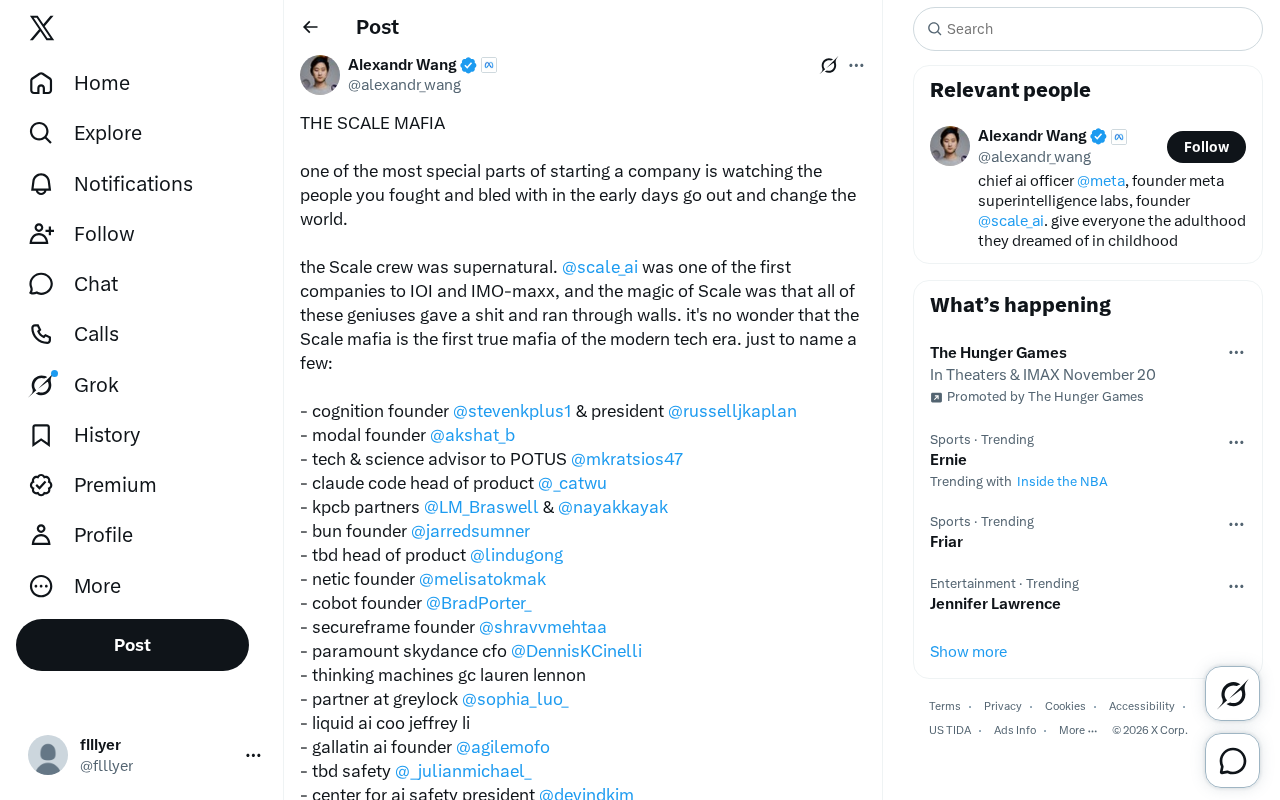
Scale's alumni network spans the AI industry chain, becoming modern tech's first true "Mafia."
The article draws the concept of "Scale Mafia" from a Twitter post and outlines the founders and executives who came out of Scale, covering the model layer (Liquid AI, Thinking Machines), developer tooling layer (Bun, Claude Code, Modal), application layer (Cognition, Cobot, Netic), investment firms (KPCB, Greylock), and policy and safety roles (White House advisor, Center for AI Safety). It analyzes why it formed: high-density IOI/IMO talent and high-pressure project work forge "battlefield friendships," the mid-supply-chain position lets employees see both underlying needs and the last mile of deployment, and the network self-reinforces by holding capital and rule-making power. It concludes that the Mafia was not deliberately designed, and the only replicable lesson is: put the best people on the hardest battlefield and let them trust each other.
From Battles to Changing the World: Scale's Unique Culture
A post from Twitter brought the term "Scale Mafia" to the surface. The poster recalled that one of the most special experiences of starting a company is watching the comrades who fought alongside you in the early days go out and change the world. He described Scale's team as something "supernatural"—it was among the first companies to push IOI (International Olympiad in Informatics) and IMO (International Mathematical Olympiad) backgrounds to the extreme, and the real magic is that this group of geniuses is not only smart but actually cares, willing to "walk through walls" to solve problems.
This evaluation is not mere courtesy. Against the backdrop of the AI industry's widespread pursuit of polished resumes, the rough phrase "geniuses gave a shit" instead pinpoints the source of Scale's talent density: beyond intelligence, there is a relentless drive to execute.
The Scale Mafia Roster: Spanning Models, Tools, and Policy
The post named a long list of people who came out of Scale or are deeply associated with it, covering multiple key nodes of the current AI ecosystem:
- Cognition: founder Steven (@stevenkplus1) and President Russell Kaplan (@russelljkaplan)
- Modal: founder Akshat (@akshat_b)
- Bun: founder Jarred Sumner (@jarredsumner)
- Claude Code: product lead Cat Wu (@_catwu)
- KPCB (Kleiner Perkins): partners Laura Braswell (@LM_Braswell) and Naya (@nayakkayak)
- Greylock: partner Sophia Luo (@sophia_luo_)
- Liquid AI: COO Jeffrey Li
- Netic: founder Melisa Tokmak (@melisatokmak)
- Cobot: founder Brad Porter (@BradPorter_)
- Secureframe: founder Shrav Mehta (@shravvmehtaa)
- Paramount Skydance: CFO Dennis Cinelli (@DennisKCinelli)
- Thinking Machines: general counsel Lauren Lennon
- Gallatin AI: founder (@agilemofo)
- TBD: product lead (@lindugong), security lead Julian Michael (@julianmichael)
- Center for AI Safety: president Devin Kim (@devindkim)
- White House Science and Technology Advisor: Michael Kratsios (@mkratsios47)
What makes this list special is not the number of people but the span. From the model layer (Liquid AI, Thinking Machines), the developer tooling layer (Bun, Claude Code, Modal), the application layer (Cognition, Cobot, Netic), to investment firms (KPCB, Greylock), and further to policy and safety (White House advisor, Center for AI Safety), Scale's alumni have covered almost every link in the AI industry chain. The poster thus asserts: the Scale mafia is the first truly meaningful "mafia" of the modern tech era.
RLHF (Reinforcement Learning from Human Feedback) is the technical backdrop of Scale's early core business. It refers to first having human annotators rank model outputs by preference, then training a reward model on that, and finally using reinforcement learning to align the language model with human intent. Scale was precisely the intermediary layer providing this kind of high-quality human feedback data to frontier labs, so its employees could simultaneously touch the underlying needs of model training and the last mile of product deployment.
"Mafia" in tech specifically refers to the network of founders and executives formed by former employees of a certain company, originating from the "PayPal Mafia"—PayPal's early team later founded Tesla, LinkedIn, YouTube, and other companies. Judging whether a mafia is real usually comes down to three points: whether members have independently succeeded across multiple fields, whether the network controls capital and discourse power, and whether the ties go beyond a shared label on LinkedIn.
Why Scale Could Grow a "Mafia"
The tech world uses "mafia" to describe the founder network emerging from a certain company, traceable at the earliest to PayPal. Since then there have been terms like "Stanford mafia" and "Google mafia," but most remain loose peer relationships. The Scale case offers several observations worth unpacking.
High-Density Talent Pool and High-Intensity Project Work
Scale entered the market early with data annotation and RLHF services, a business that naturally requires a large number of highly intelligent people to tackle hard problems in short cycles. Engineers with IOI/IMO backgrounds gathered under the same roof formed "battlefield friendships" rather than ordinary colleague relationships. The phrase "fought and bled with" in the post points precisely to the bonds left by this high-pressure collaboration.
Vision from Infrastructure to Frontier Research
Scale sits in the middle layer of the AI supply chain, serving frontier labs upward and managing large-scale human labor downward. This position lets employees see both the underlying needs of model training and the last mile of product deployment. Modal does serverless infrastructure, Bun does a JavaScript runtime, Claude Code does an AI coding product—these startup directions seem scattered but in fact all stem from firsthand experience with the "AI development workflow."
Serverless infrastructure refers to the cloud computing model in which developers do not need to manage servers and capacity automatically scales on demand. Modal is precisely the startup bringing this model to AI workloads (such as model inference and GPU tasks). A JavaScript runtime is the environment that executes JavaScript code, and Bun challenges Node.js's position with a high-performance integrated toolchain. AI coding products like Claude Code let developers drive code generation and modification with natural language. These three directions seem scattered but in fact all revolve around firsthand experience with the "AI development workflow."
The Self-Reinforcement of the Alumni Network
The list already includes investment firm partners (KPCB, Greylock) and policy roles (White House, Center for AI Safety). This means Scale alumni are not only starting companies downstream but also beginning to hold upstream discourse power over capital allocation and rule-making. When a network simultaneously possesses the three capabilities of "building companies," "funding companies," and "setting rules," its influence amplifies itself.
IOI and IMO are the International Olympiad in Informatics and the International Mathematical Olympiad, respectively, the highest-level academic competitions for middle school students worldwide. Contestants who win awards in them typically possess extremely strong algorithmic and mathematical foundations and are sought after by AI labs and quantitative firms. Scale's earliest batch pushing such backgrounds to the extreme means its talent pool approaches the intellectual density of national competition teams, which is also the source of the "genius" side in the "geniuses gave a shit" evaluation.
Lessons for Founders
For engineers currently choosing an employer, the Scale case suggests a counterintuitive criterion: rather than the company's current valuation, look at whether it can offer high-density peers and opportunities for hard battles. These two things are not written in the offer letter, yet they determine the quality of your network five years later.
For founders, the formation of a "Mafia" is not the result of deliberate design. Members of the PayPal mafia have repeatedly stressed that back then they were just solving payment problems and had no plan to "cultivate founders." Scale is the same—it was just doing the hard work between data and models, and along the way honed a group of people into founders capable of fighting independently. The only truly replicable lesson may be this: put the best people on the hardest battlefield, and then let them trust each other.
An Open Question
The end of the post mentions that this group photo came from Nate Herman's wedding, and the poster calls him a co-founder of Scale in many senses. This personal detail precisely shows that the cohesion of the Scale mafia partly comes from real personal relationships rather than a shared label on LinkedIn.
Of course, however long the list is, it is only a starting point. Whether a "mafia" is real ultimately depends on whether the companies these people build can continue to deliver. Cognition, Modal, and Bun have already entered developers' view, and more names remain to be verified. But at least for now, the density and span of Scale's alumni network have no comparable second sample in the AI industry.
One-line Summary
Scale's alumni network spans the AI industry chain, becoming the first truly meaningful "Mafia" of modern tech.
Paragraph Summary
The article draws the concept of "Scale Mafia" from a Twitter post and outlines the roster of founders and executives who came out of Scale, covering the model layer (Liquid AI, Thinking Machines), developer tooling layer (Bun, Claude Code, Modal), application layer (Cognition, Cobot, Netic), investment firms (KPCB, Greylock), and policy and safety roles (White House advisor, Center for AI Safety). It analyzes the reasons for its formation: high-density IOI/IMO talent and high-pressure project work forge "battlefield friendships," the position in the middle layer of the supply chain lets employees see both underlying needs and the last mile of deployment, and the alumni network further reinforces itself by holding capital and rule-making power. Finally, it points out that the Mafia was not deliberately designed, and the only replicable lesson is: put the best people on the hardest battlefield and let them trust each other.
Related articles

Cursor AI in Practice: Weighing Efficiency Gains Against Costs in an AI IDE
An in-depth look at Cursor AI IDE's interface layout, four modes (Agent/Plan/Debug/Ask), model selection, and Git context integration, with hands-on demos weighing subscription costs against going direct to Claude.
Free Landing Page Design Rules Library: A Practical Guide for Claude Code and Cursor
A free landing page design skill for Claude Code and Cursor: MIT licensed, nearly 9,000 stars, asks about offer/audience/action before planning 12 sections with hard font and spacing constraints.

Cursor Keeps Writing Wrong Code? The Problem May Be Context, Not Prompts
Cursor keeps writing wrong code? The problem may be context, not prompts. Learn how to supply relevant files, full error messages, and expected results, plus a plan-first, small-step, test-driven workflow to reduce AI coding errors—while remembering code review remains the developer's job.