Scaleway's Dual-Country GPU Zones Go Live: AMD and NVIDIA Running in Parallel

Scaleway launches dual-chip GPU clusters, Milan's third availability zone, and an expanded model catalog; procurement must distinguish announced from available capacity.
Scaleway announced three infrastructure updates at ai-PULSE 2026: an AMD MI355X cluster in Stockholm and an NVIDIA B300 cluster in Copenhagen, forming a single-vendor dual-chip family; two new availability zones in Milan reaching three, giving it the resilience threshold for production workloads; and a Generative APIs model catalog exceeding 40, adding LightOn OCR 3, DeepSeek V4.1-Flash, and GLM 5.3. The article notes that the dual-chip setup is commercially good for price comparison but adds a second software stack cost operationally. The Jotunn8 European inference chip partnership with VSORA and ZML, and the European AI Gigafactory project, are described only directionally, without specs or dates. Neither new GPU cluster has announced delivery dates or pricing; procurement evaluation should focus on availability zone distribution, SLA commitments, accelerator unit prices, and exit costs, while distinguishing announced from available capacity.
Scaleway laid out three cards at once at the ai-PULSE 2026 conference: new GPU Zones, new accelerator clusters, and an expanded model catalog. For buyers, these three things map to three different questions—resilience, price, and portability. Breaking them apart is more useful than broadly accepting the "European AI infrastructure" narrative.
Two Countries, Two Accelerators
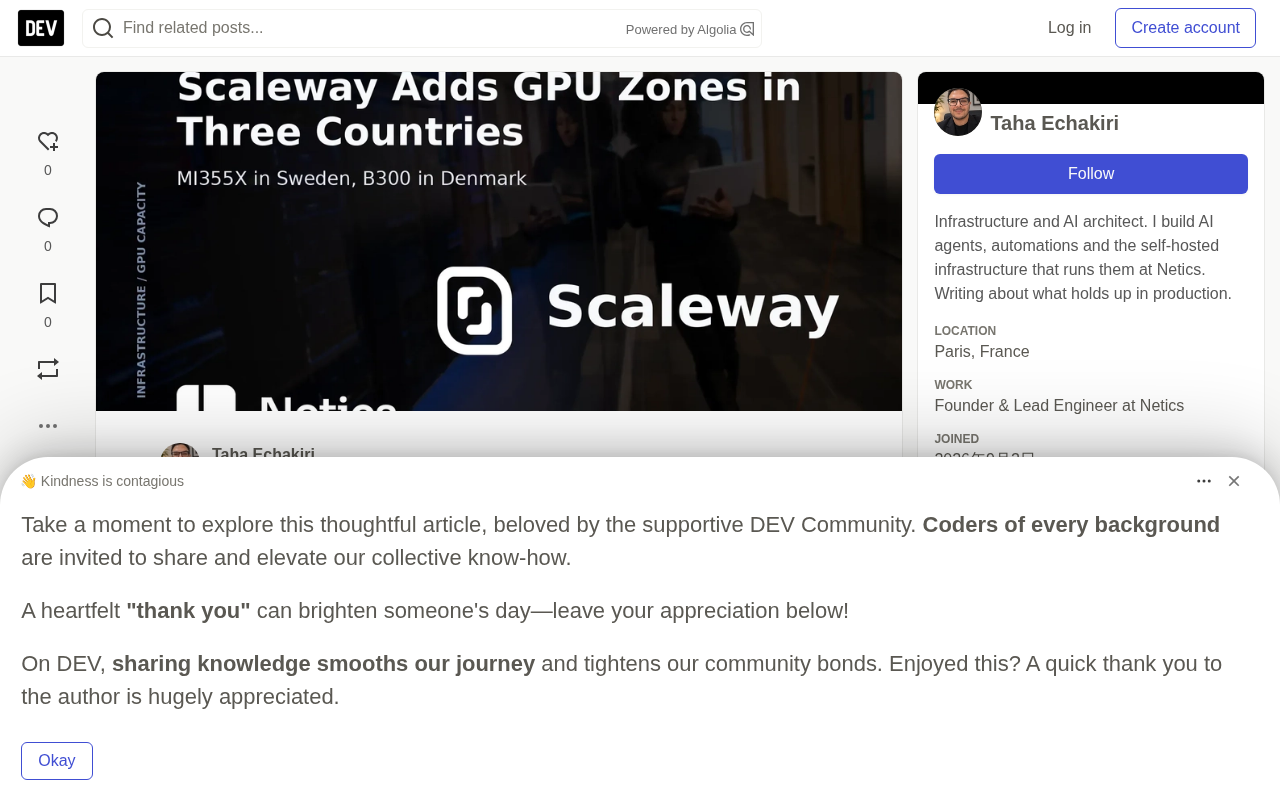
Scaleway placed different chips in different countries. Stockholm gains an AMD Instinct MI355X cluster, which the company says aims to be among the first such infrastructure from a European cloud provider; Copenhagen deploys an NVIDIA B300 cluster at a scale of thousands of GPUs. The GPU Zones in Paris, Copenhagen, and Stockholm are described as ultimately representing tens of thousands of GPUs, tens of exaflops, and tens of megawatts of capacity.
The term "GPU Zone" deserves its own definition: it is a dedicated part of a cloud region built around graphics accelerators for model training and inference, with a procurement logic entirely different from general-purpose compute regions. In other words, buying a GPU Zone and buying a general-purpose instance are two separate calculations.
The company gave no delivery dates for the two new clusters, nor any pricing. This needs an asterisk during evaluation—announced capacity and available capacity are two different things.
What Dual Chips Actually Mean for Buyers
From a commercial standpoint, having two chip families within one vendor benefits buyers. Inference workloads come in many shapes; some loads have the lowest hourly cost on one accelerator, and a vendor holding two product lines can compete the two against each other on price. Scaleway itself made this point: a broader range of processor architectures helps preserve customers' freedom of choice.
But from an operations standpoint, a second chip family means a second software stack. Images, drivers, and build pipelines all need to be maintained again, and the cost falls on the maintainer. A migration plan written for one accelerator often has to be redone for the other. This detail determines whether a team will actually use that cheaper option.
Availability Zone is an independent fault domain that a cloud provider carves out within the same geographic region. Each availability zone has its own power, cooling, and network facilities, physically isolated from one another but interconnected via low-latency links. Cloud providers typically use "region" to denote a city-level geographic location and "availability zone" to denote an independent data center cluster within a region. The industry generally treats three availability zones as the baseline for production-grade deployment: when an application is redundantly deployed across three availability zones, it can automatically fail over on a single point of failure while maintaining acceptable replication latency across zones. Two availability zones provide redundancy, but when one fails, the remaining nodes often cannot carry the full traffic and can only run in degraded mode. Therefore, "Milan reaching three availability zones" means the region qualifies to host core production systems, not just an expansion of the resource pool.
Exaflops (quintillions of floating-point operations per second) is a common unit for measuring the compute scale of supercomputers and AI clusters; 1 exaflop equals 10^18 floating-point operations per second. For reference, a current high-end single GPU delivers FP16 compute on the order of tens of petaflops, so "tens of exaflops" implies tens of thousands of accelerators working together, which is consistent in order of magnitude with the "tens of thousands of GPUs" mentioned in the original text. Note that exaflops published by cloud providers usually refer to peak theoretical values at a specific precision (such as FP8 or FP16), and actual training throughput is significantly degraded by network interconnect, memory bandwidth, and software stack efficiency.
Instinct MI355X and NVIDIA B300 represent the latest generation of data center accelerators from AMD and NVIDIA, respectively. The architectural differences between the two vendors go far beyond hardware specifications: NVIDIA centers on the CUDA ecosystem, with mainstream training frameworks, operator libraries, compilers, and community documentation defaulting to it first; AMD's ROCm software stack has made significant progress in recent years but still lags in operator coverage, third-party library compatibility, and debugging tool maturity. This directly explains the "second software stack" cost mentioned in the original text: it is not simply installing drivers, but re-establishing experience across container images, performance tuning, troubleshooting, and benchmarking. For a team, before choosing the cheaper accelerator, it should first assess whether its workloads are highly dependent on vendor-specific libraries (such as cuDNN, TensorRT) and whether it has the engineering resources to bear dual-stack maintenance.
Milan: Three Availability Zones Is What Makes It Production-Grade
The Italian region is the most concrete part of this announcement. Milan gains two new availability zones, bringing the region to three. Three availability zones is the threshold for a region to host production workloads—an application distributed across three independent zones can withstand the loss of one, and the company calls the resulting service enterprise-grade resilience.
The Italian story also extends to Qarnot Computing. This company was acquired by Scaleway earlier in 2026 and specializes in high-performance computing and waste heat recovery. In Brescia, Qarnot partners with A2A to connect its HPC infrastructure to the city's district heating network. Waste heat utilization is a real engineering choice with physical constraints—you need to find a heat buyer within pipeline distance, and the Brescia arrangement is presented by the company as an example.
In addition, Scaleway plans to add six more availability zones for Stockholm and Frankfurt in 2027. This is the planning portion of the announcement and should be viewed separately from what has been delivered.
Data center waste heat recovery refers to taking the low-grade heat generated by server cooling, raising its temperature through heat pumps or heat exchangers, and feeding it into district heating networks for residential heating or industrial use. Its engineering constraint is that the economic radius for heat transport is usually only a few kilometers, and a long-term heat purchase agreement must be signed with the owner of the heating network, so data center siting must spatially match heat demand. The Brescia arrangement fits this logic: Qarnot's HPC infrastructure is adjacent to A2A's city heating network, giving the waste heat a stable buyer. For buyers, such arrangements do not directly affect compute pricing, but they reflect the vendor's positioning on energy costs and sustainability compliance, which may affect its power procurement strategy and regional expansion pace over the long term.
European Inference Chips in the Partnership List
Scaleway also lists a chip partnership that goes beyond "buying accelerators." Together with VSORA and ZML, the company says it is contributing to a new European AI inference solution based on the Jotunn8 processor, with the goal of supporting new European chip architectures and broadening the technology options available to enterprises.
This item should be treated the same as the GPU counts. Development partnerships are an early step on a long path, requiring passage through three gates: silicon, compilers, and production workloads. The company gave no specifications, timeline, or performance data for Jotunn8, and the honest reading is "direction" rather than "product." The European AI Gigafactory project that Scaleway and iliad Group joined falls into the same category.
European AI Gigafactory is a public investment program pushed by the EU to narrow the AI compute gap with the United States and China, aiming to build large-scale supercomputing facilities for AI training and inference, funded by joint investment from member states and the private sector, with iliad Group (Scaleway's parent company) as one participant. The significance of such projects lies in improving Europe's domestic compute supply and data sovereignty, but they are characterized by long cycles, dependence on subsidies, and a rollout pace subject to political and budget cycles. Distinguishing them from delivered GPU clusters is key to assessing a vendor's actual available capacity: Gigafactory is a multi-year capacity plan, not a resource procurable this quarter.
Model Catalog: The Part Small Teams Can Use This Month
The catalog portion is what small teams can use right now. More than 40 models are available through Generative APIs, with three added this time: LightOn OCR 3 from French company LightOn, for text recognition and information extraction from complex documents; DeepSeekAd V4.1-Flash, with native visual understanding capabilities; and Z.ai's GLM 5.3, an open-source model described as suited for software development and multi-step complex agent tasks. The families listed by the company cover Qwen, Gemma, DeepSeek, GLM, Mistral, and Devstral.
Running models on European-hosted infrastructure answers the data path question but leaves another: portability of the work. Prompts, evaluation sets, and fine-tuning results are the assets a team accumulates, and their portability depends on interfaces, not server location. The announcement also mentions that the inference platform supports cached tokens and customizable rate limits—these are the control levers that determine per-request cost—as well as a partnership with Dataiku to place the orchestration platform on the same cloud.
The Questions You Can Price Today
The gap between announced capacity and available capacity is where the procurement work lies. Three questions can settle most of it: which availability zone the workload will land in, and what the SLA commits to in the event of losing one availability zone; which accelerator to choose, at what hourly price, and for what commitment term; and what exit looks like—data formats, interfaces, and migration-out costs.
Then price a workload. Pick an eligible European region and calculate the monthly cost of a single inference service or fine-tuning job to get a number comparable to your current bill. That is closer to a decision than any "tens of thousands of GPUs" narrative.
As for Jotunn8 and the Gigafactory, put them on the watch list: the direction is clear, specifications and dates are pending.
Related articles

A Single Prompt Triggers a Global PHP Security Storm: Is AI a Savior or a Hidden Risk?
A single AI prompt triggered a global PHP security crisis affecting Wikipedia and the Internet Archive. This article reviews the incident, analyzes the OpenAI-Amazon controversy, and explores the security paradox of lowered vulnerability discovery barriers in the AI era and developer response strategies.

When AI Is Taken Away: How Reliance on Shortcuts Undermines Your Problem-Solving Resilience
A study of 1,222 people found that after using AI to answer questions, once AI was removed, people gave up on more problems than a control group that never used AI. The article analyzes the impact of AI reliance on learning resilience and metacognition, and explores design implications for AI learning tools.

Carta and NewView Partner to Let Startup Employees Cash Out Equity Early
Carta and NewView Capital partner to simplify startup tender offers, helping employees sell equity early. Analysis of the mechanism, liquidity pain points, and impact.