scientific-agent-skills: 163 Validated Skills That Turn AI into a Research Assistant

Open-source project with 163 validated skills turns any AI agent into a scientific research assistant.
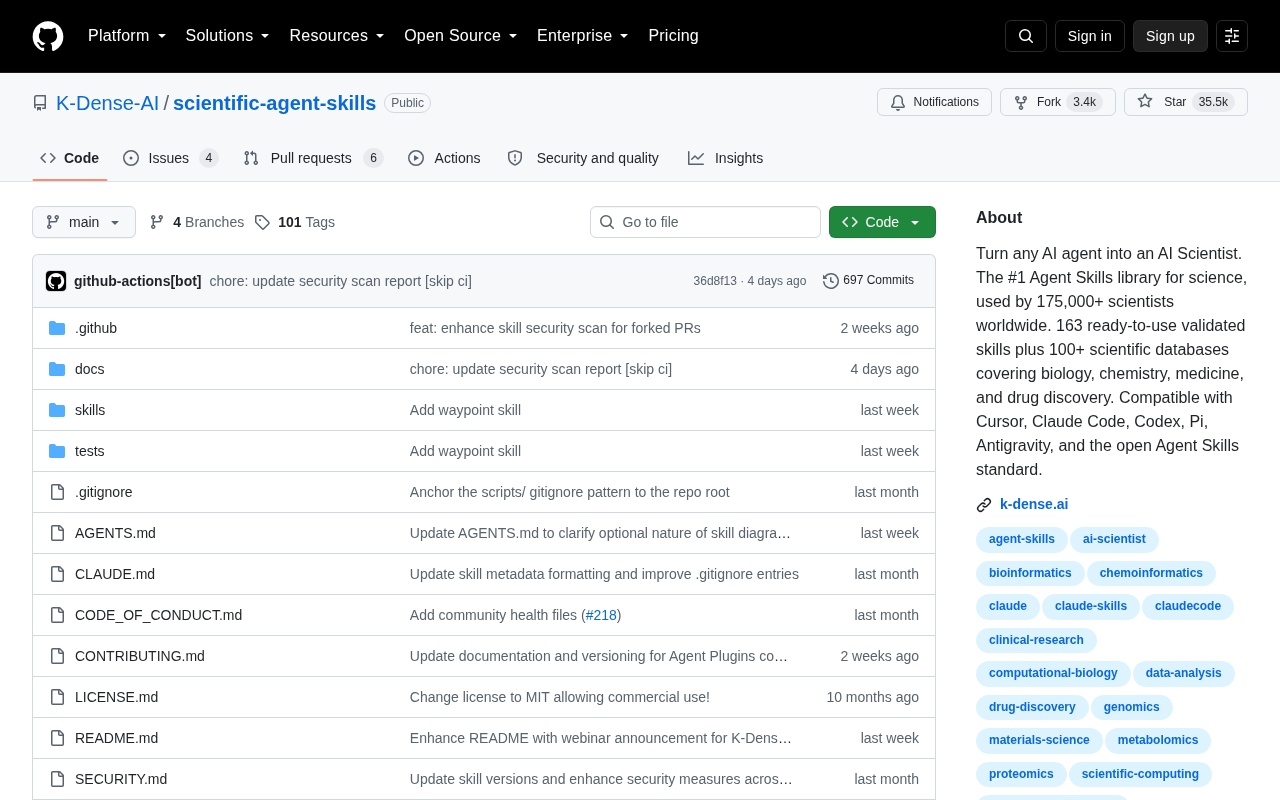
scientific-agent-skills is an open-source project by K-Dense-AI that provides 163 validated, ready-to-use research skills and integrates over 100 scientific databases spanning biology, chemistry, medicine, and drug discovery. Compatible with mainstream tools like Cursor, Claude Code, and Codex, it follows the open Agent Skills standard to turn any general-purpose AI agent into a capable scientific assistant with minimal setup.
When AI Agents Enter the Lab
In recent years, the capabilities of AI agents have been expanding rapidly — from writing code and searching information to automating office tasks, they seem capable of almost anything. But in highly specialized scientific research, general-purpose AI often falls short. It might know what PCR is, but it may not be able to properly design a set of primers. It can explain protein folding, yet struggle to directly invoke structure prediction tools to complete an analysis.
The scientific-agent-skills project, open-sourced by the K-Dense-AI team, was built to solve exactly this problem. Its positioning is crystal clear: turn any AI agent into an AI scientist. The repository has already garnered over 35,000 Stars on GitHub, with nearly 500 new Stars added daily. The project claims to be used by more than 175,000 scientists worldwide, making it the #1 Agent Skills library in the scientific domain.
163 Validated Research Skills: The Project's Core Value
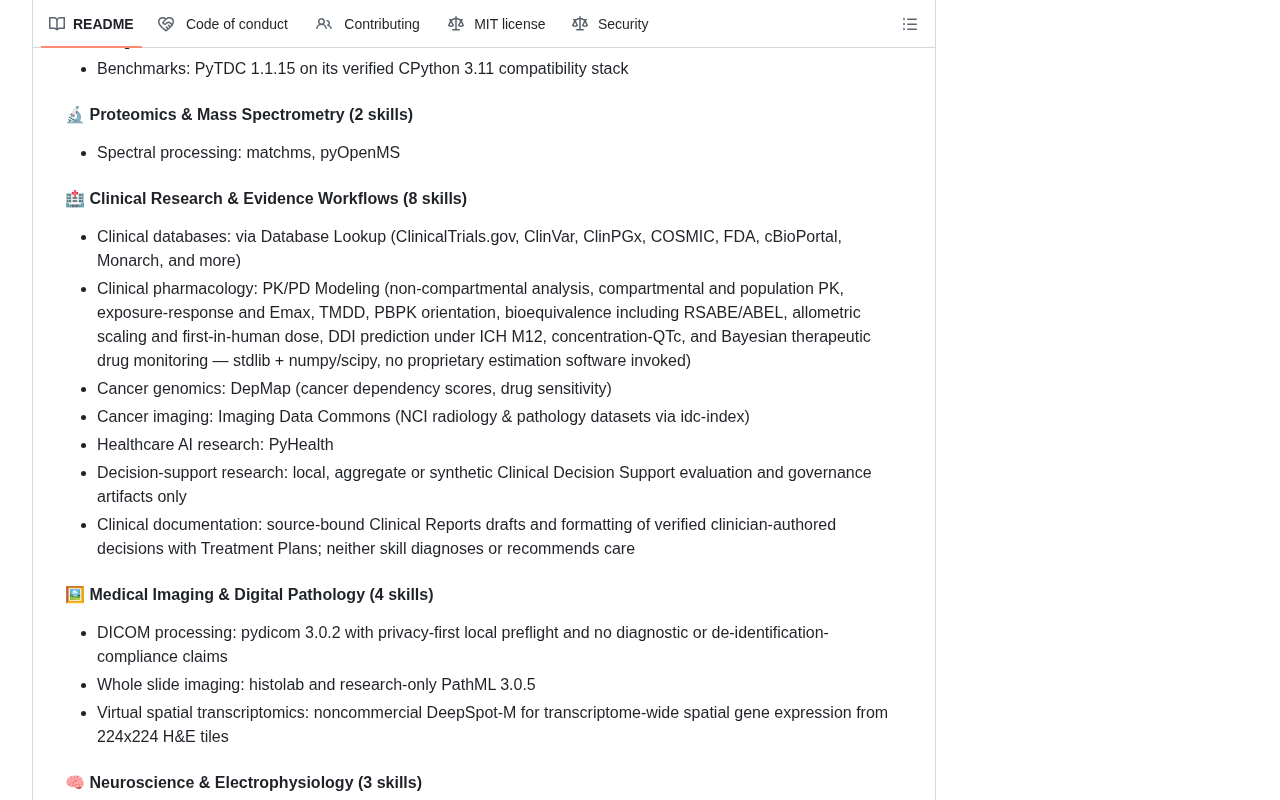
The core value of the project lies in its 163 ready-to-use, validated skills. These skills cover four major research tracks: biology, chemistry, medicine, and drug discovery.
Why "Validated" Matters
In research settings, the reliability of AI-generated results is paramount. An unvalidated analysis pipeline could derail an entire experimental direction due to incorrect parameters or improper methodology. By emphasizing that all skills are validated, scientific-agent-skills signals that these capabilities are not simply stacked prompt templates, but standardized operational units that have been tested against real scientific workflows.
Modular Skill Design
Each "Skill" is essentially an encapsulated capability module that allows AI agents to be invoked directly when facing specific research tasks, without requiring researchers to write complex calling logic from scratch. This modular approach aligns with the emerging Agent Skills standard — breaking down complex capabilities into reusable, composable skill units is a key pathway to making agents truly practical.
100+ Scientific Database Integrations: Breaking Through Data Bottlenecks
Beyond the skills themselves, the project integrates over 100 scientific databases. In research, data accessibility is often the efficiency bottleneck. Biology research requires gene sequence databases, chemistry research depends on molecular structure libraries, and drug discovery simply cannot function without compound and target databases.
Connecting these databases with AI agents means researchers can use natural language commands to have AI directly search, access, and analyze authoritative scientific data — without constantly switching between multiple platforms. This "skills + data" dual-engine approach is the project's core competitive advantage over ordinary AI plugins.
Broad Compatibility with Mainstream AI Tools, Embracing Open Standards
Notably, scientific-agent-skills hasn't locked itself into any specific platform. Instead, it embraces an open ecosystem. The project claims compatibility with mainstream AI coding and agent tools including Cursor, Claude Code, Codex, Pi, and Antigravity, while adhering to the open Agent Skills standard.
The Practical Significance of Compatibility
This broad compatibility significantly lowers the barrier to entry for researchers. Regardless of which AI coding tool you prefer, you can plug this scientific skills library into your existing workflow. For individual researchers, this means virtually zero migration cost. For research teams, it enables collaboration under a unified skill standard, avoiding the efficiency losses caused by tool fragmentation.
The Long-Term Value of Open Source
The project is written in Python and is fully open source (with 3,414 Forks to date). This not only allows scientists worldwide to use it for free but, more importantly, enables the community to participate in building it together. The scientific field has countless specialized sub-domains, and no single team can cover all the needs. The open-source model leverages community power to continuously expand and optimize the skill library.
A Practical Implementation of the AI for Science Trend
From a broader perspective, the popularity of scientific-agent-skills reflects how AI for Science is moving from concept to practical application. In the past, AI applications in research mostly stayed at the level of specific algorithms or specialized models — like AlphaFold for protein structure prediction. Now, general-purpose large model agents are attempting to become universal assistants across the entire research workflow.
This project offers a clear path to implementation: rather than training specialized scientific large models from scratch, empower general-purpose agents through standardized skill libraries. This approach is lower in cost, faster to iterate, and easier for the broader research community to adopt.
Of course, we should maintain a balanced perspective. The claim of 175,000 scientists is self-reported by the project team. The actual scientific rigor, depth of skill coverage, and acceptance of AI-generated results in peer review still need time and practice to validate further. Nevertheless, the direction of systematically integrating AI agents into research workflows has already demonstrated enormous potential.
Conclusion
The scientific-agent-skills project equips general-purpose AI agents with a "scientific brain" through 163 validated skills and 100+ databases. It serves as both a model case for implementing the Agent Skills standard and a pragmatic exploration under the AI for Science trend. For researchers looking to boost their efficiency, an open-source, free, and broadly compatible skill library like this is undoubtedly worth trying. And for the AI industry as a whole, it reaffirms a key insight: the future of agents depends not only on how powerful the model itself is, but on how many validated professional capabilities it can leverage.
Related articles

AgentCore in Practice: Connecting Custom Tools and MCP Servers to Agents
DebuggerCafe tutorial shows how to connect custom tools and MCP servers to Amazon Bedrock AgentCore agents, covering tool contract design, MCP reuse, and production concerns.

816B Parameters Scores Only 39? The Real Cost-Effectiveness of the Open-Source LLM Parameter Race
Meta's 816B Muse Spark Open scores just 39 on Artificial Analysis, while 180B Qwen3.8-Flash-Next scores 40. This article analyzes 11 open-weight models' parameters vs. scores, exploring the real impact of activated parameters, quantized size, and deployment cost.

Aerial Manipulators: The Next Step for Drones from 'Seeing' to 'Changing'
Starting from a Reddit discussion, this article analyzes the technical challenges, potential applications, and deployment bottlenecks of aerial manipulators, exploring the key challenges for drones moving from environmental perception to physical manipulation.