Scored a Brand-New DGX Spark for $4,000: The Best Bang for Your Buck in Local AI Deployment
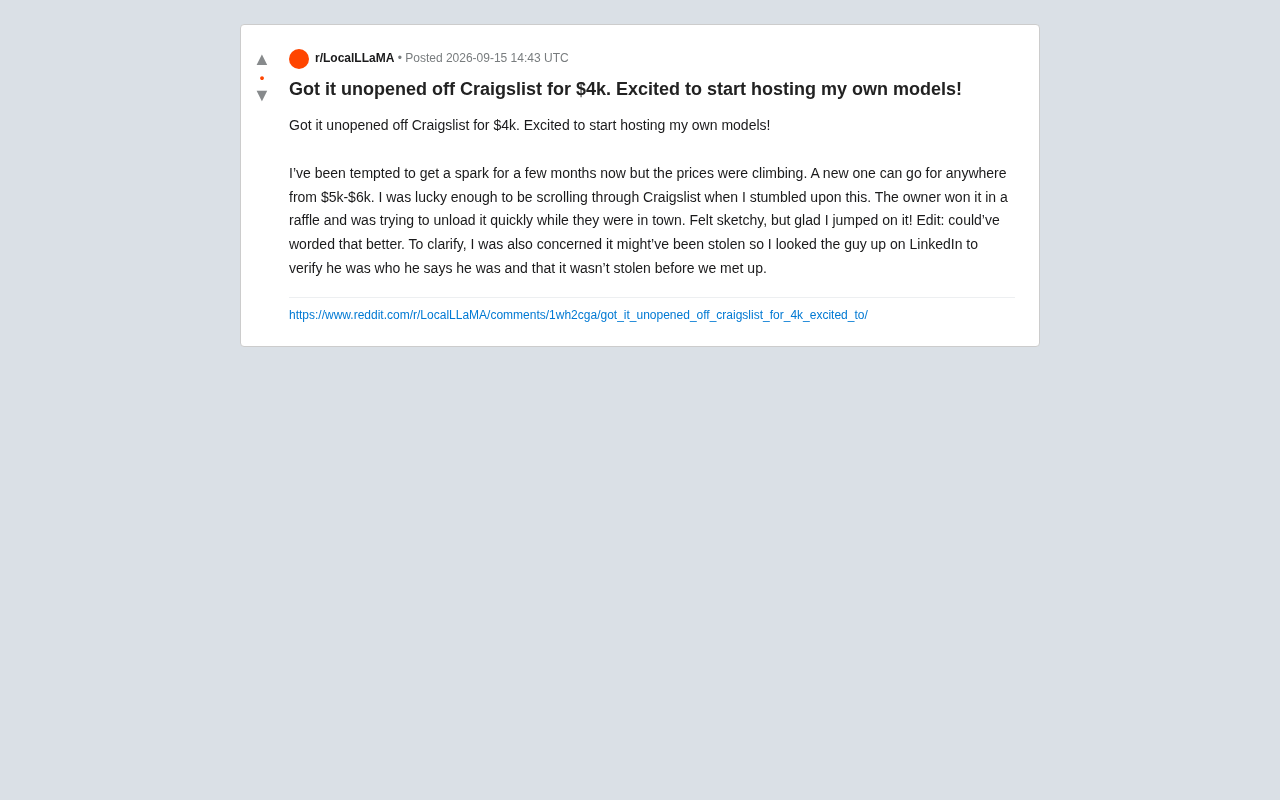
A Reddit user bought a sealed DGX Spark for $4K on Craigslist, spotlighting the local AI deployment boom.
A Reddit user purchased a brand-new, sealed NVIDIA DGX Spark on Craigslist for $4,000 — below the $5,000–$6,000 retail price — to self-host AI models locally. Two things stand out: the buyer verified the seller's identity via LinkedIn to rule out stolen goods, offering a practical template for high-value offline transactions; and the DGX Spark's rising prices and strong demand reflect a growing trend of developers and enthusiasts choosing to run large language models locally for privacy, cost control, and customization freedom.
A Bargain Find on Craigslist
A Reddit user recently shared their experience scoring a deal: they picked up a brand-new, sealed DGX Spark on Craigslist for $4,000. According to the post, the original owner had won the unit in a raffle and, being out of town, wanted to offload it quickly — hence the below-market price.
For anyone interested in local AI deployment, that price is genuinely attractive. A new DGX Spark currently retails somewhere between $5,000 and $6,000, and prices have been climbing as demand rises. The buyer admitted they'd had their eye on the device for months, watching prices creep higher, until this Craigslist listing popped up — and they pulled the trigger.
Safety Considerations for Second-Hand Deals
What's worth noting here is how cautious the buyer was throughout the transaction. In the post, they mentioned being upfront about their concern that the unit might be stolen. Before meeting in person, they took the time to verify the seller's identity on LinkedIn — confirming it was actually that person and that the device hadn't been obtained illegally.
This approach is a useful reference for anyone buying high-value electronics through offline channels. When something seems suspiciously below market price, verifying the seller's real identity and understanding the item's provenance are essential steps to manage risk. Cross-referencing a seller's information through social platforms is a low-cost but effective way to protect yourself.
Why Go Local for Model Deployment?
The buyer's core reason for getting the DGX Spark was clear: to self-host AI models. In recent years, with the rapid rise of open-source large language models, a growing number of developers and enthusiasts have been gravitating toward running models locally rather than relying entirely on cloud-based APIs.
The advantages of local deployment come down to a few key areas: better data privacy, since sensitive information never has to leave your own hardware; more predictable long-term costs, free from cloud metering fees; and greater freedom to fine-tune, experiment with, and customize models. Compact devices like the DGX Spark — purpose-built for AI workloads — are aimed squarely at this niche.
For users looking to break free from cloud services and build their own personal AI infrastructure, dedicated hardware is an unavoidable investment. Getting a brand-new unit below market price naturally lowers the barrier to entry.
The DGX Spark is NVIDIA's desktop-class AI supercomputer aimed at individual developers and small teams. It's powered by the GB10 Grace Blackwell Superchip, which integrates a GPU and ARM CPU in a single package, delivering up to 1,000 TOPS of AI performance and supporting up to 128GB of unified memory — enough to run large language models with up to 70 billion parameters locally. Compared to enterprise-grade DGX servers that can cost hundreds of thousands of dollars, the Spark is positioned as a "desktop-ready AI workstation": compact, reasonably power-efficient, and widely seen as the entry-level gateway for developers getting into local AI deployment. That positioning has attracted a large community of hobbyists who want to run open-source models like Llama and Mistral at home or in small offices — and tight supply relative to demand has been pushing secondary market prices steadily higher.
The technical bar for self-hosting AI models has dropped dramatically in recent years. Tools like llama.cpp, Ollama, and LM Studio make it possible for everyday users to load and run open-source models locally without deep engineering expertise. Meta's Llama series, Mistral AI's Mistral/Mixtral models, and DeepSeek, among others, offer open weights for commercial or research use — making it genuinely feasible for individuals to build private AI assistants, code completion tools, or knowledge base Q&A systems. The maturation of this ecosystem is the fundamental reason driving demand for high-performance local inference hardware like the DGX Spark.
Takeaway
What looks like just another second-hand transaction is actually a small reflection of the broader enthusiasm around local AI deployment. The DGX Spark's sustained high price and strong demand signal that more and more people are willing to pay a premium to keep their models under their own control. At the same time, this story is a reminder that in the pursuit of a good deal, transaction safety deserves just as much attention as the price tag.
Related articles

LangGraph Beginner's Guide: The Complete OS for AI Agents
LangGraph is called the OS for AI Agents. This guide covers its relationship with LangChain, State/Node/Edge fundamentals, checkpoints, human-in-the-loop, and subgraphs.

Andrew Ng on Agentic AI: Cutting Through the Hype to Find the Core Skills That Actually Matter
Andrew Ng's Agentic AI course cuts through industry hype to reveal the real skills that matter: systematic evals and error analysis for building reliable agent workflows.

Andrew Ng on Agentic AI: The Core Methodology for Building Intelligent Agent Applications
Andrew Ng's Agentic AI course decoded: from overhyped buzzword to real applications in customer support, research, legal, and healthcare — with evals and error analysis as the core methodology.