ScrapeOps Proxy Tester: Choose the Right Proxy for Your Scraper with Real-World Data

ScrapeOps Proxy Tester benchmarks proxies against your specific target URL with real-world performance data.
ScrapeOps has launched Proxy Tester, a benchmarking tool that tests 20+ proxy configurations (residential, datacenter, mobile, Proxy API, Unblockers) against your specific target URL. It measures success rate, latency, reliability, bandwidth, and estimated cost to help scraping developers and AI Agents make data-driven proxy decisions instead of relying on provider marketing claims.
The Perennial Headache for Scraping Developers: Proxy Selection
In the world of data collection and web scraping, choosing the right proxy server has always been a headache for developers. The market is flooded with proxy providers of all kinds—residential proxies, datacenter proxies, mobile proxies, Proxy APIs, Unblockers, and more—each claiming the highest success rates and lowest latency. But the reality is often that these "generic marketing numbers" simply don't hold up on the specific websites you actually need to scrape.
The Fundamental Differences Between Proxy Types
To understand why proxy selection is so complex, you first need to grasp the underlying logic of different proxy types. Residential proxies route requests through IP addresses belonging to real household users. Because these IPs come from pools assigned by ISPs to actual users, they have the lowest probability of being detected and blocked by target websites—but they're also the most expensive, typically billed by bandwidth ($10-15/GB). Datacenter proxies come from IP ranges belonging to cloud servers or data centers. They're fast and cheap, but because their IP characteristics are obvious (the IP ranges belong to known datacenter ASNs), they're easily identified by anti-bot systems. Mobile proxies use 4G/5G network IPs from mobile carriers. Due to the dynamic allocation nature of mobile network IPs and carrier NAT mechanisms, a single IP may simultaneously serve thousands of real users, making it very difficult for target websites to block them without affecting legitimate users. Proxy APIs encapsulate proxy management logic as an API service, freeing users from worrying about IP rotation and session management. Unblockers represent the highest level of abstraction, typically integrating browser fingerprint simulation, JavaScript rendering, CAPTCHA solving, and other capabilities as a fully managed anti-detection solution.
Why "Generic Data" Fails on Specific Websites
A proxy that performs brilliantly on an e-commerce site might get blocked repeatedly on a social media platform; a solution claiming 99% success rates might not even hit 50% in real testing. The root cause of this phenomenon lies in the complexity and diversity of modern anti-bot technologies. Anti-bot service providers like Cloudflare, Akamai, PerimeterX (now DataDome), and Kasada have introduced multi-layered defense mechanisms including browser fingerprinting (Canvas fingerprint, WebGL fingerprint, Audio fingerprint), TLS fingerprint detection (JA3/JA4 fingerprints), behavioral analysis (mouse trajectories, scrolling patterns), and JavaScript challenges. Different websites adopt different anti-bot solutions, versions, and configurations, which means simply rotating IPs is far from sufficient—a proxy service's effectiveness depends on whether it can simultaneously handle IP reputation, TLS handshake characteristics, browser environment simulation, and other multi-dimensional detection vectors. This disconnect between marketing claims and reality is exactly the core problem that ScrapeOps' Proxy Tester aims to solve.
What Is ScrapeOps Proxy Tester?
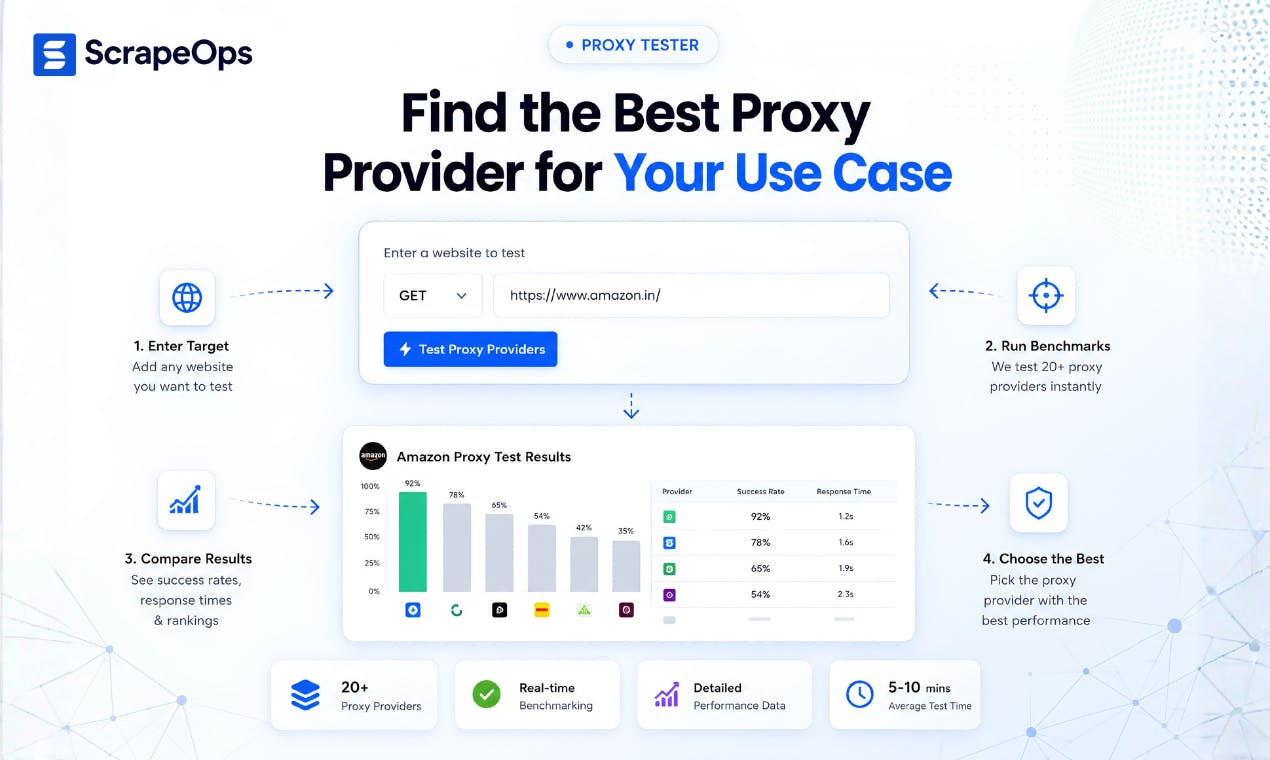
According to its Product Hunt listing, ScrapeOps Proxy Tester is a proxy benchmarking platform designed for developers, scraping teams, data service providers, SaaS companies, and even AI Agents. Its positioning is crystal clear: help users make proxy infrastructure decisions backed by real data, rather than relying on provider marketing rhetoric.
The product earned 104 upvotes on Product Hunt, ranked #5 for the day, and was categorized under API, SaaS, and Developer Tools.
How It Works
The workflow is straightforward: users simply submit a target URL (the website they actually want to scrape), and the platform tests over 20 different proxy configurations against that specific target, covering mainstream types including residential proxies, datacenter proxies, mobile proxies, Proxy APIs, and Unblockers.
This "target-specific" testing approach is the product's essence. It doesn't give you a generic leaderboard—instead, it tells you: for this specific website of yours, which proxy configuration performs best.
What Key Metrics Does Proxy Tester Measure?
Proxy Tester's benchmarking goes far beyond a single success rate metric, providing real-world quantitative assessment across multiple dimensions:
- Success Rate: The proportion of real requests that successfully retrieve data—the most critical reliability indicator. It's worth noting that professional success rate evaluation can't rely solely on HTTP status codes—some websites return 200 status codes but with empty page content or honeypot pages. True success means obtaining valid, complete target data.
- Latency: Request response speed, which directly impacts the efficiency of large-scale collection. For systems that need to scrape millions of pages daily, saving 100ms per request means reducing total time by dozens of hours.
- Reliability: Consistent performance during sustained use, including connection timeout rates, disconnection rates, etc. This determines whether your scraping system needs frequent exception handling and retry logic.
- Bandwidth: Data transfer capacity, which is especially critical when downloading large amounts of page content or media files.
- Estimated Cost: A cost-effectiveness reference combining all the above metrics.
Methodological Considerations for Benchmarking
It's worth mentioning that the reliability of proxy benchmarks depends on several methodological factors. First is sample size—a single request's result may be affected by network fluctuations, and only a sufficient number of request samples can yield statistically significant conclusions. Second is the choice of testing time periods, as many websites' anti-bot strategies differ across time slots (e.g., peak hours vs. early morning). Third is whether the test request patterns simulate real scraping behavior (such as concurrency levels, request intervals, page depth), since anti-bot systems typically make comprehensive judgments based on behavioral patterns. These details determine the practical reference value of benchmark results.
Ultimately, the platform generates a ranking tailored to your specific use case based on these real measurements. This means developers can make data-backed decisions based on their budget and performance requirements, rather than burning money through trial and error.
Why This Proxy Testing Tool Deserves Attention
Shifting from "Marketing Rhetoric" to "Real-World Data"
The proxy services industry has long suffered from information asymmetry. Providers' advertised numbers are often measured under ideal conditions or against the easiest-to-scrape websites. When developers deploy in production, they discover performance falls far short of expectations. Proxy Tester puts decision-making power back in the hands of data itself, which has real significance for reducing trial-and-error costs.
Meeting Proxy Needs in the AI Agent Era
One notable detail: the product description specifically mentions "AI Agents" as a target user group. As autonomous AI agents increasingly need to access and collect web data, stable and reliable proxy infrastructure has become a critical requirement.
This need stems from the rapid evolution of current large language model (LLM) application architectures. In paradigms like RAG (Retrieval-Augmented Generation), Agent frameworks (such as LangChain, AutoGPT, CrewAI), and MCP (Model Context Protocol), AI systems need real-time internet access for the latest information rather than relying solely on training data. These AI Agents may need to continuously access dozens or even hundreds of web pages while executing complex task chains, all in an automated, unattended manner. The emergence of commercial AI Agent products like OpenAI's Operator and Google's Project Mariner further drives demand for high-quality web access infrastructure.
AI Agents can't debug repeatedly like humans during task execution—once a step fails due to proxy issues, the entire task chain may need to restart from scratch. Therefore, using data to pre-select optimal proxy configurations is crucial for improving automated task success rates. This reflects the product team's keen grasp of future trends.
Cost Optimization Value for Scraping Teams
For data service providers and large-scale scraping teams, proxy costs are often the largest operational expense. Take a typical e-commerce price monitoring system—needing to scrape 1 million product pages daily, if each page averages 500KB, residential proxy bandwidth costs alone could reach $5,000-7,500 per day. But if benchmarking reveals that datacenter proxies can also achieve 90%+ success rates on specific targets, costs could drop by an order of magnitude. Proxy service pricing models typically fall into three categories: bandwidth-based billing (common for residential proxies), per-request billing (common for Proxy APIs), and subscription-based per-port/IP pricing (common for datacenter proxies)—different models have dramatically different cost implications for different scraping scenarios.
Through Proxy Tester's cost estimation feature, teams can select the most cost-effective solution while ensuring adequate success rates, avoiding paying premium prices for redundant high-end proxy performance.
Conclusion: Replacing Guesswork in Proxy Selection with Real Data
The value of ScrapeOps Proxy Tester isn't in technical complexity—it's in precisely hitting a real but often overlooked pain point in scraping development: the blindness of proxy selection. Through multi-dimensional real-world testing against specific target URLs, it transforms what was once a decision based on experience and luck into a data-driven engineering problem.
Of course, as a relatively novel tool, its actual test coverage, data accuracy, and adaptability to complex anti-bot scenarios still need long-term validation from more users in production environments. For example, whether test results remain consistent across different time periods, whether they reflect true performance under high-concurrency scenarios, and how large the gap is between test and production environments—these are all issues worth monitoring. But from a product philosophy standpoint, the direction of "replacing generic marketing claims with real benchmark data" is undoubtedly correct. For any team or developer deeply reliant on web data collection, this tool is at minimum worth adding to your evaluation toolkit.
Key Takeaways
Related articles

From OpenCV to Industrial-Grade Vision: An Advanced CV Learning Path and Practical Guide
A complete advanced path from mastering OpenCV and YOLO basics to building industrial-grade computer vision systems, covering deep learning, custom model training, real-time inference, edge deployment, and spatial perception.

ros2_control Closed-Loop Feedback in Practice: Encoder and PID Control Explained
How ros2_control combines encoder feedback with chained PID controllers for closed-loop motion control, covering motor driving, encoder reading, and differential drive configuration for precise ROS 2 navigation.

SJTU's ARIS Framework: Making Research Agents Reliably Conduct Autonomous Science
Shanghai Jiao Tong University releases ARIS framework for reliable end-to-end research automation. Self-review loops, score thresholds, and human-in-the-loop design solve AI agent drift problems.