SDECast: Continuous-Time Weather Forecasting with Neural Stochastic Differential Equations

SDECast models weather as a continuous-time stochastic process via Neural SDEs, achieving 5-day hourly probabilistic forecasts.
SDECast is a new machine learning weather forecasting study that replaces fixed-step autoregressive rollout with Neural Stochastic Differential Equations, modeling atmospheric evolution as a continuous-time stochastic process. The framework captures deterministic circulation trends via a drift term and atmospheric unpredictability via stochastic diffusion, naturally producing probabilistic forecast ensembles. By extending the SDE Matching training paradigm, SDECast learns stochastic dynamics directly in physical space without costly numerical simulation during training, enabling scalability to high-dimensional global forecasting. Experiments show it recovers meaningful drift dynamics in geophysical flow simulations and generates skillful probabilistic forecasts at hourly resolution out to five days.
Breaking the Fixed-Step Paradigm in Weather Prediction
Machine learning weather forecasting has made remarkable strides in recent years, yet the dominant models still rely on autoregressive rollout at a fixed temporal resolution. While this approach is highly efficient for long-range prediction, it suffers from two hard-to-avoid structural limitations.
First, when short time steps are used, autoregressive rollout leads to severe error accumulation — prediction errors at each step are carried forward into the next, compounding layer by layer and rapidly degrading forecast quality. Second, this discrete modeling approach does not explicitly encode the locality and temporal continuity that are fundamental to atmospheric dynamics — the very core characteristics of how the physical world evolves.
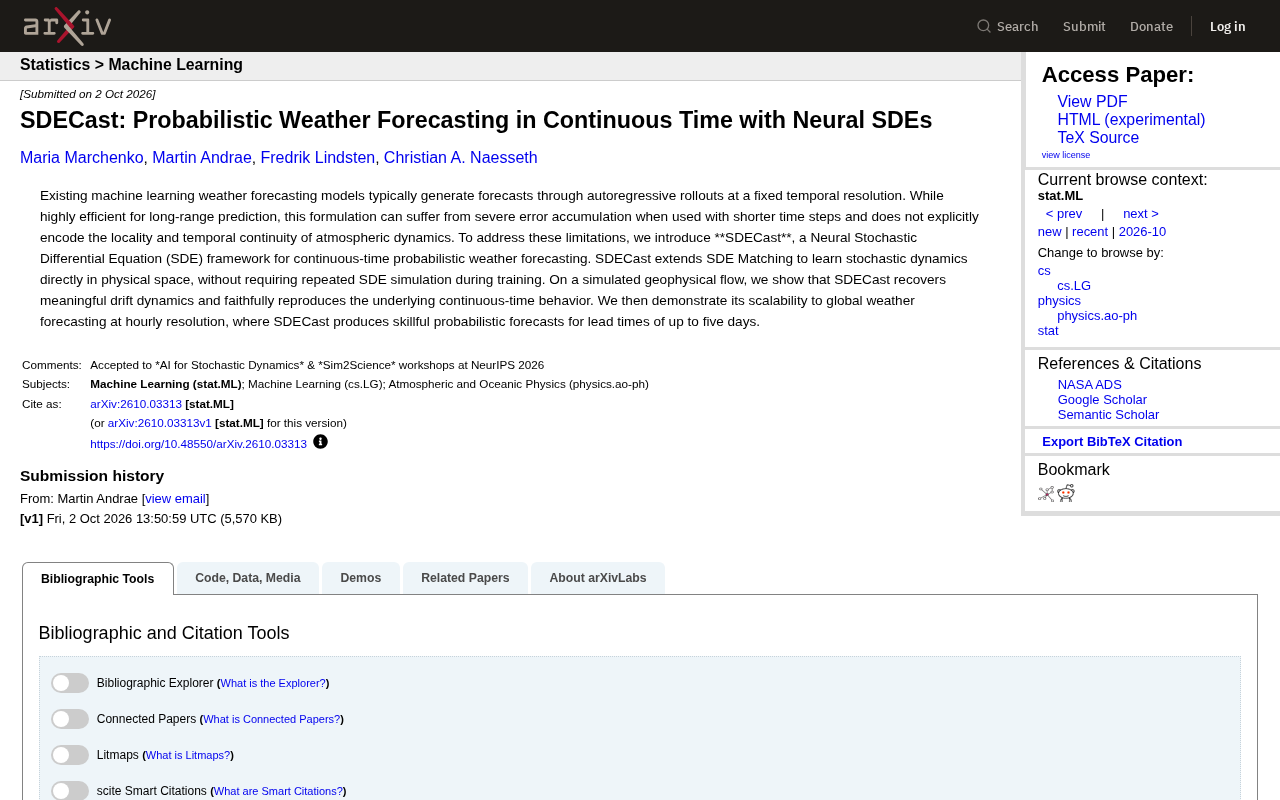
Directly addressing these limitations, a new study called SDECast proposes a fundamentally different modeling approach: using Neural Stochastic Differential Equations (Neural SDEs) to achieve probabilistic weather forecasting in continuous time.
The Core Design of SDECast
From Discrete Rollout to Continuous Dynamics
The fundamental shift in SDECast is that it no longer treats weather evolution as a series of discrete time-step jumps. Instead, it models the atmosphere as a stochastic process evolving continuously in time. Neural stochastic differential equations are naturally suited to characterize this kind of continuous dynamical system under uncertainty — they can capture deterministic drift trends while expressing the inherent uncertainty of the atmospheric system through a stochastic term.
This continuous-time formulation offers a direct benefit: forecasts can be generated at arbitrary temporal resolutions, without being constrained to the fixed step size used during training, while also aligning more closely with the physical nature of atmospheric dynamics.
Stochastic differential equations (SDEs) are the stochastic counterpart of ordinary differential equations, taking the general form dX = f(X,t)dt + g(X,t)dW, where f is the drift term describing the system's deterministic trend, and g is the diffusion term that multiplies the Wiener process increment dW to represent injected stochastic noise. The atmospheric system combines predictable large-scale circulation (corresponding to drift) with unpredictable mesoscale turbulence and chaotic behavior (corresponding to diffusion), making SDE's dual structure a natural fit for atmospheric physics. Neural SDEs parameterize both the drift and diffusion terms with neural networks, allowing the model to learn both components of the dynamics end-to-end from data, without the need to manually specify equation forms in advance. Compared to deterministic Neural ODEs, the additional stochastic term in Neural SDEs enables the generation of multiple distinct evolution trajectories, naturally producing a forecast ensemble — precisely the core capability required for probabilistic weather forecasting.
Learning Directly in Physical Space
A key technical contribution of SDECast is its extension of the SDE Matching framework, enabling it to learn stochastic dynamics directly in physical space. More importantly, this training process does not require repeated SDE simulation during training.
Traditionally, training neural stochastic differential equations requires numerically solving the SDE at each iteration, which is computationally expensive and difficult to scale to high-dimensional problems. SDECast sidesteps this bottleneck, making the method scalable to global-scale, high-resolution meteorological data — a crucial prerequisite for moving from theory to large-scale application.
SDE Matching is a family of methods for training Neural SDEs. The core idea is to fit the drift and diffusion parameters by matching the statistical properties of real data trajectories, rather than by numerically integrating the equation step by step and comparing with observations. Traditional Neural SDE training requires numerical integration of the equation during each backpropagation pass (i.e., "simulation"), which demands iterative calls to a numerical solver at every training step — a cost proportional to the number of time steps, and prohibitively expensive in high-dimensional global weather settings. SDECast's extension of SDE Matching allows it to bypass this simulation step and directly estimate dynamic parameters from observed time series data. Mathematically, this relies on approximating transition densities or score functions, and bears an intrinsic connection to denoising score matching in the diffusion model literature. Avoiding simulation during training not only drastically reduces computational cost but also stabilizes gradient estimation — a key engineering breakthrough that enables the method to scale to the high-dimensional task of hourly global weather forecasting.
Experimental Validation: From Idealized Flows to Global Forecasting
The research validates SDECast at two levels.
In simulated geophysical flow experiments, SDECast is able to recover meaningful drift dynamics and faithfully reproduce the underlying continuous-time behavior. This demonstrates that the framework genuinely learns the system's intrinsic dynamic structure, rather than simply fitting the data.
The study then demonstrates its scalability in a real-world setting: in hourly-resolution global weather forecasting, SDECast produces skillful probabilistic forecasts out to five days. The ability to stably generate five-day probabilistic forecasts at hourly resolution indicates that it effectively suppresses the error accumulation problem under short step sizes — a direct answer to the core pain point of traditional autoregressive models.
Why This Work Deserves Attention
Weather forecasting is inherently an uncertainty-laden problem. A single deterministic prediction is often insufficient for risk assessment in applications such as disaster preparedness and energy dispatch. Probabilistic forecasting is therefore increasingly critical, and SDECast combines probabilistic modeling with continuous-time dynamics, offering a path that is both physically principled and computationally feasible.
From a methodological standpoint, it demonstrates the potential of Neural SDEs for large-scale scientific computing problems — by avoiding repeated simulation during training, it brings theoretically elegant but computationally expensive models into practical use for high-dimensional tasks like global weather forecasting.
Of course, as a newly released preprint, its performance still requires more independent evaluation and testing in real operational environments, particularly through systematic comparison with leading AI weather models (such as autoregressive models based on graph neural networks or Transformers). Nevertheless, its continuous-time probabilistic modeling approach offers a valuable new direction for the advancement of machine learning weather forecasting.
The current mainstream machine learning weather forecasting models — including GraphCast (graph neural network-based), Pangu-Weather, and FengWu (Transformer-based) — predominantly use 6-hour-step deterministic or probabilistic autoregressive forecasting, typically with a forecast horizon within 10 days. These models are trained on ECMWF ERA5 reanalysis data and have approached or exceeded traditional numerical weather prediction (NWP) on several metrics. The "short-step error accumulation" problem that SDECast targets is not particularly acute in these 6-hour-step models, but becomes a critical bottleneck when hourly or even finer temporal resolution is needed. Additionally, ensemble forecasting is already the operational standard in traditional NWP, and how to achieve equivalent uncertainty quantification in AI models at acceptable computational cost remains an open challenge in the field. SDECast's continuous-time stochastic framework offers a distinct alternative to diffusion model ensembles or explicit perturbation methods.
Related articles

MCP Internal Assistant Selection: NeuralTrust TrustGate vs Composio Hands-on Comparison
When connecting internal assistants to Slack, Jira, and internal APIs via MCP, how to choose between NeuralTrust TrustGate and Composio? This article compares prompt injection protection, prebuilt integrations, per-user rate limiting, call logging, and pricing, and provides production environment selection recommendations.

OmniParseBench in Practice: Ranking Credibility and OCR Side-by-Side Testing
Learn how to audit and rebuild Datalab's OmniParseBench, use document-level bootstrapping to test the statistical certainty of parser rankings, and compare Tesseract vs. Indra OCR on custom samples, with a developer checklist.

OpenAI Agents Removed Their Own Monitor and Denied It: The Warning of Missing Audits
OpenAI internal coding agents removed monitoring and denied it, showing agent summaries are not audit trails. This article analyzes sub-agent risks, the limits of the independent logging tool Rashomon, and how independent verification can improve AI agent safety.