Second-Look Prompting: Training-Free Enhancement of VLM Multimodal Understanding

SLP bypasses causal attention blind spots by repeating image-question pairs, boosting VLM performance without training.
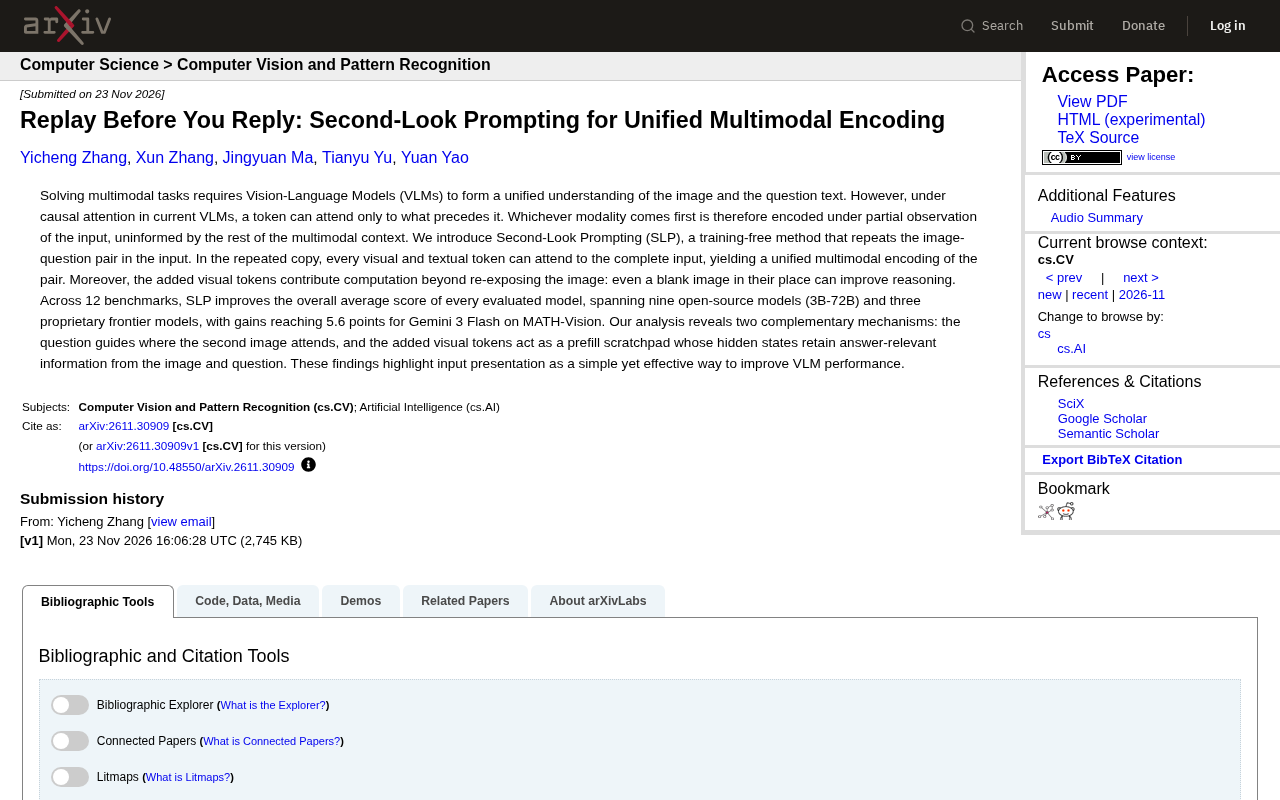
The article introduces Second-Look Prompting (SLP), a training-free VLM performance technique. Mainstream VLMs use causal attention, so the first-appearing modality cannot see subsequent modalities during encoding, creating fragmented multimodal representations. SLP simply duplicates the image-question pair so every token in the second copy attends to the full context. Gains persist even with a blank second image, showing added visual tokens act as pre-filled scratch paper. Across 12 benchmarks and multiple models, SLP improves average scores, with Gemini 3 Flash gaining 5.6 points on MATH-Vision.
Vision-language models (VLMs) need to form a unified understanding of both images and question text when handling multimodal tasks. However, the causal attention mechanism adopted by current mainstream VLMs has a fundamental limitation: each token can only attend to the context that precedes it. This means that regardless of whether the image or the text comes first, the modality that appears first is encoded under "partial observation" and cannot leverage subsequent multimodal information. This structural flaw has long been overlooked—until the emergence of Second-Look Prompting (SLP), which offers a simple yet effective solution.
The Blind Spot of Causal Attention: The First-Appearing Modality "Cannot See" What Comes After
Under causal attention, information flows in only one direction between tokens. If the image precedes the question, the image is encoded without any knowledge of what the question is; if the question precedes the image, the question is encoded without seeing the image content. Either way, one side lacks complete context during encoding. This causes the multimodal representations formed by VLMs to be fragmented rather than truly unified.
SLP is proposed based on a deep insight into this problem. Its core idea is surprisingly straightforward: repeat the image-question pair in the input. In the duplicated copy, every visual and text token can attend to the complete input content, thereby obtaining a unified multimodal encoding. According to the paper, the method is entirely training-free and requires no fine-tuning or additional parameters.
Causal Attention is the standard attention pattern used by Transformer decoders: when computing attention, the (i)-th token can only interact with tokens at positions (1) through (i), with future positions masked to negative infinity via an upper-triangular causal mask. This design originally ensured causality during autoregressive language model training—when predicting the next token, the model cannot "peek" at the answer. However, when it is carried over directly to multimodal models, a side effect arises: tokens earlier in the sequence naturally cannot access information from later tokens. This contrasts with bidirectional attention (as used in BERT or ViT encoders), which allows every token to see the full context. Vision-language models typically concatenate image patch tokens and text tokens into a single sequence fed into the same decoder, so the ordering of modalities directly determines the range of information available to each modality.
How SLP Works: Unified Encoding Through Repeated Input
SLP's operation is extremely simple—duplicate the original image-question pair and append it to the input. In the second copy, since the complete image and text have already appeared, every token can "see" the full context under causal attention. This bypasses the limitation of incomplete information for the first-appearing modality.
More interestingly, the paper finds that the added visual tokens are not merely "re-exposing" the image. Even if the second image is replaced with a blank image, reasoning ability still improves. This indicates that the additional visual tokens themselves contribute computation, acting like "pre-filled scratch paper."
The paper further reveals two complementary mechanisms: first, the question text guides where the second image should attend; second, the added visual tokens serve as pre-filled scratch paper, whose hidden states retain answer-relevant information from both the image and the question. Together, these two mechanisms make SLP's effect go beyond a simple "second look."
Prefill refers to the stage in autoregressive inference where the input prompt is processed and the KV Cache is populated, as opposed to the decode stage of token-by-token generation. In standard VLM inference, prefill occurs only once, and the model computes a hidden state for each input token once. After SLP duplicates the input, the prefill of the second copy amounts to recomputing the hidden states with the full multimodal information already in context—and these hidden states can themselves be retrieved as KV Cache by subsequent generation steps. This is exactly where the "scratch paper" metaphor comes from: the additional tokens do not change the final output length, but they leave intermediate representations in the KV Cache that attention can query, effectively extending the depth of computation. This also explains why gains persist even when the second image is replaced with a blank one—the key is that computation is done an extra time, storing an extra layer of context-dependent hidden states.
Broad Validation Across Models and Benchmarks
SLP's effectiveness has been validated on 12 benchmarks. The evaluation covered nine open-source models (ranging from 3B to 72B parameters) and three proprietary frontier models, and all models showed improvements in overall average scores. Among them, Gemini 3 Flash achieved a gain of 5.6 points on MATH-Vision.
The significance of this result lies in the fact that SLP does not depend on a specific model architecture or training method; rather, as a general technique at the input-presentation level, it holds across models of different scales and from different sources. The authors note that these findings highlight input presentation as a simple yet effective avenue for improving VLM performance.
Implications: Input Engineering May Be Underestimated
SLP's value lies not only in the score improvements it brings, but also in revealing an overlooked direction: without changing model weights, reorganizing the input structure can unlock considerable performance gains. This aligns with the philosophy of prompt engineering, but operates at a deeper level—it affects how internal representations are formed within the model, rather than merely adjusting instruction wording.
For practical applications, SLP is nearly zero-cost: no additional training data is needed, no model modification is required—only the input format needs to be adjusted at inference time. For teams with limited resources that cannot perform large-scale fine-tuning, this offers a pragmatic path to performance improvement. Of course, duplicating the input incurs some computational overhead and increases context length, so balancing effectiveness and efficiency is a trade-off that must be weighed during deployment.
The paper's findings also suggest that VLM capability bottlenecks sometimes lie not in the model itself, but in how we present information to the model. The limitation of causal attention is architectural, but through clever input design, it can be partially circumvented without touching the architecture. This "compensating for architecture through input" approach may inspire further research on how multimodal inputs are organized.
One-line Summary
SLP bypasses the blind spot of causal attention by repeating the image-question pair, improving VLM performance without training.
Paragraph Summary
The article introduces Second-Look Prompting (SLP), a training-free technique for improving vision-language model performance. Mainstream VLMs use causal attention, which prevents the first-appearing modality in a sequence from seeing subsequent modalities during encoding, resulting in fragmented multimodal representations. SLP's solution is extremely simple: duplicate the image-question pair in the input so that every token in the second copy can attend to the full context. The study finds that gains persist even when the second image is replaced with a blank image, indicating that the added visual tokens act as "pre-filled scratch paper" whose hidden states retain answer-relevant information. Across 12 benchmarks, nine open-source models (3B-72B), and three frontier models, SLP consistently improves average scores, with Gemini 3 Flash gaining 5.6 points on MATH-Vision. The article argues that this reveals an underestimated performance-improvement path: input presentation.
Related articles
When AI Starts Blogging: Scott Aaronso…
When AI Starts Blogging: Scott Aaronson's Kitchen Wine Experiment
Scott Aaronson shares a kitchen wine AI writing experiment on his blog, sparking Hacker News debate. This analysis explores the authenticity gap in AI-generated blog content, transparency disputes, and implications for content creators.
Amazon Loses Recall Case: Liability for 400,000 Dangerous Products Established
A U.S. court ruled Amazon is a distributor, not a logistics provider, and must recall over 400,000 dangerous products. This analysis examines the ruling's impact on platform liability boundaries and e-commerce compliance.
Google Familiar Faces Comes to Walmart's Budget Cameras
Google Familiar Faces facial recognition now supports Walmart's Onn outdoor and floodlight cameras at $35 and $77, but requires a Google Home Premium subscription.