Secret Key: An Open-Source Password Inheritance Solution for Emergency Family Access

Open-source Secret Key uses password sharding, SMS verification, and a 48-hour delay to enable emergency vault access.
Secret Key is an open-source, self-hosted tool that gained traction on Product Hunt, addressing the digital legacy problem of password managers' single point of failure. It splits the master password into shards via secret sharing—e.g., 3-of-5—so any 3 trusted people can collaborate to recover it. Unlocking also requires SMS verification and a 48-hour delay with one-click cancellation, balancing emergency access and everyday security. Open source and self-hosting enable auditability and independence from third-party servers but add operational overhead. It suits technically capable users who value digital legacy planning, though SMS fragility and delay limits in extreme emergencies remain trade-offs.
When you lose a loved one, digital legacy often becomes a difficult problem. Keys, accounts, and cryptocurrencies stored in password managers may lie dormant forever. An open-source tool on Product Hunt called Secret Key attempts to solve this: it lets you split your master password into multiple shards and entrust them to trusted family members, enabling collaborative unlocking of your password vault in emergencies.
Why an "Emergency Access" Feature Is Needed
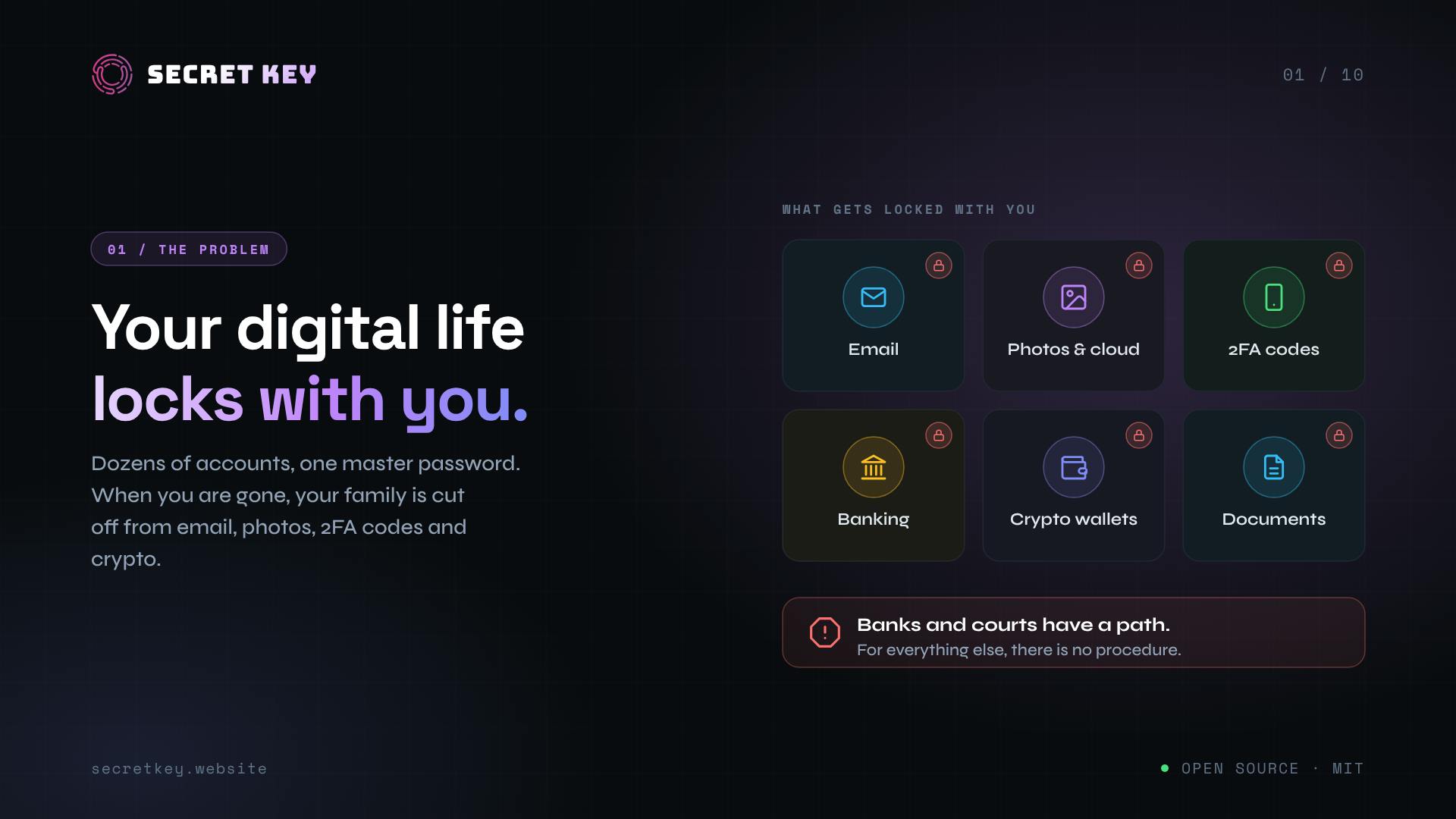
Password managers protect privacy, but they also create a single point of failure. If someone passes away suddenly or becomes incapacitated, family members often cannot access critical accounts—or may not even know the password vault exists. Secret Key's premise is clear: add a secure, controllable emergency channel to the password vault without sacrificing everyday security.
This tool received 74 votes on Product Hunt, ranking 9th for the day, with tags including open source, privacy, and security. For a tool targeting a niche use case, this result reflects growing attention to digital legacy management.
Password Sharding: A 3-of-5 Trust Mechanism
At the core of Secret Key is a cryptographic secret sharing scheme. You split your master password into multiple shards and distribute them to people you trust. For example, you can designate 5 people to hold shards, and any 3 of them can combine theirs to recover the master password. This avoids single-point trust risk—no one can unlock alone, and recovery won't fail just because a few individuals become unreachable.
This mechanism is common in key escrow scenarios, but Secret Key brings it to the realm of personal password management. Self-hosting means the shards and verification process are entirely under your control, without relying on third-party servers.
Secret sharing is an umbrella term for a class of cryptographic protocols, the most famous implementation being Shamir's Secret Sharing (SSS), proposed by Adi Shamir in 1979. The principle is to encode a secret value (such as a master password) as the constant term of a high-degree polynomial, then evaluate it at different points to obtain multiple shares. As long as the number of collected shares reaches a preset threshold (e.g., 3), the polynomial can be reconstructed via Lagrange interpolation and the secret recovered; with fewer than the threshold, no information about the secret can be obtained. The 3-of-5 scheme used by Secret Key falls into this category. Unlike simply "cutting a password into pieces and concatenating them," secret sharing guarantees in an information-theoretic sense that any combination of fewer than the threshold number of shares leaks no information—so even if some holders are coerced or their shares leak, overall security still holds.
Double Protection: SMS Verification and a 48-Hour Delay
Sharding alone is not enough. Secret Key adds two key layers of protection:
- SMS verification: Unlock requests require an SMS verification code, ensuring the initiator actually holds the bound phone number.
- 48-hour delay: Unlocking does not take effect immediately but has a 48-hour waiting period. During this time, you can cancel the request with one click.
This means that even if an attacker obtains some shards, they still need to pass SMS verification, and cannot succeed immediately after you receive the notification. The 48-hour window gives you ample reaction time, balancing emergency access with everyday security.
SMS OTP as a second factor has come under increasing scrutiny in recent years. SMS is transmitted in plaintext and can be hijacked via SIM swapping attacks—where attackers use social engineering to trick carriers into transferring the victim's phone number to a SIM card they control, thereby receiving verification codes. In addition, issues such as phone numbers being recycled and reassigned or SMS delays while roaming can affect reliability. Therefore, in security practice, SMS verification is generally regarded as a "weak second factor," with TOTP (time-based one-time password) apps or hardware security keys being preferred. Secret Key's use of SMS verification lowers the barrier to use, but users should be aware that this step is not impregnable—especially in high-value scenarios where additional safeguards are needed.
The Significance of Open Source and Self-Hosting
Secret Key is built by developer Mateusz Karpierz and follows an open-source model, with auditable code. For security tools, open source means trust does not depend on vendor claims but on verifiable code. Self-hosting avoids the risk of cloud providers leaking data or shutting down.
However, self-hosting also brings operational burden—you need to deploy and maintain the service yourself and ensure its availability. For family users with weaker technical backgrounds, this may be a barrier.
"Open source and auditable" has a concrete meaning in security: anyone can download the source code and check for backdoors, logic flaws, or key-leakage paths; security researchers can also independently reproduce the build process to verify that the released binaries match the source code (reproducible builds). But this does not mean open-source software is automatically secure—auditing requires expertise and time investment, and in practice many open-source projects receive insufficient review. Self-hosting means users run server software on their own servers or devices, with data not passing through third parties. Its advantage is that data sovereignty belongs entirely to the user; its drawbacks include having to handle backups, updates, firewall configuration, and availability monitoring yourself. Once the server goes down or is misconfigured, the emergency access process may fail exactly when it is most needed.
Use Cases and Limitations
Secret Key suits users who value digital legacy planning and have some technical ability. You can distribute shards to a spouse, adult children, or a lawyer and set the unlock threshold. But it is not a panacea: SMS verification depends on phone number security, and if the phone is lost or the number is recycled, the process may be blocked. In addition, the 48-hour delay may seem too long in a genuine emergency (such as a medical crisis).
Compared with the emergency access features of commercial password managers, Secret Key's advantages lie in being open source, self-hosted, and shard-controlled. But commercial products usually offer a smoother experience and customer support. Users need to weigh these according to their needs.
Digital legacy planning is a concept that has emerged in recent years, referring to arrangements individuals make during their lifetime for digital assets—including account credentials, cryptocurrency private keys, cloud storage data, social media accounts, and more—so that trusted people can take over after death or incapacity. Traditional wills often do not cover digital credentials, and password managers themselves typically do not provide a standard mechanism for "automatic handover after death." Commercial products such as 1Password's Emergency Access and Bitwarden's emergency access feature allow designated contacts to request access and gain permission after a waiting period, but they rely on vendor servers. Secret Key's sharding scheme disperses trust among multiple people, avoiding a single vendor or single contact becoming a point of failure, but the cost is a more complex process and the need for advance coordination among people and technical deployment.
Conclusion
With cryptographic sharding and a delay mechanism, Secret Key offers a noteworthy approach to digital legacy management. It does not chase the mass market but serves those willing to take extra steps for security. For users who care about privacy and self-control, this open-source project is worth a look.
One-line Summary
Open-source tool Secret Key uses password sharding, SMS verification, and a 48-hour delay to provide an emergency access channel for password vaults.
Paragraph Summary
Secret Key is an open-source, self-hosted tool that gained attention on Product Hunt, designed to solve the digital legacy problem caused by password managers' "single point of failure." It splits the master password into multiple shards via a secret sharing scheme and entrusts them to trusted people—for example, under a 3-of-5 mechanism, any 3 people can collaborate to recover the master password. The unlock process adds SMS verification and a 48-hour delay, during which the request can be canceled with one click, balancing emergency access with everyday security. Open source and self-hosting make the code auditable and independent of third-party servers, but also introduce operational barriers. The tool suits users with some technical ability who value digital legacy planning, but the fragility of SMS verification and the limitations of the delay in extreme emergencies still need to be weighed.
Related articles

VERS: Editing Activation Explanations to Halve Reasoning Model Tokens
VERS guides reasoning models by editing activation explanations, cutting 45.8% of tokens on GSM8K with only a 0.82 pp accuracy drop and transferring to larger models, but losing accuracy on competition problems.

Finding Errors Is Not Enough: Selective Model Escalation for Entity-Targeted Sentiment Analysis
This study explores selective model escalation for entity-targeted sentiment analysis, comparing data collection ordering, uncertainty-driven re-examination, and model routing—finding that minority-class priority only helps at very small data volumes, the oracle upper bound far exceeds actual gains, and escalation must be tailored to each dataset.

WAS-PO: Using Whitened Advantages to Solve the Correlation Trap in Multi-Reward Reinforcement Learning
WAS-PO paper proposes whitening advantages to correct correlation bias in multi-reward RL: when rewards are correlated, naive weighted summation effectively applies Σ^{1/2}w instead of w. Experiments show training reward improves steadily, but held-out accuracy does not improve in sync, and under two rewards it actually falls behind.