Segue: A Deep Dive into the Cross-Platform AI Conversation Context Migration Tool

Segue enables seamless AI conversation context transfer across platforms via short handles.
Segue is a new tool that addresses the pain point of losing conversation context when switching between AI platforms like ChatGPT and Claude. It works by saving conversation context and generating a short handle that can be referenced in any other AI tool to restore the full context. The article explores its working mechanism, the importance of AI interoperability and data sovereignty, and challenges including semantic consistency across models, privacy concerns, and ecosystem coverage.
An Overlooked AI Usage Pain Point
Today, many people navigate between multiple AI tools in their daily workflows: using ChatGPT to organize thoughts, Claude to draft documents, and other specialized models for specific tasks. However, every platform switch means a "context reset" — you need to re-explain the background, paste previous conversations, and restate project details. This repetitive labor is not only inefficient but also prone to missing critical information.
To understand the technical root of this pain point, you need to understand the "context window" mechanism of large language models. The context window is the maximum number of tokens a model can process in a single inference — GPT-4 Turbo supports 128K tokens, and Claude 3.5 supports 200K tokens. But the context window only addresses capacity for a single conversation; cross-session and cross-platform memory depends entirely on each platform's proprietary implementation. ChatGPT's Memory feature automatically extracts user preferences from conversations and persists them, while Claude's Projects allows users to upload documents as persistent context — these solutions are all platform-exclusive, creating de facto data lock-in.
Segue, which recently appeared on Hacker News as a "Show HN" post, targets precisely this pain point. Show HN is a dedicated section of Y Combinator's tech community where founders and developers can showcase projects they're building and receive community feedback — early-stage companies like Dropbox and Stripe once gained initial attention through this mechanism. Segue's core concept is straightforward: save conversation context in one AI and load it in another through a short handle. While it currently has modest traction (8 points, 6 comments), the problem it addresses is a real frustration for many heavy AI users.
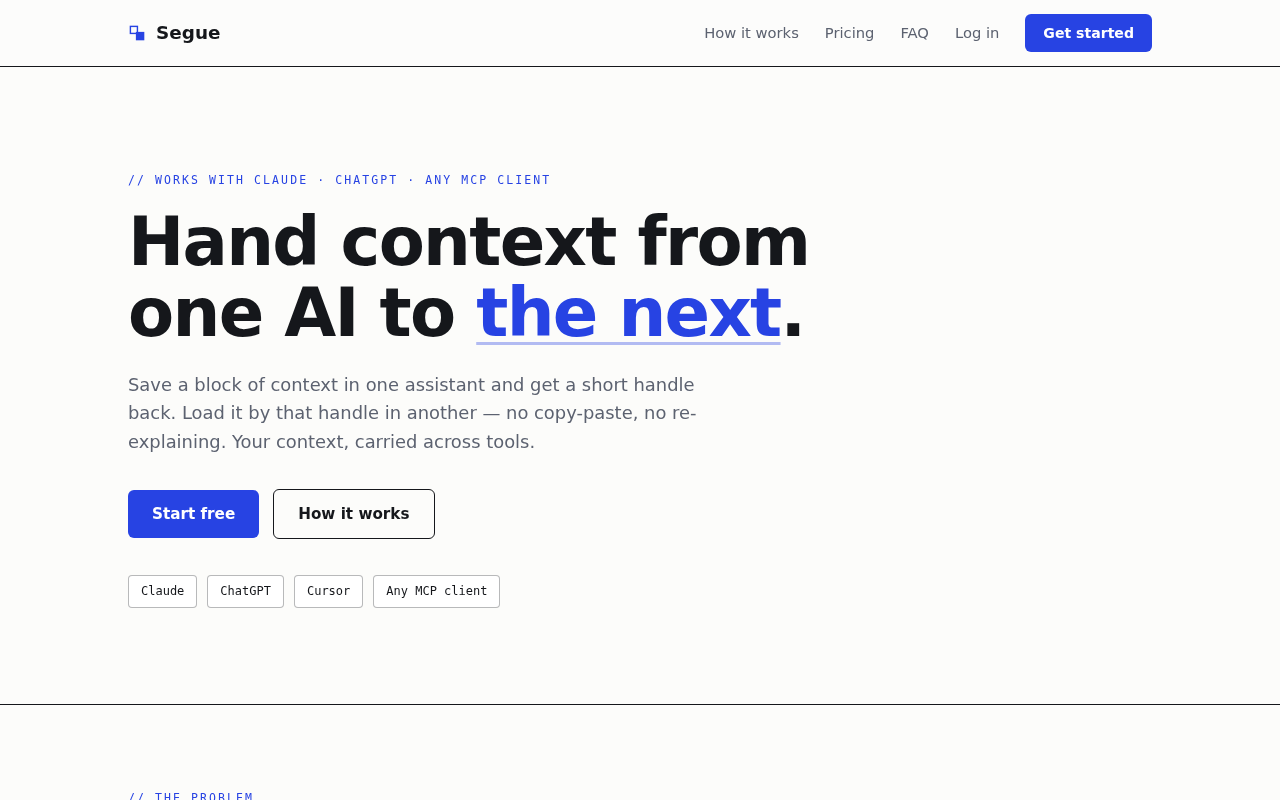
How Segue Works: Transferring Context via Short Handles
Core Mechanism Explained
Segue's design logic can be understood as a "clipboard for context." When you complete a valuable conversation on an AI platform, you can save that context, and the system generates a short identifier (handle). Then, regardless of which AI tool you switch to, you simply reference that handle to "load" the complete previous context into your new conversation.
The elegance of this design lies in replacing cumbersome copy-pasting with lightweight references. Under the traditional approach, migrating context across platforms means manually transferring large blocks of text — not only tedious but often distorted by length limits or formatting issues. Through a short handle, users can seamlessly continue their train of thought across different tools, achieving a truly "uninterrupted transition" — which is exactly what the product name "Segue" (a musical term meaning seamless transition) signifies.
Positioned for Multi-AI Workflows
Segue's value proposition clearly targets the "multi-AI usage" pattern that's rapidly becoming mainstream. As different vendors' models excel at specific tasks — for example, GPT-4o excels in multimodal understanding, Claude has unique advantages in long-form writing and code analysis, and Gemini is unmatched in Google ecosystem integration — an increasing number of professional users no longer rely on a single platform but flexibly choose tools based on task requirements. This fragmented usage pattern creates new demands for context management, and Segue aims to become the bridge connecting these isolated islands.
Why AI Context Interoperability Matters
The "Walled Garden" Phenomenon of AI Tools
There's an obvious ecosystem closure among current mainstream AI products — each platform's conversation history, memory features, and project context are locked within their respective systems. ChatGPT has its own memory system, Claude has its Projects feature, but they're virtually unable to communicate with each other. This means users' knowledge and context are fragmented across different services.
Interoperability is not a new demand in the software industry. In messaging, the Matrix protocol and the EU's Digital Markets Act (DMA) are already pushing for interoperability between WhatsApp, iMessage, and other platforms; in file formats, the OpenDocument Format (ODF) was an important standard countering Microsoft Office's proprietary formats; in identity authentication, OAuth and OpenID Connect enable cross-platform single sign-on. What Segue does is essentially attempt to establish a similar interoperability layer for AI conversations — a cross-platform context exchange protocol.
The approach Segue represents is actually filling this interoperability gap. It doesn't try to replace any AI platform but acts as a neutral "context layer," giving users stronger portability and control over their conversation data. In the long run, this concept of "portable context" could become an important infrastructure direction in the AI tool ecosystem.
Users' Demand for AI Data Sovereignty
This product also reflects users' growing concern about data sovereignty. When context is bound to a closed platform, users are effectively subject to the platform's storage policies, privacy policies, and migration barriers. An independent context management tool allows users to autonomously decide when, where, and how to use their accumulated conversation assets.
Data sovereignty is gaining new legal support in the AI era. GDPR grants European users the "Right to Data Portability," but the applicability of this right in AI conversation scenarios remains ambiguous — do users' conversation records with AI constitute user data? Who owns the memory summaries extracted by models from conversations? After the EU AI Act officially took effect in 2024, these questions will be further pushed onto the regulatory agenda. Segue's emergence, in a sense, proactively addresses users' demands for AI data autonomy through technical means and provides a feasible implementation path for potential future regulatory requirements.
Potential Challenges Facing Segue
Semantic Consistency of Context
One of the biggest technical challenges in cross-platform context migration is that different models may interpret the same context differently. Each model's training data, conversational style, and instruction-following capabilities vary, and the same loaded context may produce inconsistent continuation results across different AIs. Ensuring that the context carried by a handle is accurately "restored" on the target platform is a core capability that such tools need to continuously refine.
This challenge has deep technical roots. First, there's tokenization differences — the GPT series uses the tiktoken tokenizer while Claude uses a proprietary tokenization scheme; the same text is segmented into tokens differently, affecting the model's semantic parsing granularity. Second, there are differences in system prompts — each platform has implicit behavioral constraints and role settings that affect how models interpret user-provided context. Additionally, different preference data used during RLHF (Reinforcement Learning from Human Feedback) training leads to systematic differences in response style and reasoning paths for the same instruction. This means Segue can't merely transport text; it may also need to perform some form of "semantic normalization" on context to ensure cross-model consistency.
Privacy and Security Boundaries
Since Segue saves and transfers conversation context, where this data is stored, how it's encrypted, and whether it can be accessed by third parties become questions users must consider. As an intermediary layer handling sensitive conversation content, establishing trustworthy privacy protection mechanisms will be key to its adoption by professional users. Especially for conversations involving trade secrets, code assets, or personal privacy, users need assurance that this data won't become a new leak risk. End-to-end encryption, zero-knowledge architecture, and local-first storage are all privacy protection paths such tools could consider.
Ecosystem Coverage Challenges for an Early-Stage Product
As an early-stage project that just appeared on Hacker News, Segue's success largely depends on how many mainstream AI platforms it can cover and how smooth the integration is. If every use requires cumbersome manual operations, its advantage over direct copy-pasting will be diminished. Ideally, it should be as close to users' existing workflows as possible, achieving "seamless integration."
There's also a practical question: whether mainstream AI platforms will remain open to this kind of third-party context injection. While current platform APIs allow custom system prompts and conversation histories, in consumer-facing products (like the ChatGPT web interface or Claude.ai), the ability for external tools to intervene in conversations is very limited. Segue may need to achieve integration through browser extensions, API middleware, or custom GPT/Claude MCP mechanisms, each path having its own technical constraints and stability risks.
Conclusion
Segue is a small but focused product experiment. It has no grand model ambitions but precisely addresses a real pain point in multi-AI usage scenarios. In today's increasingly fragmented AI tool landscape, "context portability" is likely to evolve from a niche demand into a mainstream necessity. Regardless of whether Segue itself goes far, the direction it points toward — AI interoperability and user data sovereignty — deserves continued attention from the entire industry. For users who switch between multiple AIs daily, a tool like this already delivers tangible value even if it only saves the time spent repeatedly explaining context.
Related articles

Gemini 3.7 Flash Spotted in Google Cloud Console — Launch Countdown Begins
Developers spot Gemini 3.7 Flash in Google Cloud Console, sparking discussion about its relationship to Pro and Google's model distillation strategy.

AI-Memory: Building a Cross-Tool Long-Term Memory System for Coding AIs
AI-Memory is a Rust-based open-source project providing long-term memory for Claude Code, Cursor, Aider and other Agent coding CLIs, enabling seamless handoff between vendors.

Bullet Enters the Stage: YC Newcomer Bets on a Faster Coding Agent
YC S26 startup Bullet launches a speed-focused coding Agent targeting developer latency pain points. Analysis of its differentiation, acceleration techniques, and market opportunity against Cursor and Claude Code.