Selective Auditing: Making AI Decisions Both Reliable and Labor-Efficient

Proposes a selective auditing framework that reviews only suspicious AI decisions, drastically reducing human involvement while keeping error rates under control.
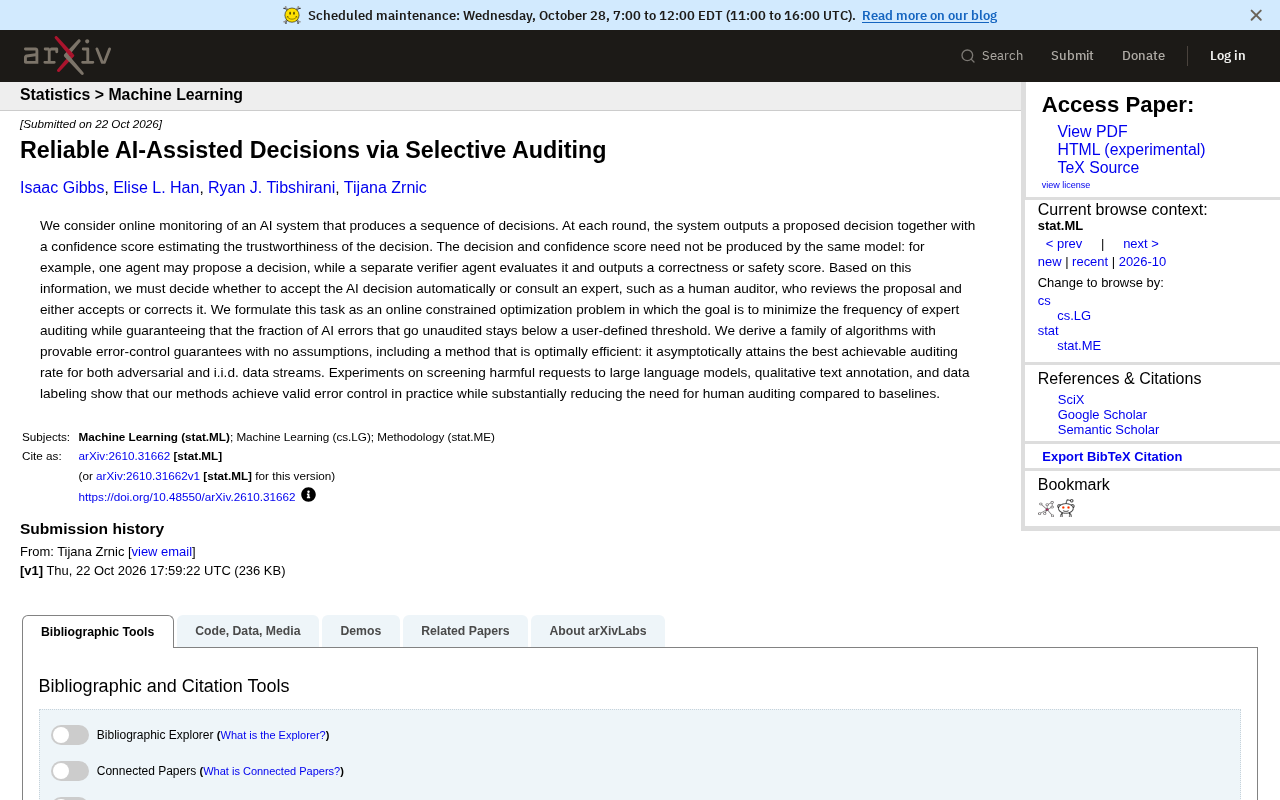
The article introduces a study titled Reliable AI-Assisted Decisions via Selective Auditing, which addresses the dilemma in AI-assisted decision-making—full trust is risky, full manual review is costly—by proposing a selective auditing scheme. Modeled as online constrained optimization, the system decides whether to accept or escalate each AI decision to minimize audit frequency while keeping the unaudited error rate below a user-specified threshold. The authors propose assumption-free algorithms with provable error control guarantees, and experiments show effective error control with significantly reduced human audits.
AI systems are increasingly involved in real-world decision-making, from content moderation to medical assistance—but how can we ensure these decisions are reliable? Fully trusting AI can be risky, while manually reviewing everything is costly. A study titled Reliable AI-Assisted Decisions via Selective Auditing proposes a middle ground: audit only the "suspicious" AI decisions, thereby drastically reducing human involvement while keeping the error rate under control.
The Core Question: When Should We Trust AI?
The study sets up an online decision-making scenario: in each round, the AI system provides a decision recommendation along with a confidence score. This score can come from different models—for example, one agent proposes a decision while another verifier model assesses its correctness or safety. Based on this information, the system must decide whether to accept the AI decision directly or escalate it to a human expert for auditing.
This is essentially an online constrained optimization problem. The goal is to minimize the frequency of expert audits while ensuring that the proportion of unaudited AI errors does not exceed a user-specified threshold. In other words, let the AI run autonomously as much as possible within an acceptable error rate.
Online constrained optimization is a class of optimization problems in which decisions are made sequentially over time, and each decision incurs a constraint cost. Unlike one-shot batch optimization, online constrained optimization requires acting immediately after each round of observation without foreknowledge of future data, so algorithms must balance exploration (gathering information to improve the policy) and exploitation (acting according to the current best policy). Common solution approaches include Lagrange multiplier methods, primal-dual methods, and joint analysis of regret and constraint violation. In this scenario, the "constraint" is that the unaudited error rate must not exceed a threshold, and the "objective" is to minimize the number of audits—together these naturally form an online constrained optimization problem.
Algorithm Design: Assumption-Free Error Control
The authors propose a family of algorithms that provide provable error control guarantees without any assumptions about the data distribution. One of these methods achieves optimal efficiency: it asymptotically attains the best audit rate regardless of whether the data stream is adversarial or independent and identically distributed (i.i.d.).
This "assumption-free" property means the algorithm is more robust in real-world scenarios. Many machine learning methods rely on the i.i.d. assumption, but real data often exhibits distribution shift or adversarial behavior, and this algorithm does not depend on such premises.
The independent and identically distributed (i.i.d.) assumption is one of the most common assumptions in statistical learning theory: all samples come from the same fixed but unknown distribution and are mutually independent. The theoretical guarantees of many machine learning algorithms (such as empirical risk minimization, cross-validation, and confidence interval estimation) are built on i.i.d. However, real data streams often exhibit distribution shift (e.g., user behavior changing with seasons), temporal correlation, or adversarial manipulation. Once the i.i.d. assumption is violated, the original error rate guarantees may fail. Therefore, this paper's emphasis that the algorithm does not rely on i.i.d. means its error control guarantees hold under broader and harsher data conditions—particularly important for real-world deployment.
Adversarial data streams refer to data generated by a malicious or strategic adversary who can observe the algorithm's historical behavior and deliberately construct inputs that cause it to err. Under adversarial settings, any statistical method relying on randomness assumptions can be deceived, so more robust algorithm designs are needed (such as adversarial bandits or the expert advice framework in online learning). The optimal algorithm in this paper can asymptotically achieve the best audit rate under both adversarial and i.i.d. data streams, indicating that its error control does not depend on data being "friendly"—which has practical value in safety-sensitive scenarios (e.g., content moderation where someone deliberately tries to evade detection).
Experimental Validation: Effectiveness Across Three Scenarios
The study conducted experiments on three tasks: screening harmful requests to large language models, qualitative text annotation, and data labeling. The results show that the method achieves effective error control in practice while significantly reducing the need for human audits compared to baselines.
For example, in harmful request screening, the system can automatically clear a large number of obviously safe requests and only send borderline cases to human review. This lowers moderation costs while preventing harmful content from slipping through.
Implications for AI Deployment
This research provides a pragmatic quality control framework for AI-assisted decision-making. When deploying AI, organizations do not have to choose between "fully automated" and "fully manual"; instead, they can dynamically balance risk and efficiency through selective auditing. Especially for high-frequency decision scenarios such as content moderation and data labeling, this method is expected to significantly reduce operational costs.
Of course, practical applications must also consider factors such as the calibration quality of confidence scores and audit latency. But the theoretical guarantees and experimental results of this work offer new ideas for building more reliable AI decision systems.
Calibration of confidence scores refers to whether the confidence output by a model truly reflects its probability of correctness. For example, if a model makes 100 predictions with confidence 0.9 and exactly 90 of them are correct, the model is said to be calibrated at that confidence level. Deep neural networks often suffer from overconfidence (high confidence but high error rate) or underconfidence. Selective auditing algorithms rely on confidence scores to distinguish "suspicious" from "trustworthy" decisions; if the scores are uncalibrated, threshold setting and auditing strategies may deviate from expectations, leading to failure of error rate control or increased auditing costs. Before real deployment, post-hoc calibration methods such as temperature scaling or Platt scaling are typically needed, or a validation set can be used to estimate calibration error.
One-line Summary
Proposes a selective auditing framework that reviews only suspicious AI decisions, drastically reducing human involvement while keeping error rates under control.
Paragraph Summary
The article introduces a study titled Reliable AI-Assisted Decisions via Selective Auditing, which addresses the dilemma in AI-assisted decision-making—"full trust is risky, full manual review is costly"—by proposing a selective auditing scheme. The study models the problem as online constrained optimization: in each round, the AI provides a decision and a confidence score, and the system decides whether to accept it directly or escalate to human audit, with the goal of minimizing audit frequency while keeping the unaudited error rate below a user-specified threshold. The authors propose a family of algorithms without data distribution assumptions, with provable error control guarantees; the optimal algorithm asymptotically achieves the best audit rate under both adversarial and i.i.d. data streams. In three experiments—harmful request screening, qualitative text annotation, and data labeling—the method effectively controls errors and significantly reduces the need for human audits, providing a pragmatic quality control framework for AI deployment.
Related articles

AgentCore in Practice: Connecting Custom Tools and MCP Servers to Agents
DebuggerCafe tutorial shows how to connect custom tools and MCP servers to Amazon Bedrock AgentCore agents, covering tool contract design, MCP reuse, and production concerns.

816B Parameters Scores Only 39? The Real Cost-Effectiveness of the Open-Source LLM Parameter Race
Meta's 816B Muse Spark Open scores just 39 on Artificial Analysis, while 180B Qwen3.8-Flash-Next scores 40. This article analyzes 11 open-weight models' parameters vs. scores, exploring the real impact of activated parameters, quantized size, and deployment cost.

Aerial Manipulators: The Next Step for Drones from 'Seeing' to 'Changing'
Starting from a Reddit discussion, this article analyzes the technical challenges, potential applications, and deployment bottlenecks of aerial manipulators, exploring the key challenges for drones moving from environmental perception to physical manipulation.