Self-Hosting a Google Voice Alternative: A Complete Guide to Privacy-Focused Virtual Numbers

A complete guide to self-hosting a privacy-focused virtual phone number system as a Google Voice replacement.
This guide explains how to build a self-hosted Google Voice alternative using Asterisk and FreePBX, covering the technical architecture of SIP trunks and DID providers, SMS verification challenges, real privacy gains versus limitations, and lighter alternatives like MySudo for users who want privacy without full infrastructure management.
Why You Need a Self-Hosted Virtual Number Solution
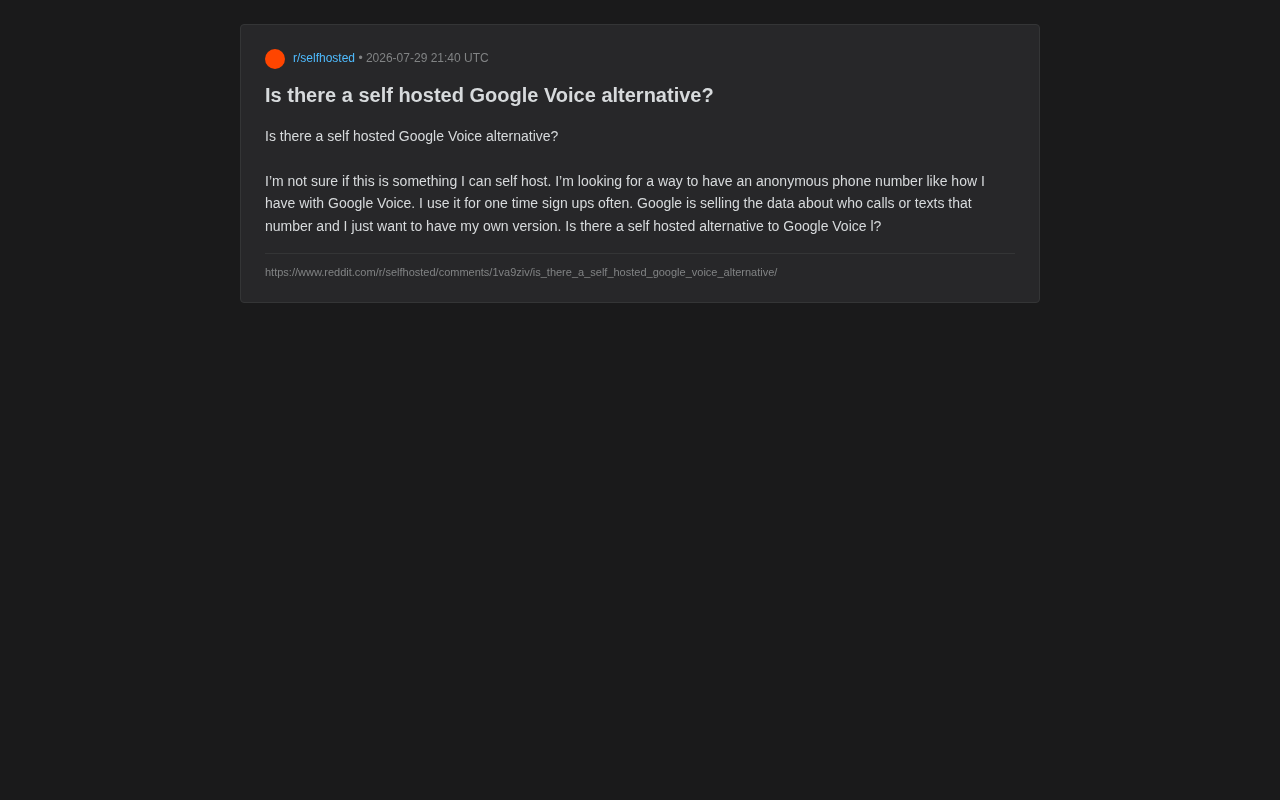
In a Reddit self-hosting community discussion, a user raised a highly representative privacy concern: they had been using Google Voice to get an "anonymous" phone number, primarily for one-time sign ups. But they gradually realized a problem—Google is actually selling metadata about "who calls or texts this number."
Since its launch in 2009, Google Voice has attracted users with its free calling and texting services. However, according to Google's privacy policy and multiple independent studies, Google collects metadata including call times, call duration, call recipients, SMS content, and messaging frequency. This data is integrated into Google's advertising profiling system for targeted ad delivery. Notably, the value of metadata is often underestimated—even without reading call content, the pattern of "who contacted whom at what time" alone is sufficient to reconstruct a person's social network, daily routines, and even health conditions. The NSA documents leaked by Snowden revealed that intelligence agencies value metadata no less than communication content itself.
In other words, while Google Voice provides a layer of isolation from your real phone number, it is not a true privacy protection tool. Your call records, text message exchanges, and contact relationship graphs can all become links in the data monetization chain of tech giants.
The user's core question was: Is there a self-hosted Google Voice alternative? One that would let them own and control their anonymous number system without handing data over to a third party.
This question touches on a key contradiction in today's privacy protection landscape: the trade-off between convenience and data sovereignty. Free services often come at the cost of data, while truly controlling your data requires technical and operational investment. This contradiction is a microcosm of the broader Data Sovereignty Movement—a combined response to the 2013 Snowden revelations, the 2018 Cambridge Analytica scandal, and the awakening of data rights awareness following GDPR implementation. In tech communities, this manifests as the rise of Homelab culture: increasing numbers of technical users are setting up home servers to self-host email (Mail-in-a-Box), cloud storage (Nextcloud), password managers (Vaultwarden), and communication systems. Reddit's Self-Hosted community has over 300,000 subscribers, reflecting a substantial user base actively addressing data privacy concerns through action.
Technical Implementation of a Self-Hosted Phone System
Phone Numbers Themselves Cannot Be Self-Hosted
First, a common technical misconception needs clarification: PSTN phone numbers themselves cannot be self-hosted. Number resources are allocated and managed by telecom regulators and carriers in each country. Any virtual number must ultimately connect to the Public Switched Telephone Network (PSTN) through a licensed carrier or VoIP provider.
The Public Switched Telephone Network (PSTN) is the foundational infrastructure of global telephone communications, originally established by the Bell System in the late 19th century and now evolved into a hybrid network covering landlines, mobile, and VoIP. Phone number resources are coordinated by the International Telecommunication Union (ITU), with each country's telecom regulator (such as the FCC in the US or MIIT in China) managing allocation domestically. Numbers are hierarchically assigned to licensed carriers through numbering plans (such as North America's NANP—North American Numbering Plan). DID (Direct Inward Dialing) numbers were originally a technology in enterprise PBX systems that allowed external calls to directly reach extensions, and have now become the standard form of virtual number rental in the VoIP era.
Therefore, what's accurately called a "self-hosted Google Voice alternative" is: you build and control the call/SMS processing system (PBX) yourself, but the number source still needs to be purchased through a third-party DID provider.
Core Solution: Asterisk and FreePBX
In the self-hosted phone system space, the most mature open-source solution is Asterisk and its visual management interface FreePBX. They can run on your own server or home NAS, providing complete telephone switching functions: answering calls, making calls, voicemail, call forwarding, and more.
Asterisk was created by Mark Spencer in 1999 and is now maintained by Sangoma Technologies. It is the most widely deployed open-source communications platform globally. Its core architecture uses a modular design: Channel Drivers handle connections for different protocols (SIP, IAX2, PJSIP, etc.); Application modules provide specific features like voicemail and conference bridging; Codec modules handle audio format conversion. Asterisk uses a Dialplan to define call routing logic, supporting everything from simple call forwarding to complex IVR (Interactive Voice Response) systems.
- Asterisk: The underlying open-source PBX engine—powerful but complex to configure, suitable for users with some Linux experience.
- FreePBX: A web management interface built on Asterisk that significantly lowers the configuration barrier. FreePBX provides a PHP-based graphical management interface on top of Asterisk, transforming complex configuration file editing into intuitive operations, while adding enterprise-grade features like user management, firewall configuration, and system backups.
With these systems, you need to purchase a number from DID providers like VoIP.ms, Twilio, or Telnyx, then connect the number to your self-hosted system via a SIP Trunk.
SIP (Session Initiation Protocol) is the core signaling protocol for VoIP communications, defined by the IETF in RFC 3261. SIP itself only handles establishing, modifying, and terminating communication sessions—actual voice data transmission is handled by RTP (Real-time Transport Protocol). A SIP Trunk is a virtual channel connecting a local PBX system to the external telephone network, replacing traditional physical phone lines. When you make a call through a SIP Trunk, your PBX sends SIP signaling to the DID provider's server, which then routes the call to the PSTN network. This architecture means voice data can be encrypted via SRTP and TLS between your server and the DID provider, but once it enters the PSTN it reverts to traditional unencrypted signals.
This way, the "processing logic" for calls and texts runs entirely on your own server, while the carrier handles only the lowest-level network connectivity.
The Challenge of Receiving SMS Verification Codes
The user's primary need is "one-time sign ups," which means receiving SMS verification codes is essential. There's a technical detail worth noting here: not all VoIP numbers can reliably receive SMS verification codes. Many platforms (like banks and major internet services) actively block known VoIP number ranges to prevent mass registration and fraud.
Major internet platforms block VoIP numbers using several technical methods: first, number type database lookups, such as Twilio's Lookup API or Telesign's PhoneID, which can identify whether a number is landline, mobile, or VoIP; second, number range identification, where known VoIP carrier ranges are directly flagged; third, behavioral pattern analysis, where registering large numbers of accounts from the same number range in a short period triggers risk controls. The logic behind this blocking is anti-fraud—VoIP numbers are cheap to obtain and easy to acquire in bulk, making them common tools for spam accounts and telecom fraud. For privacy-minded users, this creates a paradox: the more privacy-focused the number type, the more likely it is to be rejected by platforms.
Therefore, when choosing a DID provider, you need to confirm that their numbers support SMS reception and test their availability on your target registration platforms.
Actual Privacy Benefits and Limitations
Privacy Advantages of Self-Hosting
Compared to Google Voice, a self-hosted solution does provide several substantive privacy improvements:
- Call and SMS metadata is no longer analyzed and monetized by third parties—data is stored on your own server.
- Complete log control—you decide whether to retain or delete records.
- Flexible multi-number management—you can configure different numbers and processing rules for different purposes.
Realistic Limitations That Must Be Acknowledged
However, self-hosting does not equal "absolute anonymity." Several real-world constraints exist:
- DID providers can still see your traffic: The carrier connection point cannot be bypassed—carriers still have access to your call records. The real privacy improvement is "no longer having a giant like Google systematically analyzing your social graph."
- Identity verification requirements: In many countries and regions, purchasing numbers requires providing identity or payment information, which inherently conflicts with "complete anonymity." For example, in the EU, anti-money laundering regulations (AML) require VoIP providers to perform KYC (Know Your Customer) verification on customers; in the US, while relatively relaxed, payment information itself constitutes an identity trail.
- Operational costs: Self-hosting means you're responsible for server security, system updates, and troubleshooting. If misconfigured, it could actually introduce new security risks. SIP protocol in particular was designed with insufficient security considerations—SIP servers exposed to the public internet are highly vulnerable to brute-force attacks and toll fraud, requiring hardening through fail2ban, IP whitelisting, and strong password policies.
More Pragmatic Privacy Number Alternatives
For the specific scenario of "one-time sign ups," beyond building a complete PBX system, there are some lighter-weight options worth considering:
Paid Privacy Number Services
If the core goal is privacy rather than complete technical autonomy, some privacy-focused paid services (such as MySudo, and certain VoIP providers that accept anonymous payment) may be more cost-effective than self-hosting. They don't use data sales as a business model, exchanging subscription fees for service. MySudo is particularly noteworthy—it provides users with up to 9 independent "digital identities" (Sudos), each containing an independent phone number, email, and virtual credit card number, with identity compartmentalization as its core design philosophy.
Email Alias and Disposable Number Combination Strategy
For purely registration purposes, combining email alias services (such as SimpleLogin, addy.io) with temporary SMS reception services can further reduce the risk of a single number being tracked through correlation. The principle of email alias services is to establish a deletable intermediate layer between your real inbox and external services—each registration uses a different random alias address, so even if a particular alias is leaked or receives spam, it won't affect your main inbox or other registrations. Extending this approach to phone numbers creates a "disposable number + disposable email" dual-layer isolation strategy.
Rational Cost-Benefit Assessment
Setting up Asterisk/FreePBX plus purchasing a DID number requires an initial investment of learning time and some monthly fees (server + number rental). Taking VoIP.ms as an example, a US DID number costs approximately $0.85-1.25 per month, plus $0.01 per SMS and potential per-minute call charges—the hard costs aren't high. The real cost lies in the learning curve and maintenance time: initial Asterisk configuration may take several days, and troubleshooting common issues like SIP registration failures, one-way audio, and NAT traversal requires patience. If you're only occasionally registering a few accounts, this investment may not be worthwhile; but if you heavily rely on number compartmentalization and are already running a home server (Homelab), incorporating a phone system into your self-hosted infrastructure is a natural extension.
Conclusion
The question raised by this Reddit user fundamentally reflects the growing "data sovereignty" awareness among technical users. Google Voice has never provided privacy—it provides a convenient layer of isolation—at the cost of your communication metadata.
A truly self-hosted alternative (Asterisk + FreePBX + third-party DID) is technically entirely feasible and can help you reclaim control over your communication data. But it also requires you to face two realities: the carrier connection point cannot be fully decentralized, and self-hosting brings operational responsibilities.
For privacy seekers, the ideal approach is to find a balance between "technical autonomy," "privacy protection," and "convenience costs" based on your actual usage intensity. This is not just a technical choice—it's a structural response to the business model of "surveillance capitalism"—using technical capability to reclaim data control that rightfully belongs to you.
Related articles

ml-pipes: Building Software Engineering Best Practices Into ML Inference Pipelines
ml-pipes is an open-source framework that builds pre-run validation, pipeline inspection, tracing, and benchmarking into ML inference pipelines, bridging the MLOps engineering gap.

Aquifer Open Source: A Traffic Smoothing Solution for Peak Shaving Bursty GPU Inference Workloads
Aquifer is an open-source traffic smoothing runtime that uses durable queue buffering and backend backpressure to solve burst traffic challenges in GPU inference services, enabling peak shaving and cost reduction.

AI Mass-Producing Sales Videos: The Horse Racing Revolution in Content Commerce
Breaking down an explosive overseas AI content commerce strategy: batch-generating sales videos via AI workflows and horse-race testing them on TikTok and Instagram with CLI + Codex automation.