Semantic Observability: How a Multi-Agent Framework Revolutionizes Root Cause Analysis

Paper proposes a semantic observability framework combining property graphs, multi-agent systems, and LLMs for root cause analysis.
The article introduces the "Semantic Observability" framework from a paper, addressing the difficulty of quickly locating failure root causes amid massive heterogeneous logs in microservices. It uniformly models scattered logs into a dynamic property graph database, abstracting physical topology, dependencies, and events as attributed nodes and relationships to bridge the semantic gap of flat logs. A stateful multi-agent system orchestrated via directed cyclic graphs applies causal algorithms and temporal backtracking to isolate the blast radius, then feeds pruned subgraphs to an LLM for code-level RCA while compressing tokens and suppressing hallucinations. The work remains conceptual, with quantitative evaluation pending.
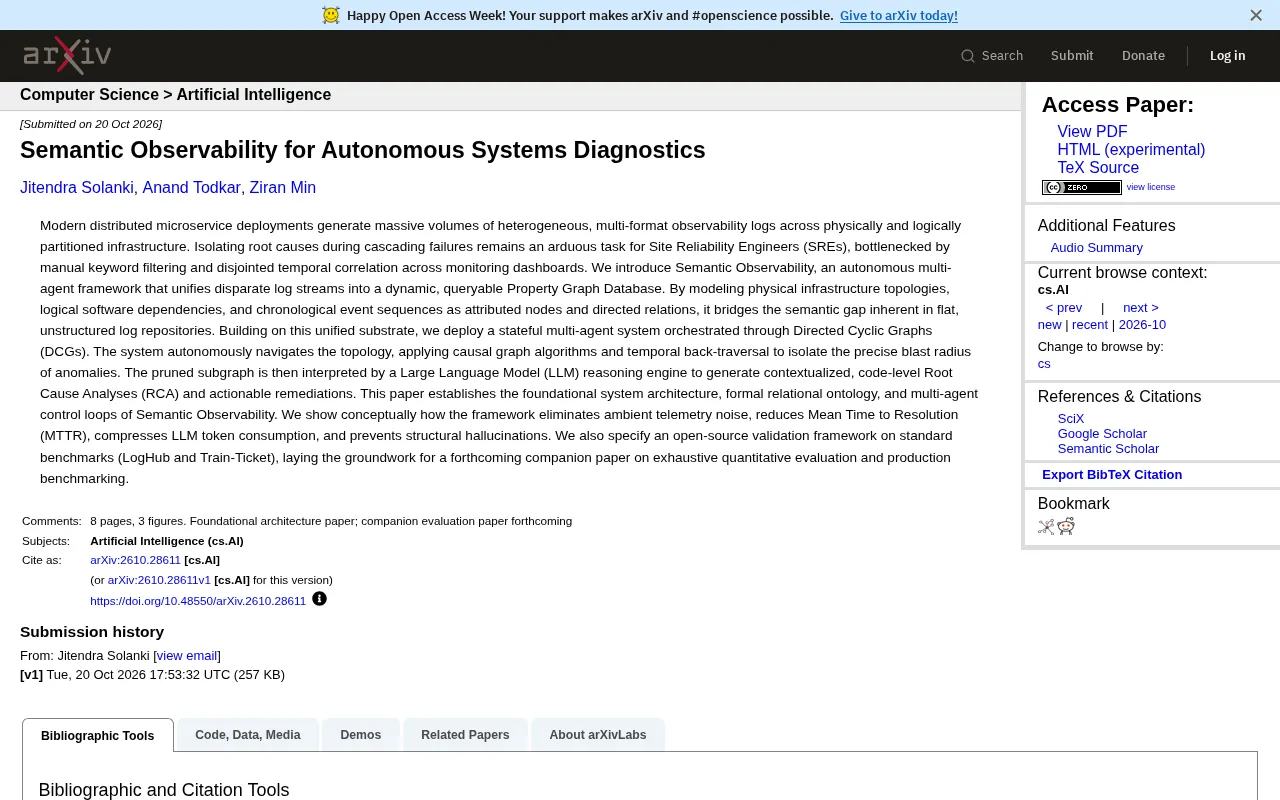
The proliferation of microservices architecture has caused system scale and complexity to grow exponentially, bringing with it massive, heterogeneous, multi-format observability logs. When failures cascade like dominoes, SRE teams often find themselves mired in manual keyword filtering and fragmented time correlation across dashboards, searching for root causes like a needle in a haystack. A recently proposed paper introduces the "Semantic Observability" framework, which attempts to fundamentally change this situation using multi-agent and graph database technologies.
Core Architecture: From Flat Logs to Dynamic Property Graphs
The core innovation of this framework lies in uniformly modeling scattered log streams into a dynamic, queryable Property Graph Database. Physical infrastructure topology, logical software dependencies, and time-series event sequences are each abstracted as attributed nodes and directed relationships. This design bridges the semantic gap inherent in flat, unstructured log repositories—previously isolated log entries are now given context through infrastructure and software dependencies, and SREs no longer need to manually piece together fragmented information.
According to the paper, this unified substrate enables the system to quickly locate failure propagation paths through graph queries rather than relying on traditional full-text search.
A Property Graph Database is a data model with nodes and edges as basic elements, where both nodes and edges can carry key-value pair attributes. Unlike traditional relational databases, it is naturally suited to expressing multi-hop, heterogeneous relationships—for example, Service A depends on Service B, B is deployed on Host C, and C is located in Rack D. In observability scenarios, property graphs can unify infrastructure topology, service dependencies, and event sequences into the same query semantics, supporting graph traversal queries such as "find all call chains passing through the failed host" without pre-defining complex table join patterns. Common implementations include Neo4j, JanusGraph, and others.
Multi-Agent System and Causal Graph Algorithms
On top of the unified graph substrate, the authors deploy a stateful multi-agent system orchestrated through Directed Cyclic Graphs (DCGs). These agents can autonomously navigate the topology, apply causal graph algorithms and temporal reverse traversal, and precisely isolate the anomalous "blast radius." In other words, the system can not only see which services are affected but also trace back along the causal chain to pinpoint the true source of the failure.
This automated navigation significantly reduces manual intervention. The paper points out that this approach can eliminate ambient telemetry noise, allowing subsequent analysis to focus on critical paths.
A Directed Cyclic Graph (DCG) is a directed graph that allows cycles, as opposed to a Directed Acyclic Graph (DAG). In multi-agent orchestration, DCGs allow control flow between agents to form feedback loops—for example, an agent that discovers an anomaly can pass results back to an upstream agent to trigger secondary analysis, thereby supporting iterative reasoning and dynamic adjustment. This contrasts with DAG workflows (such as the unidirectional dependencies common in Airflow), which cannot express the looping logic of "going back to re-investigate based on intermediate results"—yet this is precisely a common requirement in root cause analysis.
"Blast radius" borrows the metaphor of the scope of failure impact, referring to the range of services, hosts, and users affected as a failure spreads outward from its source. In microservices architecture, due to deep call chains and complex dependencies, a single component failure can cascade and amplify along dependency edges. The core of isolating the blast radius lies in distinguishing "symptom nodes" from "root cause nodes": the former are downstream services where alerts first fire, while the latter are the true sources that trigger the chain reaction. Causal graph algorithms analyze temporal precedence and topological dependency direction, traversing in reverse along the causal chain to separate the affected scope from the failure source.
LLM Reasoning Engine and Hallucination Suppression
The pruned subgraph is then fed into a Large Language Model (LLM) reasoning engine to generate context-relevant, code-level root cause analysis (RCA) and actionable remediation recommendations. Interestingly, because what is fed to the LLM is a compact subgraph filtered by causal analysis rather than raw massive logs, the paper claims this can compress LLM token consumption while preventing structural hallucinations—the model is constrained to reason within actually existing topological relationships, reducing the possibility of fabrication.
This design approach transforms the LLM's role from "omniscient analyst" to "evidence-based reasoner," better aligning with production environment reliability requirements.
Structural hallucination refers to a large language model generating plausible-sounding but factually nonexistent entities or relationships when lacking external constraints—for example, fabricating a service name or dependency edge that does not exist. In root cause analysis scenarios, such hallucinations are particularly harmful because operations personnel may take incorrect remediation actions based on them. Common approaches to suppressing structural hallucinations include Retrieval-Augmented Generation (RAG), constraining model output within a known graph schema, and requiring the model to reason only based on provided subgraph evidence. This paper uses the pruned subgraph as the sole source of truth, which is essentially an "evidence constraint" strategy.
Open-Source Validation and Future Outlook
The paper also specifies an open-source validation framework, planning to evaluate on standard benchmarks (LogHub and Train-Ticket). The authors acknowledge that detailed quantitative evaluation and production environment benchmarking will be presented in a subsequent companion paper. Therefore, the current work is more of a conceptual demonstration of system architecture, formalized relational ontology, and multi-agent control loops, with actual effectiveness still awaiting experimental data.
For the SRE and AIOps domains, this direction is worth watching: it attempts to combine causal reasoning with LLMs to reduce MTTR (Mean Time To Resolution) while controlling costs. However, how far it is from concept to production deployment will be a key focus of subsequent research.
Key Takeaways
- The semantic observability framework unifies logs into a property graph database, bridging the semantic gap.
- The multi-agent system is orchestrated through directed cyclic graphs, using causal graph algorithms to isolate the anomalous blast radius.
- The LLM reasoning engine generates code-level RCA based on pruned subgraphs, compressing token consumption and suppressing hallucinations.
- The current work is a conceptual architecture, with quantitative evaluation left for future papers.
One-line Summary
The paper proposes a semantic observability framework that combines property graphs and multi-agent systems with LLMs for root cause analysis.
Paragraph Summary
The article introduces the "Semantic Observability" framework proposed in a paper, aimed at solving the problem of quickly locating failure root causes amid massive heterogeneous logs in microservices architecture. The framework uniformly models scattered logs into a dynamic property graph database, abstracting physical topology, software dependencies, and time-series events as attributed nodes and relationships, bridging the semantic gap of flat logs. On this basis, a stateful multi-agent system is orchestrated through directed cyclic graphs, applying causal graph algorithms and temporal backtracking to isolate the anomalous blast radius, then feeding the pruned subgraph into an LLM to generate code-level root cause analysis and remediation recommendations while compressing token consumption and suppressing structural hallucinations. The article notes that the current work remains a conceptual architecture, with quantitative evaluation left for a subsequent companion paper.
Related articles
world2vec: Building Mechanistic World Models with Latent Dynamics Learning
world2vec proposes a reward-free method for learning mechanistic world models via latent dynamics, faithfully reproducing systems over long horizons with at least an order of magnitude fewer parameters than DreamerV3, TD-MPC2, and LeWM, and achieving accurate system identification on 71 attractor benchmarks.

A New KL-DRO Paradigm: Adaptive Scenario Generation Around a Learned Density Model
KL-DRO research proposes centering the KL ball on a learned density model instead of the empirical distribution, with adaptive scenario generation guiding sampling toward the worst case. Experiments show lower cost under distribution shift when records are scarce and the model can extrapolate, with comparable in-distribution cost.

ODE Samplers for Discrete Diffusion Models: Exponential Residual Flows Accelerate Generation
Discrete diffusion models lack deterministic ODE sampling? This article introduces Exponential Residual Flows (ERFs), which introduce continuous residual variables per token to construct piecewise ODEs for deterministic sampling and support consistency distillation acceleration. Superior to prior methods on code and text generation tasks.