Semantica: Graph-Native Infrastructure Making AI Decisions Traceable and Accountable

Semantica uses graph-native infrastructure to make AI reasoning traceable and accountable.
Semantica is an open-source project that addresses two critical challenges in AI systems: structured context management and decision accountability. By using graph-native architecture instead of flat vector retrieval, it enables multi-hop reasoning, long-term memory, and full traceability of AI decision paths—making it especially suited for enterprise knowledge management, compliance-heavy industries, and multi-agent collaboration scenarios.
When AI Needs "Memory" and "Accountability"
In the era dominated by large language models, building reliable AI systems faces two core challenges: how to provide models with rich, structured context, and how to make AI decision-making processes traceable and accountable. The open-source project Semantica (semantica-agi/semantica) targets precisely these two pain points, proposing a "Graph-Native" infrastructure solution.
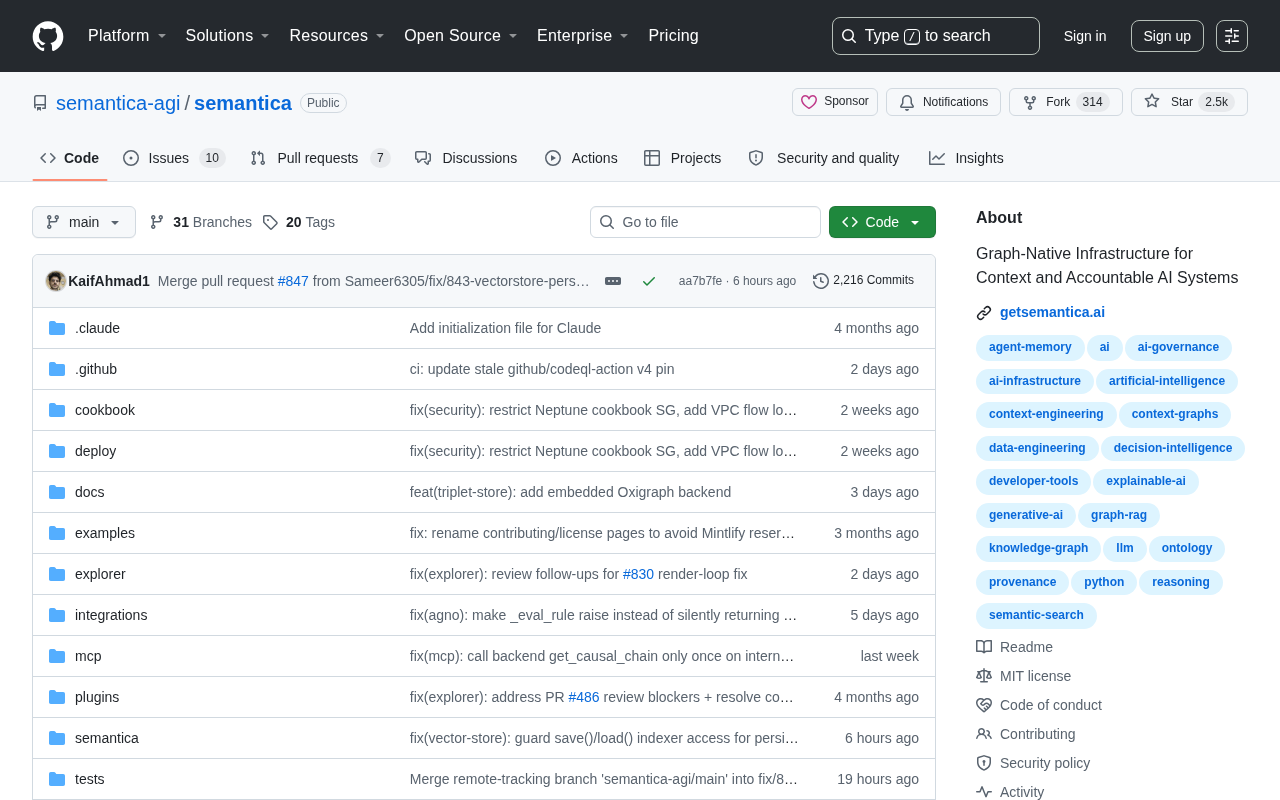
The project has already accumulated over 2,473 Stars and 314 Forks on GitHub, with a recent single-day growth of 122 new Stars, indicating strong interest from the developer community in this direction. As a project primarily written in Python, it lowers the barrier to entry for AI engineers and researchers.
What Is "Graph-Native" Infrastructure
From Vector Retrieval to Graph Structures: Why an Upgrade Is Needed
Current mainstream RAG (Retrieval-Augmented Generation) approaches mostly rely on vector databases, retrieving relevant text chunks through semantic similarity. RAG was first proposed by Meta AI's research team in 2020, and its standard pipeline includes document chunking, vector embedding (converting text into high-dimensional vectors using models like OpenAI Embedding or BGE), vector database storage (such as Pinecone, Milvus, Weaviate, etc.), and semantic retrieval based on cosine similarity. This approach works well for simple Q&A tasks, but when dealing with complex relationships between entities, multi-hop reasoning, and knowledge evolution, flat vector representations often fall short—they can only tell you "which text chunks are semantically close to the question" but cannot answer structural questions like "how does Entity A influence Entity B through what chain of relationships."
Sematica's core idea is to natively store and manage context in graph form. Graph databases are grounded in graph theory, using Nodes, Edges, and Properties to represent and store data, making them naturally suited for handling highly interconnected data and complex relationship queries. In graph structures, entities (nodes) and relationships (edges) are explicitly modeled, allowing AI systems to reason along relationship chains rather than relying solely on fuzzy matching based on text similarity. This design inherits the core philosophy of knowledge graphs—expressing relationships between entities in a structured way through triples (subject-predicate-object), supporting multi-hop queries and logical reasoning, and compensating for the shortcomings of purely statistical models in structured reasoning. It is naturally suited for expressing knowledge graphs, event causal chains, and interaction relationships between multiple agents.
Context as a First-Class Citizen: From Ephemeral Windows to Long-Term Memory
Unlike treating context as "temporarily concatenated prompts," graph-native architecture treats context as a first-class citizen of the system. To understand the value of this design philosophy, one must first recognize the current technical constraints of large models: the Context Window is the maximum number of tokens a model can process in a single inference pass, growing from GPT-3's 4K tokens to GPT-4 Turbo's 128K tokens, Claude's 200K tokens, and Gemini's million-level tokens. Although windows keep expanding, they are fundamentally "stateless"—after each call ends, the model doesn't automatically retain information from previous interactions. Current industry solutions include conversation history summarization/compression and vectorized long-term memory (such as the MemGPT/Letta project), but these approaches still have notable shortcomings in knowledge correlation and reasoning coherence.
In Semantica's graph-native architecture, every interaction, every piece of knowledge, and every reasoning step is structurally recorded in the graph, forming persistent, queryable, and reusable knowledge assets. The advantage of graph-structured memory lies in storing not just the information itself but also the logical relationships and temporal evolution between pieces of information. This means AI systems can possess true "long-term memory" rather than just ephemeral context windows effective only within a single session.

Accountable AI Systems: From Black Box to Transparency
Why AI Accountability Matters So Much
As AI is applied to high-risk domains such as finance, healthcare, and law, the trust crisis caused by "black-box decisions" is becoming increasingly prominent. This issue has evolved from an academic research topic into a hard legal compliance requirement. The EU AI Act officially came into effect in 2024, classifying AI systems by risk level and explicitly requiring transparency and explainability for high-risk AI systems. The U.S. Algorithmic Accountability Act draft and China's Interim Measures for the Management of Generative AI Services similarly impose traceability requirements on AI decisions. In the financial sector, the Basel Accords and national financial regulators require credit decision models to have explainability; in healthcare, the FDA's approval process for AI-assisted diagnostic systems increasingly emphasizes transparency of clinical decision pathways. Regulators and enterprise users increasingly demand that AI systems can explain: Why was this conclusion reached? What information was relied upon? What reasoning path was followed?
Sematica builds "accountability" into the infrastructure layer. Since all context and reasoning processes are recorded in graph form, the system can fully trace back the knowledge nodes and relationship edges that an AI relied upon when making a specific judgment. This provides a solid technical foundation for auditing, debugging, and compliance, transforming "accountable infrastructure" from a technical option into an engineering necessity.
From Traceability to Trust: Graph Paths as Decision Evidence
Traceability is the prerequisite for trust. When every decision step of an AI agent can be reconstructed as a specific path on a graph, developers can not only discover the source of errors but also make targeted corrections to the knowledge base or reasoning logic. This is consistent with the version control and log auditing philosophy in software engineering—just as Git makes every code change traceable, graph-native infrastructure makes every reasoning step of an AI verifiable. This transparency is crucial for building production-grade, enterprise-level AI applications, and is the key differentiator between Semantica and many frameworks that "only focus on generation quality."
Technical Positioning for the Agent Era
From the project name semantica-agi, its vision clearly points toward the broader direction of Artificial General Intelligence (AGI). In cutting-edge scenarios such as multi-agent collaboration and autonomous task planning, agents need to share a consistent world model and context while ensuring the verifiability of every decision.
Multi-Agent Systems (MAS) represent an important frontier in current AI applications, with representative frameworks including Microsoft's AutoGen, CrewAI, and LangGraph. In such systems, multiple AI agents each play specific roles and collaborate to complete complex tasks, but face two core challenges: first, state sharing—how to enable different agents to make decisions based on a consistent world model; second, attribution tracking—when the final output is wrong, how to pinpoint which agent introduced the error at which step. Traditional message-passing mechanisms only record communication content and lack structured causal relationship tracking. Graph structures naturally support multi-entity relationship modeling and path backtracking, making them considered the ideal data structure for multi-agent collaboration infrastructure.
Graph-native infrastructure is uniquely positioned to serve both needs simultaneously: the graph is both a carrier of knowledge and a ledger of accountability. Building agent systems with persistent memory, causal reasoning, and autonomous planning capabilities is widely regarded as one of the essential technical paths toward AGI, and Semantica provides infrastructure support along this path.
For developers exploring Agent applications, Semantica offers a technical path distinct from pure vector-based approaches. It is better suited for scenarios with high demands on knowledge relationship complexity and reasoning explainability, such as:
- Enterprise Knowledge Management: Multi-dimensional internally connected knowledge systems, such as cross-linked entities spanning organizational structures, product lines, and customer relationships
- Intelligent Decision Support Systems: Business scenarios requiring multi-hop reasoning and causal analysis, such as supply chain risk assessment and investment decision chain analysis
- Compliance and Audit Industries: Sectors like finance and healthcare that require strict decision traceability, meeting regulatory requirements for algorithmic transparency
An Open-Source Rising Force Worth Watching
Accumulating thousands of Stars in a short time while maintaining rapid growth indicates that the concepts of "graph-native" and "accountability" are addressing real needs in current AI engineering. As more teams shift from "making models run" to "making models reliable, controllable, and explainable," projects like Semantica that rethink context and accountability from the infrastructure layer are likely to become an important component of next-generation AI system architectures.
It's worth noting that this direction is not exclusive to Semantica. Microsoft's GraphRAG project enhances retrieval quality by constructing community summary graphs, Neo4j has launched Graph+RAG solutions integrated with LLMs, and academic research on combining Graph Neural Networks with LLMs is also advancing rapidly. Semantica's differentiation lies in positioning graph structures as "infrastructure" rather than "an enhancement tool," and making accountability the top-priority design goal.
Of course, as an open-source project still evolving rapidly, its actual production readiness, ecosystem maturity, and integration capabilities with mainstream LLM frameworks still need to be validated in more real-world scenarios. Interested developers are encouraged to follow the documentation and examples in its GitHub repository, and evaluate and trial it based on their own business needs.
Related articles

PPT Master: AI One-Click Generation of Native Editable PowerPoint Presentations
PPT Master is an open-source project with over 45K GitHub Stars that generates native editable .pptx files via AI, featuring data charts, animations, voice narration, and custom templates.

Delphi 13 Community Edition Free Download: The Classic RAD Tool for Cross-Platform Native Development Returns
Delphi 13 Community Edition is now available for free download. Explore its cross-platform native compilation, features, licensing, and Object Pascal's unique value in modern development.

GPT-5.6 Free Unlimited Conversations, Kimi K3 Officially Joins GitHub Copilot
OpenAI announces GPT-5.6 Luna unlimited free conversations, Kimi K3 becomes the first Chinese model in GitHub Copilot. Google releases WeatherNext, NVIDIA advances Physical AI infrastructure.