Senior Developers' "Kasparov Moment": Where Does Human-AI Collaboration End Up?

About a decade after chess's centaur era, human intervention became a burden; software engineering lacks a scoreboard, so senior developers must guard against self-misjudgment.
A Reddit post draws an analogy: senior developers are in their "Kasparov era," a centaur phase of humans teaming with AI. Chess history shows that from Deep Blue's victory to human intervention becoming harmful took about a decade, and in the 2005 freestyle tournament amateurs won by guiding engines, showing that driving agents differs from traditional architecture experience. Software engineering lacks objective win/loss signals, making it hard to judge whether senior developers' guidance adds value, risking long-term self-misjudgment. Deciding what to build and for whom remains human, but feedback mechanisms like A/B testing, agent autonomy rates, and rollback rates are needed. The core conclusion: stay humble and question your value-add; skill restructuring may become the new core competency.
Introduction: From Chess to Programming, a Replayed History
A popular Reddit post offers a thought-provoking analogy: senior developers are in their "Kasparov era." In 1997, Deep Blue defeated Kasparov. The initial reaction of top players was, "Engines can calculate, but humans understand." Later, Kasparov proposed "Advanced Chess"—humans teaming up with engines, with the goal not being humans beating engines but "human + engine" beating engines alone. This judgment proved correct for about a decade afterward, but eventually engines filled in their blind spots, and human intervention actually degraded the quality of play. Today, top players like Carlsen or Gukesh don't fantasize about beating Stockfish; engines have become their preparation tools, sparring partners, and coaches.
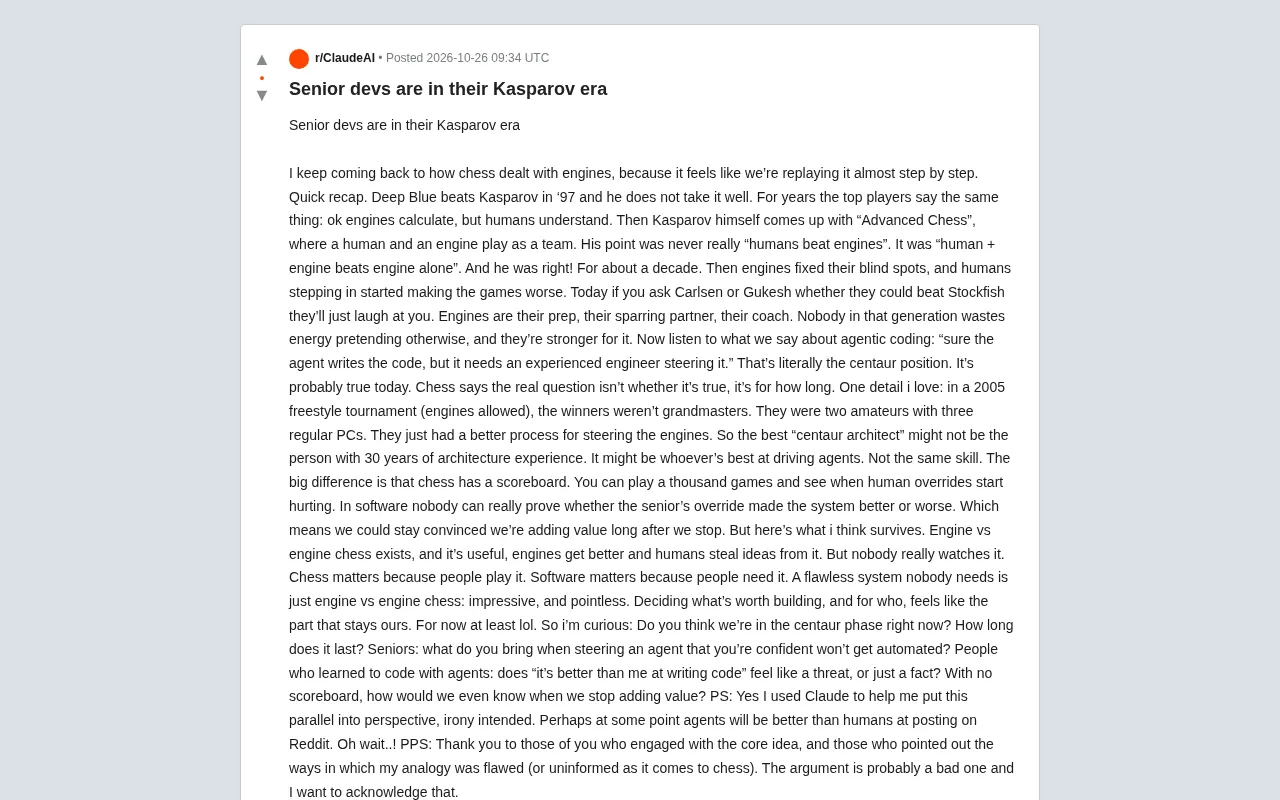
The poster argues that the current discussion around agentic coding—"agents write code, but experienced engineers are needed to guide them"—is essentially the "centaur" position. This position may hold today, but the history of chess suggests that the real question isn't whether it holds, but how long it can last.
Freestyle Chess, also known as Advanced Chess, refers to a form of play where human players team up with computer engines, typically allowing any engine and database to be used during the game. The Freestyle tournament organized by the Palamedes Chess Club (PAL/CSS) in Germany in 2005 is a landmark event for this format, with rules permitting players to freely use engines and knowledge bases. The two amateur players who won—Steven Cramnik (not to be confused with World Chess Champion Vladimir Kramnik, a common mix-up) and Zacharias Fischer—were not grandmasters; they won through a process of effectively filtering and guiding engine output rather than their own chess skill. This result profoundly illustrates that in "human + engine" collaboration, the process and judgment driving the engine may be more decisive than deep traditional domain experience. This is also the direct source of the "centaur architect" concept in the article's analogy.
The Centaur Phase: The Dividing Line Between Now and the Future
The Timeline Chess Provides
The post recalls a key detail: in a 2005 freestyle tournament that allowed engines to compete, the champion was not a grandmaster but two amateur players who, using three ordinary PCs, won through a better process of "guiding the engine." This means the best "centaur architects" may not be people with 30 years of architecture experience, but rather those best at driving agents. These two skills are not the same.
From Deep Blue's victory to human intervention becoming harmful, chess took about a decade. Software engineering has no scoreboard; we cannot verify, like playing a thousand games, whether a senior developer's intervention makes the system better or worse. The post warns: we may firmly believe we are adding value long after we have stopped.
Software Engineering's Unique Challenges
Unlike chess, value judgments in software are more ambiguous. Whether a system is "better" depends on multidimensional factors such as requirements, maintainability, and user experience, and the feedback cycle is long. Without fast, objective win/loss signals, the centaur phase may last longer—or shorter—but the direction is hard to determine.
Without a Scoreboard, How Do We Know When We Stop Adding Value?
This is one of the core questions the post raises. In chess, games produced by engine-vs-engine play can be analyzed, and humans learn from them, but few people watch engines play each other. Chess matters because humans play it; software matters because humans need it. A perfect system that no one needs is like an engine-vs-engine game: impressive but meaningless.
The poster argues that deciding "what to build" and "for whom" remains a human part. At least for now. But without an objective scoring mechanism, how can teams determine whether senior developers' guidance is creating value or hindering progress? Possible paths include establishing a stricter A/B testing culture, tracking the rate at which agents autonomously complete tasks, and regularly reviewing rollback rates after human intervention. But these metrics themselves can be gamed.
Different Perspectives: Threat, Fact, and Skill Restructuring
The post asks questions to different groups, reflecting the divide.
- Senior developers: When you guide agents, what capability do you bring that you are confident won't be automated?
- People learning to code with agents: Is "it writes code better than me" a threat, or just a fact?
- Everyone: Without a scoreboard, how do we know when to stop adding value?
The answers to these questions are not consistent. Some comments point out flaws in the analogy, and the poster graciously admits the argument may be weak. But the core insight—the necessity of skill restructuring—is worth pondering. The ability to drive agents (clearly expressing intent, designing feedback loops, managing context) differs from traditional architecture experience and may become the new core competency.
Conclusion: The Human Part
Chess's today may be software engineering's tomorrow: engines become infrastructure, and humans focus on higher-level decisions. But software is more open than chess, and value definitions are more dispersed. How long the centaur phase lasts depends on whether we can find feedback mechanisms to replace the "scoreboard." Until then, staying humble and continuously questioning one's own value-add may be the most important capability senior developers should carry.
The post humorously mentions at the end that Claude was used to help conceive this analogy, and admits "maybe someday agents will be better than humans at posting on Reddit." irony intended.
One-line Summary
About a decade after chess's "centaur era," human intervention became a burden; software engineering lacks a scoreboard, and senior developers must guard against self-misjudgment.
Paragraph Summary
Inspired by a popular Reddit post, the article draws an analogy: senior developers are in their "Kasparov era," a centaur phase of humans teaming up with AI. Chess history shows that from Deep Blue's victory to human intervention becoming harmful took about a decade, and in the 2005 freestyle tournament, amateur players won by guiding engines—showing that the ability to drive agents differs from traditional architecture experience. Software engineering lacks objective win/loss signals, making it hard to judge whether senior developers' guidance adds value, which may lead to long-term self-misjudgment. Deciding "what to build" and "for whom" remains human, but feedback mechanisms such as A/B testing, agent autonomous completion rates, and rollback rates need to be established. The core conclusion is to stay humble and continuously question one's own value-add; skill restructuring (clearly expressing intent, designing feedback loops, managing context) may become the new core competency.
Related articles

Will GitHub Die? Open Source Maintainer Burnout and the Collaboration Crisis in the AI Era
Lex Fridman podcast discussion on open source maintainer burnout and GitHub's predicament: massive pull requests overwhelm core maintainers, and AI worsens code bloat. Using math journal peer review and Poincaré conjecture verification as analogies, the article analyzes why verification in knowledge production must be deliberately slow, and how open source communities can avoid the failure mode of maintainers exiting.

Stop Building Cookie-Cutter AI Websites: 3 Tools That Transform Your Coding Agent
Three tools that boost AI coding agents: FFmpeg skill for local video editing in Claude Code and Cursor, Hallmark's 50 design themes to fix cookie-cutter AI sites, and Jailbreaks' 25+ model prompts.

How America's Gerontocracy Squeezes the Younger Generation
Americans over 55 hold nearly three-quarters of national wealth, alongside an 80-year-old president and elderly congressional leaders. The Atlantic's Idrees Kahloon explains how gerontocracy drives up housing costs, squeezes opportunities for the young, and explores zoning reform and child poverty reduction as practical fixes.