SEO AI Engineering: Search Optimization Is Becoming Software Engineering

SEO is shifting from single-page optimization to engineered system design, with AI and coding skills becoming core competencies.
The article argues that SEO is evolving into an engineering discipline, with the core shift moving from manually optimizing single pages to designing continuously running systems that detect, prioritize, and fix issues. Python automation, API data collection, SQL analysis, and AI-assisted analysis enable SEO teams to handle massive URL counts and complex tech stacks. Spec-driven development turns SEO requirements into machine-readable YAML and automated tests, reducing production regressions. The rise of AI search brings brand visibility measurement challenges requiring experimental design and statistical analysis. Future SEO teams will differentiate into strategists, technical SEO engineers, data analysts, AI engineers, and content engineers, with competitive advantage shifting from executing individual tasks to designing reliable systems.
SEO is quietly becoming an engineering discipline.
For years, the daily work of SEO revolved around keyword research, content optimization, internal linking, link acquisition, technical audits, and rank tracking. These tasks won't disappear, but the environment they operate in is undergoing a fundamental shift — search is becoming a multi-engine landscape. Users discover information through Google, ChatGPT, Gemini, Perplexity, AI Overviews, recommendation systems, and AI assistants. On the other side, SEO teams face increasingly large websites, complex JavaScript applications, hundreds of thousands of URLs, structured data, log files, APIs, automated publishing systems, and massive datasets.
This intersection has spawned a new field: SEO AI Engineering. It sits at the crossroads of SEO, software engineering, data engineering, and AI engineering.
From Single-Page Optimization to System Design
Traditional SEO asks: how do I optimize this page? SEO engineering asks: how do I design a system that continuously detects, prioritizes, and fixes search visibility issues?
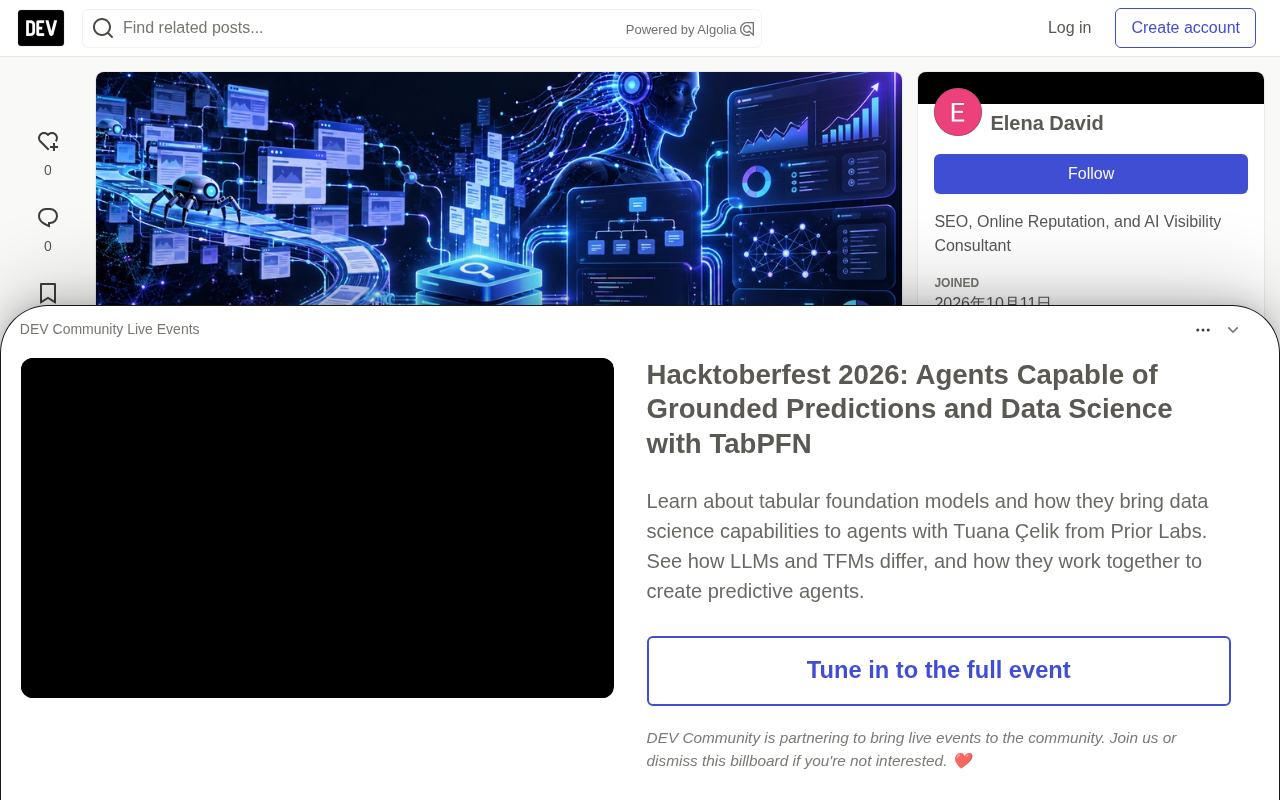
Take a site with 500,000 URLs. Manually checking canonical tags, internal links, indexability, schema markup, and page performance is completely impractical. An SEO engineer would build a pipeline: crawler → data extraction → validation rules → issue classification → priority scoring → AI-assisted analysis → fix recommendations → automated testing → deployment → monitoring.
This means audits are no longer a semi-annual PDF report — they become a continuously running quality control system.
Continuously running quality control system refers to transforming SEO audits from discrete, periodic manual reports into automated checks embedded in the website's release pipeline. It typically consists of three components: a data collection layer (crawlers, logs, APIs), a rules engine layer (validating hard requirements like canonical, indexing, schema, and performance), and a feedback layer (alerts, dashboards, fix recommendations). The key difference from traditional audits is that instead of asking "does this page have a problem," the system continuously asks "is the entire site currently deviating from expected state" and automatically triggers analysis or tickets when it does. Such systems are often integrated with CI/CD, validating SEO requirements immediately after code merges or deployments, intercepting issues before they go live rather than waiting for the next semi-annual audit to expose them.
The Leverage of Python in SEO
SEO practitioners don't need to become full-time software engineers, but basic programming skills provide enormous leverage. Python can automate HTTP status code checks, canonical tag validation, internal link analysis, orphan page detection, XML sitemap comparison, structured data extraction, server log analysis, keyword clustering, SERP change monitoring, and more.
The original article provides a simplified example using the requests library demonstrating how to batch-check URL status codes. This isn't a production-grade crawler, but the principle is powerful: a repeatable script can accomplish what would otherwise require extensive manual effort.
import requests

urls = [
    "https://example.com/",
    "https://example.com/products/",
    "https://example.com/blog/",
]

for url in urls:
    try:
        response = requests.get(url, timeout=10, allow_redirects=True)
        if response.status_code != 200:
            print(f"ISSUE: {url} returned {response.status_code}")
    except requests.RequestException as error:
        print(f"ERROR: {url} - {error}")
Simple automation creates an enormous operational difference.
How AI Changes the Game
Traditional SEO automation is deterministic: if the status code equals 404, flag the URL. AI systems can handle tasks requiring contextual interpretation — analyzing page intent, assessing content similarity, classifying search intent, generating fix recommendations, detecting anomalous content patterns, analyzing entity coverage, summarizing crawl anomalies, evaluating internal link opportunities, and comparing competitor information architecture.
Take internal linking as an example. Instead of just finding pages containing the same keywords, an AI-assisted system can synthesize multiple signals — semantic similarity, topical relationships, page importance, anchor text suitability, crawl depth, and business priority — to output recommended internal links. Engineers can combine embeddings, graph analysis, deterministic rules, and LLM-assisted evaluation, letting the system suggest link recommendations for human review rather than auto-inserting them into production pages. SEO's role shifts from manually discovering every opportunity to designing and validating systems.
Embedding is a technique that maps text, URLs, or page content into high-dimensional vectors. Semantically similar objects are closer together in vector space, making it possible to measure whether two pages discuss the same topic or whether a piece of anchor text suits linking to a target page. In the SEO internal linking context, engineers can batch-compute embeddings for all site pages, use vector similarity to find semantically related pages that aren't yet interlinked, then combine graph analysis (page importance, crawl depth) and business rules for ranking. Compared to keyword matching alone, embeddings can discover linking opportunities where "different wording, same topic" — but output still requires human review to avoid auto-insertion harming user experience or causing over-optimization.
What a Modern SEO Engineering Stack Looks Like
The original article provides a tech stack comparison table:
| Layer | Technologies |
|---|---|
| Data Collection | Search Console API, GA4, crawlers, server logs |
| Programming | Python, JavaScript, SQL |
| Data Processing | Pandas, DuckDB, PostgreSQL |
| AI | LLM APIs, embeddings, vector search |
| Automation | GitHub Actions, scheduled tasks |
| Testing | Pytest, Playwright, custom validators |
| Monitoring | Dashboards, alerts, anomaly detection |
| Deployment | Git, CI/CD, cloud infrastructure |
This is where SEO starts approaching software engineering workflows: SEO specs → Git commits → automated SEO tests → build → deploy → production validation → search performance monitoring.
Spec-Driven Development in SEO
Software engineers use explicit specifications to define expected system behavior. SEO can borrow the same approach. Instead of writing "ensure canonical tags are correct," define expected behavior with machine-readable specs:
page_type: article
canonical:
  required: true
  strategy: self_referencing
  allow_cross_domain: false
indexability:
  expected_status: 200
  robots: index,follow
structured_data:
  required_types:
    - Article
    - BreadcrumbList
These are project-specific rules, not universal SEO standards. But once requirements become machine-readable, they can drive automated tests:
def test_article_seo(page):
    assert page.status_code == 200
    assert page.canonical == page.url
    assert page.is_indexable is True
    assert "Article" in page.schema_types
    assert "BreadcrumbList" in page.schema_types
This approach transforms SEO's relationship with development teams: SEO requirements no longer exist only in documents, tickets, and Slack conversations — they become part of the engineering workflow. SEO specs → automated tests → deployment validation means fewer regressions reach production.
Machine-readable SEO specs refer to describing the technical conditions a page type should satisfy using structured formats like YAML or JSON, rather than writing them in natural language documents. The advantage is that specs can be directly read by test frameworks and converted into assertions — for example, automatically generating test cases based on page_type: article. The difference from universal SEO standards is that specs are project-specific, reflecting the site's internal conventions for canonical, indexing, structured data, and other dimensions. Once specs change, tests and CI pipelines update synchronously, allowing SEO requirements to enter version control and code review processes like product requirements, reducing regression issues caused by communication gaps or personnel changes.
The Measurement Challenge Posed by AI Search
SEO is moving beyond traditional rankings. Brands increasingly want to answer: Did ChatGPT mention our company? Did Gemini recommend our product? What sources did Perplexity cite when discussing our brand? Does changing the prompt change how AI describes us?
These questions require different measurement infrastructure. The original article provides an experimental workflow example: prepare multiple prompts, run each prompt multiple times, save model responses, then analyze brand mention frequency, citation frequency, recommendation frequency, sentiment and framing, claim consistency, source concentration, and response volatility.
The key is reproducibility. AI responses may vary by run, prompt phrasing, model version, and retrieval conditions — a single response isn't a reliable indicator of brand visibility. AI visibility measurement isn't just prompt engineering — it's experimental design, data collection, and statistical analysis. This makes it an engineering problem.
Experimental design in AI visibility measurement means treating prompts as experimental stimuli, model responses as observations, and controlling variables like repetition count, model version, temperature parameters, and retrieval conditions. Common methods include: running the same prompt multiple times to estimate response volatility; slightly rephrasing prompts to test conclusion robustness; setting control groups (e.g., not mentioning the brand) to distinguish inherent model tendencies from genuine recommendations. Statistical analysis is then used to extract signal from these non-deterministic responses — for example, calculating brand mention rates with confidence intervals, comparing whether differences between prompt groups are significant, and identifying anomalous source concentration. Without these engineering treatments, a single screenshot or response can easily be misread as reliable evidence of brand visibility.
AI Agents Will Transform How SEO Investigations Work
Imagine an SEO agent tasked with investigating a natural traffic decline affecting /products/. With appropriate permissions and integrations, it could query Google Search Console, determine when the decline began, detect affected pages and queries, crawl relevant URLs, check canonical and robots directives, compare internal link patterns, check recent deployments, check server-side rendering, propose possible explanations, and produce an evidence-based investigation summary.
The agent won't automatically know the true cause — it generates evidence-backed hypotheses. Human experts still need to validate findings and approve changes, but workflow efficiency improves significantly. This is the difference between using AI to write SEO content and using AI to operate SEO engineering workflows.
SEO Practitioners Will Become Workflow Designers
This may be the biggest change. The valuable skill is no longer just knowing which SEO tool to click — it's knowing how to design reliable processes: problem → data → specs → automation → validation → decision → monitoring.
A good SEO AI engineer asks: Can this task be automated? Can this rule be expressed as a spec? Can results be automatically tested? Can data be collected via API? Can AI assist with classification or analysis? Can recommendations be validated? Can impact be measured after deployment? These are engineering questions applied to search visibility, fundamentally different from producing yet another SEO checklist.
Will AI Replace SEO Experts?
The original author argues this isn't the most useful question. AI will automate many tasks currently done manually, but automation creates new responsibilities. Someone still needs to define: what should be measured, which signals matter, what counts as an error, how the system should behave, how experiments should be designed, whether AI output is trustworthy, when automation should stop, and how SEO requirements interact with product and engineering constraints.
Future SEO experts may spend less time manually producing recommendations and more time designing systems that generate, test, and monitor them. Competitive advantage shifts from executing individual tasks to designing reliable systems.
The Shape of Future SEO Teams
The original article envisions several increasingly specialized directions: SEO strategist responsible for search demand, market analysis, and business priorities; technical SEO engineer responsible for rendering, crawling, indexing, architecture, structured data, and web performance; SEO data analyst responsible for Search Console analysis, server logs, experiments, forecasting, and statistical evaluation; SEO AI engineer responsible for LLM workflows, AI agents, AI visibility measurement, evaluation pipelines, and automation; SEO content engineer responsible for structured content systems, entity architecture, knowledge organization, and scaled content operations.
Not every organization will use these titles, and small teams will combine multiple responsibilities, but the technical capabilities SEO requires are expanding.
What You Can Start Doing Now
The original article provides ten actionable suggestions: learn Python to automate repetitive SEO tasks; explore APIs to connect with Search Console; learn SQL to analyze SEO data; try embeddings to explore semantic similarity; build SEO tests to automatically validate technical requirements; learn Git and CI/CD to integrate SEO checks into development workflows; study LLM evaluation to systematically measure AI responses; experiment with AI agents for human-reviewed automated investigations; create machine-readable SEO specs to turn requirements into executable tests; publish your experiments sharing code, datasets, methods, and findings.
You don't need to master everything at once. Pick one SEO problem, build a small engineering solution, document it, test it, improve it, then move to the next problem.
Conclusion
The future of SEO isn't just about generating more content with AI, nor just getting mentioned in ChatGPT — it's about building reliable systems to collect data, understand search visibility issues, test technical requirements, evaluate AI responses, and support better decisions. Traditional SEO knowledge remains essential, but its implementation will increasingly involve code, data pipelines, AI models, automation, and software engineering practices.
The future of SEO isn't just optimization — it's engineering.
One-line Summary
SEO is shifting from single-page optimization to engineered system design, with AI and coding skills becoming core competencies.
Paragraph Summary
The article argues that SEO is evolving into an engineering discipline, with the core shift moving from manually optimizing single pages to designing continuously running systems that detect, prioritize, and fix issues. Python automation, API data collection, SQL analysis, and AI-assisted analysis enable SEO teams to handle massive URL counts and complex tech stacks. Spec-driven development turns SEO requirements into machine-readable YAML and automated tests, reducing production regressions. The rise of AI search brings brand visibility measurement challenges requiring experimental design and statistical analysis. Future SEO teams will differentiate into strategists, technical SEO engineers, data analysts, AI engineers, and content engineers, with competitive advantage shifting from executing individual tasks to designing reliable systems.
Related articles

RAG Getting Started in Practice: From Principles to Building an Enterprise Knowledge Base
Bilibili RAG course highlights: from retrieval-augmented generation principles, document chunking and vectorization, to five accuracy factors and enterprise knowledge base boundaries, with fine-tuning vs RAG selection advice.

AI Model Selection Guide: DeepSeek vs. Qwen3 in Practice
How should AI developers choose models? Based on a Bilibili tutorial, this article breaks down the Function Calling differences between DeepSeek V3 and R1, Qwen3's programmatic thinking mode switching and agent capabilities, and outlines a multi-model learning path and practical selection logic.

Anchoring, Loss Aversion, and Nudges: 5 Psychological Tactics Retailers Use to Make You Spend
Behavioral economics reveals how retailers use anchoring, framing, loss aversion, and nudge theory to manipulate your spending decisions. This article breaks down 5 common psychological tactics and offers counterstrategies like slowing down decisions and setting your own anchors to see through the pricing design behind discounts.