Serato DJ Officially Lands on iPhone: A Professional DJ Suite in Your Pocket

Serato brings most of its professional DJ suite to iPhone and iPad for the first time, as the mobile DJ market welcomes a desktop-class player.
Serato releases Serato DJ for iOS, bringing most of its professional suite to iPhone and iPad for the first time, changing its previous marginal stance of having only lightweight apps like Pyro on mobile. The real challenge of professional DJing on a phone is reconstructing operations that rely on physical feel—scratching, faders, effects, and loops—into touchscreen interaction, while the lower device barrier will attract traveling DJs, small parties, and practice scenarios. With Serato's entry, it will compete head-on with Algoriddim djay, which has been deeply invested in iOS for years; its advantage lies in ecosystem ties to desktop libraries, hardware, and club-standard workflows.
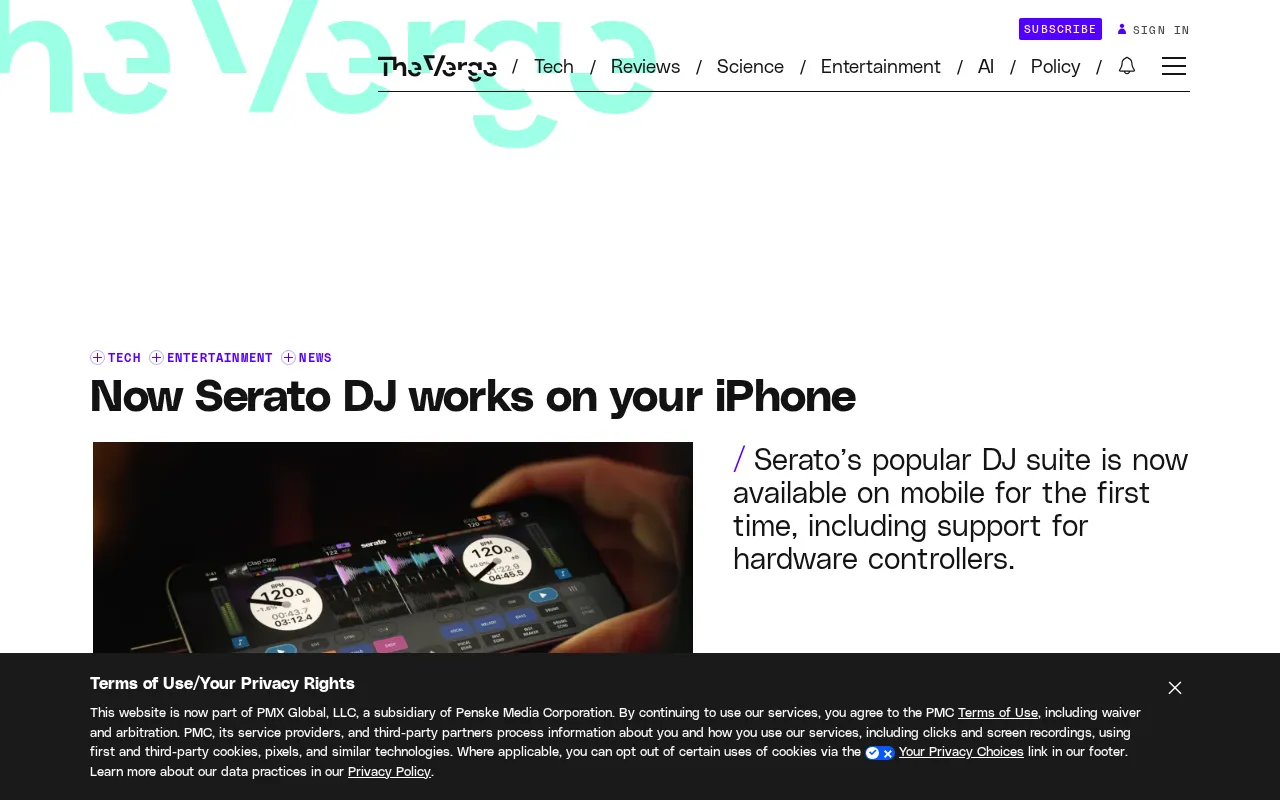
Serato has finally squeezed its professional-grade DJ suite into the iPhone. The company, which has long dominated club and festival DJ booths, has only made a few marginal attempts on mobile in the past—such as Pyro, a lightweight app that was essentially just auto-crossfading between playlists. The newly released Serato DJ for iOS marks the first time Serato has brought most of its core product's functionality to the iPhone and iPad.
From Pyro to a Full Suite: Serato's Mobile Turning Point
To understand the weight of this release, you first need to look at Serato's past stance on mobile. Pyro's existence shows the company hadn't entirely avoided the phone scenario, but its positioning was more like a "playlist player with crossfade" toy—a far cry from a real DJ workflow. For DJs accustomed to Serato DJ Pro, mobile had always been a blank space.
The launch of Serato DJ for iOS means the company is willing to push professional features down to touchscreen devices. The original article explicitly states that this is the first time Serato has brought "most of the features" of its suite to the iPhone and iPad. In other words, the phone is no longer just a supporting act for previewing or remote control—it can independently carry one end of the DJ operation.
What Professional DJing on a Phone Means
Moving professional DJ software onto a phone has never been about interface scaling; the real challenge is reconstructing the interaction model. The core DJ operations—scratching, faders, effects, and loops—are all built on physical feel. By choosing to land on iOS, Serato is essentially rearranging these control logics within multi-touch and limited screen space.
For users, the most direct change is a lower device barrier. A Serato workflow used to require a laptop plus a controller; now the iPhone or iPad itself can become a usable setup. This holds considerable appeal for traveling DJs, small party scenarios, and enthusiasts who want to practice anytime.
In DJ software, "scratching" refers to moving the record back and forth by hand on a turntable or turntable simulation interface to create rhythmic friction sounds; on digital devices, it relies on low-latency real-time reading of audio buffer positions. Faders include channel faders that control the volume of each channel and the crossfader used to switch between left and right channels—they are the physical foundation of mixing and scratching techniques. Effects usually refer to real-time audio processing modules such as filters, delays, and reverb, while a loop seamlessly repeats a segment of audio to extend or restructure the rhythm. These operations are extremely sensitive to touch latency; typically, end-to-end latency must be kept within a dozen or so milliseconds to ensure scratching and faders feel responsive. Touchscreens lack physical damping and travel, so the iOS version must compensate through gesture mapping, force sensing, and interface layout—which is also the hardest part of bringing professional DJ software to mobile.
The Competitive Landscape of the Mobile DJ Market
Serato is not the first DJ software vendor to set its sights on iOS. Algoriddim's djay series has been iterating on iPhone and iPad for years, accumulating a substantial user base in the touchscreen DJ niche. Serato's entry means professional desktop software vendors are beginning to directly address mobile scenario needs rather than treating the phone as an accessory.
For Serato, the advantage lies in its ties to a large amount of DJ hardware, library management habits, and club-standard workflows. If the iOS version can smoothly connect with the desktop library and settings, it won't be a mobile app starting from scratch but an extension of the existing Serato ecosystem. This is something pure mobile products find hard to replicate.
Algoriddim's djay is a representative mobile DJ app. It first entered the market on iOS with touchscreen dual decks and automatic beat matching, later adding support for streaming libraries such as Spotify and Apple Music as well as a large number of Bluetooth and USB controllers, and it has won an Apple Design Award. Its positioning leans toward consumer and lightweight professional users, emphasizing out-of-the-box usability and touchscreen-first interaction. Serato, by contrast, has long served club and festival scenarios; its desktop software Serato DJ Pro is deeply tied to mainstream hardware such as Pioneer DJ and Rane, and its library management and analysis system (such as Serato Crates, hot cues, and beat grids) is used as a standard workflow by many professional DJs. The key competitive difference lies in this: djay grew upward from mobile, while Serato extends downward from professional desktop—the former wins on the maturity of the touchscreen experience, the latter on ecosystem integration and credibility in professional scenarios.
Implementation Details Worth Watching
The information disclosed so far centers on the fact of "landing on iOS" itself. The specific feature list, the scope of hardware compatibility, whether it supports subscription or one-time purchase, and how the library syncs with Serato DJ Pro all await further official clarification. For professional users, these details determine whether it's a "usable phone version" or a "phone version you can take on stage."
From a trend perspective, the signal Serato's move sends is clear: mobile devices are shifting from auxiliary to primary in the DJ workflow. What to watch next is whether the iOS version can withstand the tests of latency, stability, and operational precision in real performance scenarios.
One-line Summary
Serato brings most of its professional DJ suite to iPhone and iPad for the first time, as the mobile DJ market welcomes a desktop-class player.
Paragraph Summary
Serato releases Serato DJ for iOS, bringing most of its professional suite to iPhone and iPad for the first time, changing its previous marginal stance of having only lightweight apps like Pyro on mobile. The article notes that the real challenge of professional DJing on a phone is reconstructing operations that rely on physical feel—scratching, faders, effects, and loops—into touchscreen interaction, while the lower device barrier will attract traveling DJs, small parties, and practice scenarios. With Serato's entry, it will compete head-on with Algoriddim djay, which has been deeply invested in iOS for years; its advantage lies in ecosystem ties to desktop libraries, hardware, and club-standard workflows. The specific feature list, hardware compatibility, and library sync methods remain to be officially disclosed.
Related articles

Will GitHub Die? Open Source Maintainer Burnout and the Collaboration Crisis in the AI Era
Lex Fridman podcast discussion on open source maintainer burnout and GitHub's predicament: massive pull requests overwhelm core maintainers, and AI worsens code bloat. Using math journal peer review and Poincaré conjecture verification as analogies, the article analyzes why verification in knowledge production must be deliberately slow, and how open source communities can avoid the failure mode of maintainers exiting.

Stop Building Cookie-Cutter AI Websites: 3 Tools That Transform Your Coding Agent
Three tools that boost AI coding agents: FFmpeg skill for local video editing in Claude Code and Cursor, Hallmark's 50 design themes to fix cookie-cutter AI sites, and Jailbreaks' 25+ model prompts.

How America's Gerontocracy Squeezes the Younger Generation
Americans over 55 hold nearly three-quarters of national wealth, alongside an 80-year-old president and elderly congressional leaders. The Atlantic's Idrees Kahloon explains how gerontocracy drives up housing costs, squeezes opportunities for the young, and explores zoning reform and child poverty reduction as practical fixes.