ShellBench: Do Models or Harnesses Decide the Fate of AI Agents?

ShellBench: models matter more than frameworks, but top models differ by only 1.1 points—cost is the key selection factor.
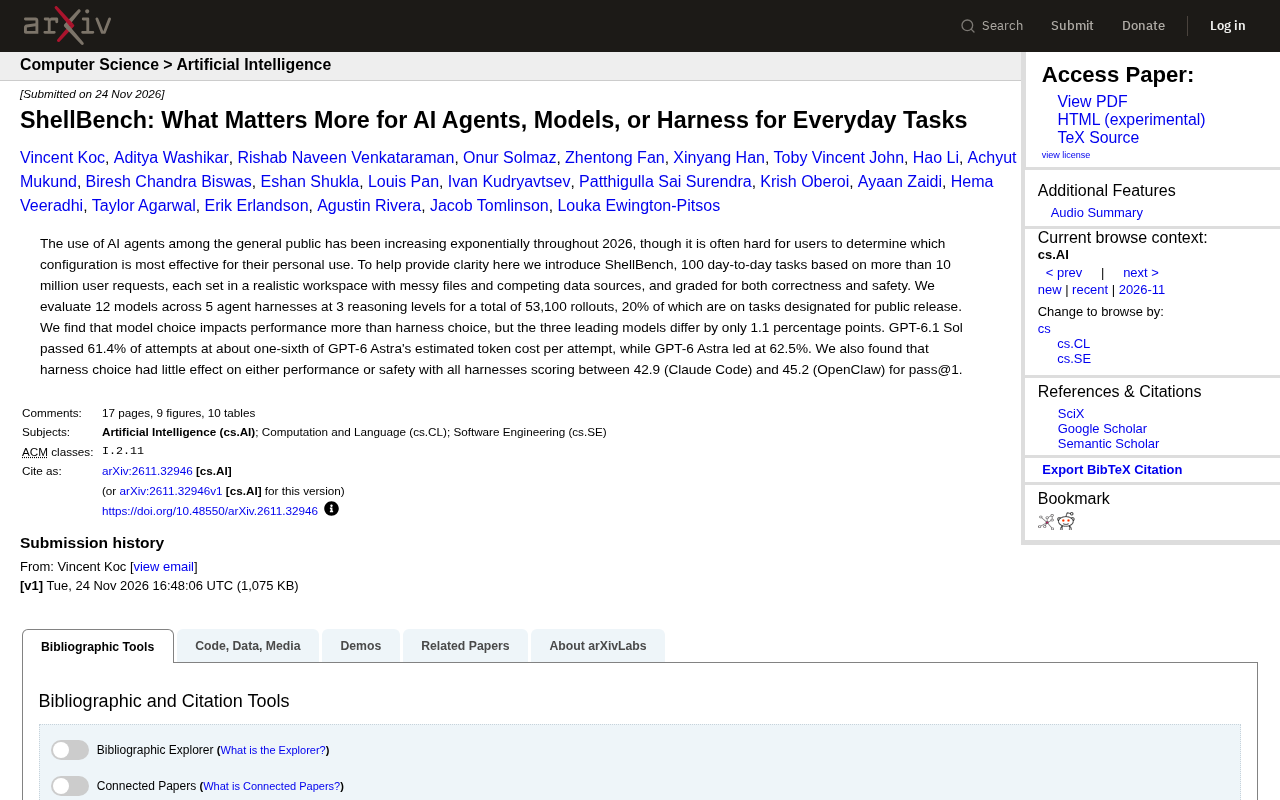
ShellBench distilled 100 everyday tasks from over 10 million real user requests, evaluating 12 models, 5 agent harnesses, and 3 reasoning effort levels across 53,100 rollouts, scoring both correctness and safety. Model choice affects performance more than harness, yet the top three models differ by only 1.1 percentage points. The real differentiator is cost: GPT-6.1 Sol reaches 61.4% pass rate at roughly one-sixth the token cost of GPT-6 Astra's 62.5%. Harness pass@1 scores cluster between 42.9 and 45.2, so framework choice is not decisive. Users should prioritize model cost-performance over framework selection.
As AI agents move from the lab into everyday use, the question ordinary users care about most has shifted from "can it work?" to "what's the best setup?" Models, agent frameworks, reasoning effort levels—these interlocking variables make choosing a configuration extraordinarily difficult. ShellBench's test results offer a counterintuitive answer: the model matters far more than the framework, yet the gaps between top models are surprisingly small.
100 everyday tasks, 53,000 real-world simulations
ShellBench's construction logic is refreshingly grounded: it distills 100 everyday tasks from over 10 million real user requests, runs each one in a realistic workspace cluttered with messy files and multiple data sources, and scores both correctness and safety. This design targets the core pain point of agent deployment—users don't submit clean, structured instructions; real environments are full of noise and conflicting information.
The evaluation scale is substantial: 12 models, 5 agent harnesses, and 3 reasoning effort levels, totaling 53,100 rollouts, with 20% of tasks marked for public release. This crossed design allows the effects of different variables to be decomposed and compared, rather than lumping everything into a single overall score.
pass@1 is a metric commonly used in code generation and agent evaluation, referring to the proportion of tasks a model completes on a single attempt (rather than picking the best of multiple samples). In contrast, pass@k allows the model to generate k candidate answers, passing if any one of them is correct. pass@1 therefore better reflects the real-world scenario where a user submits an instruction only once, and more accurately captures a model's stability and reliability. ShellBench uses pass@1 as its primary performance metric, meaning the percentages on the leaderboard can be read directly as "the probability of succeeding on a single attempt."
Rollout, in the context of reinforcement learning and agent evaluation, refers to one complete interaction trajectory from the agent receiving a task to producing a final result, including multiple rounds of tool calls, environment feedback, and state changes. Since a single task may involve dozens of model calls, the token consumption and time cost of one rollout far exceed those of ordinary Q&A. ShellBench's 53,100 rollouts were accumulated under a fully crossed design of 12 models × 5 harnesses × 3 reasoning effort levels × 100 tasks, which also explains why its cost estimates need to be measured separately as "token cost per attempt."
Model gaps are slim, cost gaps are vast
ShellBench's most notable finding is that model choice does indeed have a greater impact on performance than harness choice, but the top three models differ by only 1.1 percentage points. GPT-6 Astra leads with a 62.5% pass rate, followed closely by GPT-6.1 Sol at 61.4%—a difference that is not statistically significant.
The real dividing line is cost. GPT-6.1 Sol's estimated token cost per attempt is only about one-sixth that of GPT-6 Astra, yet its performance is only 1.1 percentage points behind. For everyday tasks that require extensive trial and error or long-running operation, this cost-performance difference may be more decision-relevant than the ranking itself. In other words, the most expensive model isn't necessarily the best fit for you—the price of marginal performance gains deserves careful weighing.
Harnesses aren't the decider—performance and safety converge
In contrast to the model dimension, harness choice has minimal impact on both performance and safety. The five harnesses' pass@1 scores cluster between 42.9 (Claude Code) and 45.2 (OpenClawAd), a spread of just a few percentage points, and safety scores show no significant divergence either.
This result challenges the common community belief that "switching frameworks is like switching blades." For users agonizing over which agent framework to choose, ShellBench's signal is clear: in the current harness ecosystem, framework differences alone are not decisive. Investing effort in model selection and task design yields more direct returns.
Agent harness (sometimes called an agent scaffold or runtime framework) refers to the software layer wrapped around the base model that drives agent behavior, with typical examples including Claude Code and OpenClaw. It usually handles several responsibilities: assembling user instructions and system prompts into model input, parsing tool-call requests from model output, actually executing file reads/writes or commands, managing multi-turn conversation context and history compression, and handling error retries and permission control. The same model may perform differently under different harnesses due to prompt design, tool interfaces, and context management strategies—but ShellBench's results show that among mature harnesses, such differences have been compressed to within a few percentage points.
The hidden trade-off between reasoning effort and safety
The evaluation also covers 3 reasoning effort levels, meaning users must not only choose a model and framework but also decide how "deeply" the model should think. ShellBench incorporates safety into its scoring rather than looking only at task completion rates—a departure from most benchmarks that focus solely on success rates. In everyday tasks, an agent that completes the task but operates dangerously has reduced practical usability.
Interestingly, whether the slim performance gaps between models get amplified in the safety dimension—ShellBench's data does not point to significant divergence, but the inclusion of safety scoring itself reminds users: don't look at just one number (the pass rate) when choosing.
Reasoning effort (or thinking budget) is an adjustable parameter introduced by reasoning models in recent years to control how deeply the model thinks internally before giving an answer, typically divided into low, medium, and high levels. Higher levels mean the model generates more thinking tokens, often more accurate on complex multi-step tasks, but with increased latency and cost; lower levels respond faster and cheaper but may err on tasks requiring planning. For agents, reasoning effort also affects the quality of tool-call decisions—insufficient thinking may lead to erroneous operations, while excessive thinking may slow down the entire task chain. It is therefore effectively a third cost-and-performance tuning knob independent of model and framework, which users must weigh based on task complexity.
Takeaways for ordinary users
Overall, ShellBench delivers several practical signals. The model is the primary variable, but top models have entered a performance plateau—a 1.1 percentage point gap is hard to perceive in real use. Cost differences are more worth attention: GPT-6.1 Sol approaches the top performance at roughly one-sixth the token cost, making it friendlier for high-frequency use. Harness influence is limited, so there's no need to agonize over framework choice.
Of course, ShellBench's 100 tasks are built on a specific user demographic and task distribution, and the generalizability of its conclusions requires more independent validation. But at least at the current stage, it has turned the vague question of "model or harness—which matters more?" into a clear, data-backed answer.
One-line Summary
ShellBench tests show: models matter more than frameworks, but top models differ by only 1.1 percentage points—cost is the real selection factor.
Paragraph Summary
ShellBench distilled 100 everyday tasks from over 10 million real user requests, evaluating 12 models, 5 agent harnesses, and 3 reasoning effort levels in cluttered real-world workspaces across 53,100 rollouts, scoring both correctness and safety. Results show model choice affects performance more than harness, but the top three models differ by only 1.1 percentage points—top models have hit a performance plateau. The real difference is cost: GPT-6.1 Sol achieves a 61.4% pass rate at roughly one-sixth the token cost, just behind GPT-6 Astra's 62.5%. The five harnesses' pass@1 scores cluster between 42.9 and 45.2, making framework choice non-decisive. The article therefore advises ordinary users to prioritize model cost-performance rather than agonizing over frameworks.
Related articles

Nothing CMF Buds 2A Drops to $17.89 on Black Friday: A New Low for ANC Earbuds
Nothing CMF Buds 2A wireless earbuds Black Friday deal: just $17.89 on Amazon, about $11 off retail and a record low. ANC earbuds at an entry-level price.

When AI Creation Gets Accused of "Spitting": Hacker News Heats Up Over the Glaude Controversy
A Hacker News post, "Spitting in the Face of Glaude," sparks debate on AI creation transparency and attribution ethics. This analysis examines the blurred creator identity behind the controversy and offers practical advice for AI content production.

Akai Embraces Custom Firmware: MPC Sample 1.4 Lets Users AI-Program Their Sampler
Akai embraces the modding community with MPC Sample 1.4 firmware, supporting vibe-coded custom firmware and effects. We analyze the impact of this open strategy on music hardware and AI-assisted programming.