ShinyHunters Breaches FBI Recruitment Portal: A Wake-Up Call on Credential Abuse Attacks

ShinyHunters used valid credentials to breach the FBI's recruitment portal, exposing the near-futility of traditional auth against credential abuse.
The ShinyHunters group breached the FBI's recruitment portal using valid credentials within a legitimate active session, and the FBI later arrested a second suspect. The incident's core lesson: no authentication alert was triggered because the session was technically legitimate. IBM data shows credential abuse attacks go undetected for an average of 197 days. Even a well-resourced federal agency like the FBI couldn't fully prevent it — proving password policies and security hygiene alone are insufficient. True defense requires shifting from "verify who you are" to "continuously assess what you're doing," built on Zero Trust architecture, user behavior analytics, continuous session validation, and shorter credential lifespans.
The Incident: FBI's Own Recruitment Portal Compromised
The ShinyHunters hacking group successfully breached the FBI's recruitment portal, after which the FBI arrested a second suspect connected to the case. What's worth reflecting on, however, is that by the time the arrest happened, the data breach itself was long over — the attackers had completed their entire operation inside what appeared to be a legitimate session, before anyone noticed anything was wrong.
This was not a typical case of brute force or vulnerability exploitation. The attackers used valid credentials and operated within an active session. To every security layer the system had, that session looked completely normal. In other words, every authentication check returned "pass."
Credential Abuse: The Hardest Attack Pattern to Defend Against
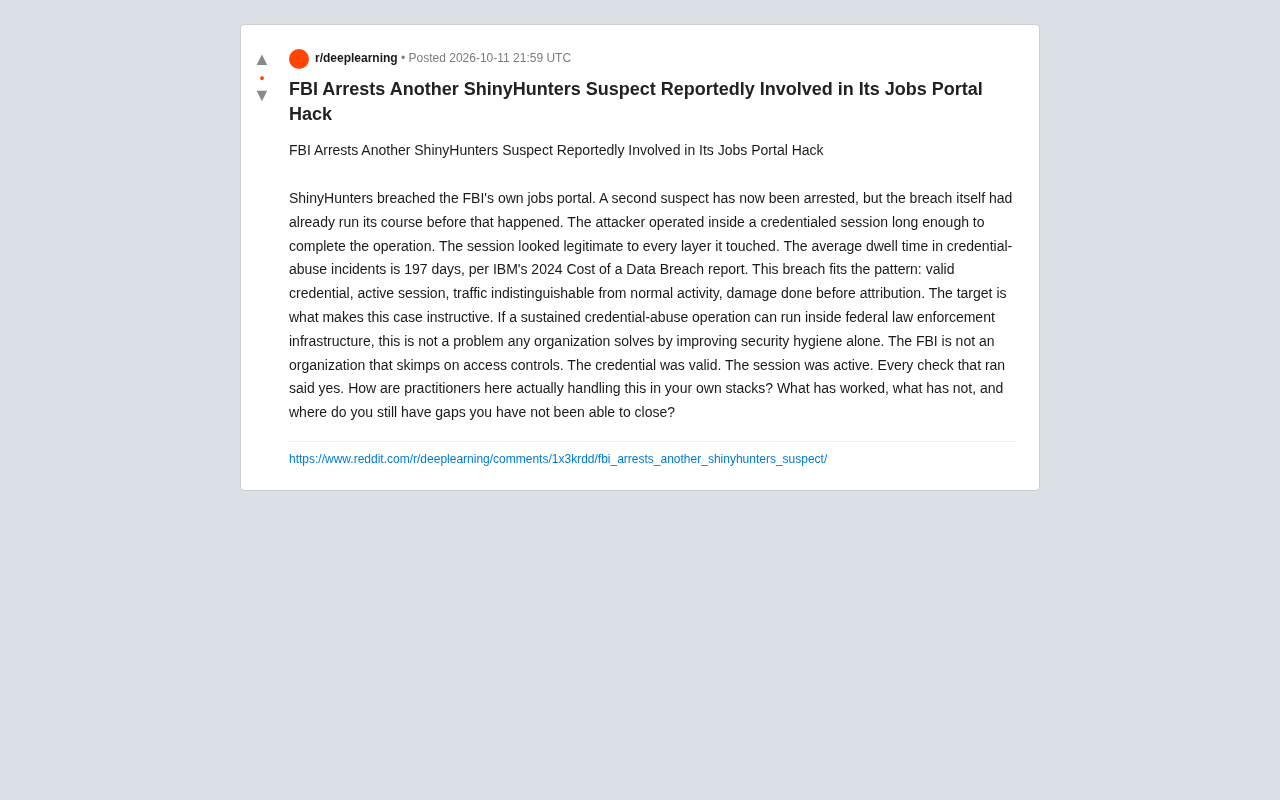
What makes this incident so significant is that it embodies the defining characteristics of a credential abuse attack: valid credentials, an active session, traffic indistinguishable from normal activity, and damage done before attribution is even possible.
According to IBM's 2024 Cost of a Data Breach Report, the average dwell time for credential abuse incidents is 197 days — meaning attackers can lurk inside a system for nearly half a year without being detected. The FBI recruitment portal breach fits this pattern exactly: with valid credentials and an active session as cover, the attackers had all the time they needed to carry out their operation at a leisurely pace.
Why Traditional Defenses Fall Short
The core problem is this: when an attacker is using legitimate credentials, traditional perimeter defenses and authentication mechanisms are nearly powerless. Every check in the system confirms "this is an authorized user" — because technically, it is. The traffic looks normal, the session looks legitimate, and no obvious anomaly triggers an alert.
This type of attack doesn't bypass a technical vulnerability — it bypasses the trust mechanism itself. Once credentials fall into an attacker's hands, the entire access control framework loses its basis for judgment.
Understanding the common pathways for obtaining credentials helps explain why defense is so difficult. Attackers typically acquire valid credentials through several methods: phishing, which tricks users into entering their credentials directly; infostealer malware (such as Redline and Raccoon), which batch-harvests browser-saved passwords and session cookies from victim devices; purchasing credential combos from dark web markets that originated from previous breaches; and session hijacking, which steals already-authenticated session tokens and bypasses the password step entirely. ShinyHunters' past attack record shows the group favors exploiting cloud storage misconfigurations or weak passwords at third-party vendors as initial footholds, then laterally pivoting into core systems. This means that even if an organization's internal password policies are airtight, a single gap in the supply chain or an external access point can hand attackers a "legitimate" entry ticket.
Why the FBI Case Matters
The target is the most striking part of this story. The FBI is a federal law enforcement agency — not an organization that cuts corners on access controls. It has a relatively mature security posture and substantial resources to invest in it.
And yet, a persistent credential abuse operation was still able to run inside federal law enforcement infrastructure. That sends a clear signal: this is not a problem any organization can solve simply by improving its security hygiene.
If an institution at the FBI's level cannot fully prevent this type of intrusion, then for organizations with more limited resources, relying solely on stronger password policies and regular patch cycles is clearly nowhere near enough.
From Perimeter Defense to Zero Trust
This incident once again underscores the industry's need to shift toward a Zero Trust architecture. The core principle of Zero Trust is "never trust, always verify" — even sessions that have already passed authentication must have their behavior continuously evaluated for anomalies.
By combining User and Entity Behavior Analytics (UEBA), anomalous session detection, and the principle of least privilege, organizations may be able to shorten the dwell time of credential abuse attacks — detecting and cutting off suspicious sessions before the damage spreads.
Zero Trust Architecture (ZTA) is not a single product but a security design philosophy centered on identity, formally defined by NIST in SP 800-207. Its key principles include: explicit verification of all resource access requests, regardless of whether they originate inside or outside the network; granting least privilege access to avoid over-authorization; and assuming breach by default, with continuous monitoring rather than one-time trust. In practice, Zero Trust typically relies on identity providers (IdPs), device health checks, micro-segmentation, and a continuous access policy engine working in concert. It's worth noting that Zero Trust adoption is incremental — full migration often takes years. For large federal agencies, the cost and complexity of modernizing legacy systems are particularly acute, which partly explains why security gaps persist even when the problem is well understood.
The Shared Dilemma of Practitioners
The question posed at the end of the original post is one every security professional should sit with: within your own tech stack, how do you actually defend against this type of attack? What works, what doesn't, and what gaps remain unfilled?
This speaks to a collective anxiety in the industry. Credential abuse is so difficult to handle precisely because it occupies a blind spot in technical defenses — attack behavior looks nearly identical to legitimate behavior at the data level. Even with multi-factor authentication (MFA) deployed, if a session is hijacked or credentials are stolen along with session tokens, the defense line can still be breached.
Actionable directions for improvement include:
- Continuous session validation: Don't treat a single successful login as the endpoint of trust — dynamically assess risk throughout the entire session lifecycle.
- Behavioral baseline modeling: Establish normal behavior patterns for users, and trigger secondary verification or alerts when actions deviate from the baseline.
- Shorter credential lifespans: Reduce reliance on long-lived credentials; adopt short-lived tokens and just-in-time privilege grants.
- Lateral movement detection: Monitor internal network access paths for anomalies, and quickly identify attackers pivoting through internal systems.
MFA is currently the most widely deployed credential protection measure, but its defensive perimeter is being eroded by session-layer attacks. Traditional MFA verifies identity at the moment of login — once authentication succeeds and a session token is issued, subsequent requests are typically trusted on the basis of that token alone. Attackers using adversarial proxy tools (such as Evilginx2 and Modlishka) can relay traffic in real time between the user and the legitimate site, capturing the session cookie the instant the user completes MFA verification, and then taking over the session in a fully authenticated state — MFA never "failed"; it was simply bypassed. This creates a significant security gap between push-notification-based MFA and hardware key-based (FIDO2/Passkey) authentication: the latter binds verification to a specific device and origin domain, fundamentally preventing this type of man-in-the-middle hijacking, and is currently the most effective MFA form against session hijacking.
Closing Thoughts
The ShinyHunters breach of the FBI recruitment portal is a stark reminder: security is not a door you can lock shut once and forget — it is an ongoing confrontation. When an attacker holds valid credentials, every check based on "is this identity legitimate?" will fail. Real defense must shift from "who are you" to a continuous assessment of "what are you doing." For organizations of any size, this remains a problem that hasn't been fully solved, and cannot be solved by any single measure.
Related articles

OpenAI Partners with Shield: How the Astra Agent Revolutionizes IT Troubleshooting
OpenAI and Shield launch the Astra agent, which autonomously logs into computers and legacy systems to fix IT issues in real time, 35-40% faster than traditional models, with humans involved only when judgment is needed.

iPhone Duo Battery Life Tested: One Charge a Day Is Unavoidable, and the Large Screen Is the Culprit
iPhone Duo battery test: heavy use needs at least one charge a day, and about 30% remains after 6.5 hours of screen-on time. How often the large screen is unfolded is key; a MagSafe battery pack helps, and long-term degradation is also worth watching.

Kimi K3.1 Pro Open-Sourced: 2.8 Trillion Parameters Close In on Opus
Moonshot releases the open-source MoE model Kimi K3.1 Pro, with 2.8T total parameters and 104B activated, trailing Opus 5.5 by under 1 point on Terminal Bench 4.0.