Shivon Zilis and Musk Break Up: A Public Drama for the Social Media Age

Shivon Zilis used a social media unfollow-tracking account to publicly announce her breakup with Elon Musk.
Shivon Zilis, Neuralink's Director of Operations and mother of several of Musk's children, announced her breakup with Elon Musk in a striking way: by quote-reposting content from "Big Tech Alert," an account that tracks follow and unfollow activity among tech figures. Described as a return to "MySpace-era internet drama," the move highlights two dynamics of the social media age — that follows and unfollows have become symbolic social signals subject to real-time public monitoring, and that proactively controlling one's own narrative in a public forum is itself a form of privacy management in the algorithmic era.
A Breakup Announcement, Social Media Style
Shivon Zilis — the mother of four of Elon Musk's children — announced on X that she and Elon Musk have broken up. The news itself wasn't entirely surprising. What's genuinely fascinating is the method she chose: a quote-repost of content published by an account called "Big Tech Alert" served as her official public statement.
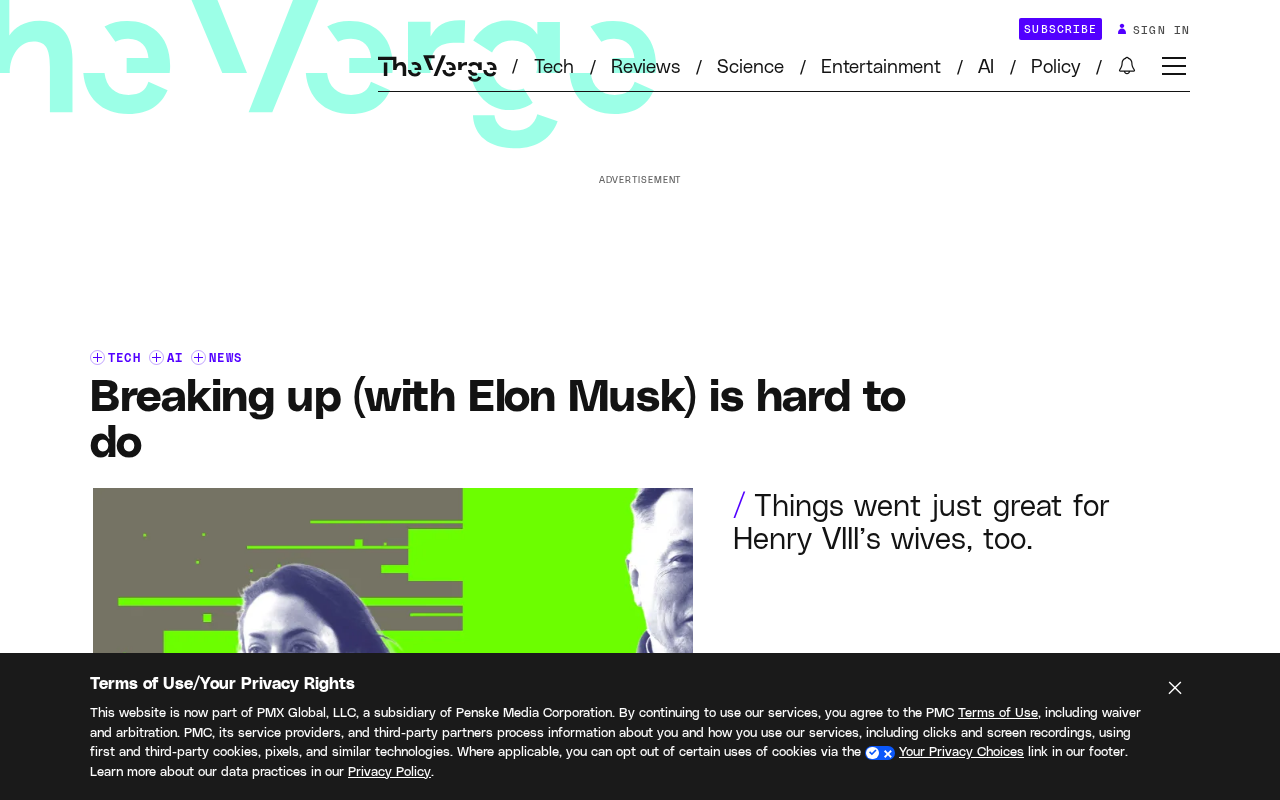
The move has been described as a return to "MySpace-era internet drama" — evoking the raw, direct, and slightly performative emotional expression of early social networking. Against today's highly centralized, algorithm-driven platform landscape, this kind of almost primitive "public callout" feels jarringly out of place, and all the more attention-grabbing for it.
Zilis is a significant figure in Silicon Valley in her own right, not merely known for her personal relationship with Musk. A Yale graduate, she has held positions at Bloomberg Beta and OpenAI, and currently serves as Director of Operations at Neuralink, Musk's neural interface company. She and Musk have had multiple children together, and she carries her own professional reputation and social capital within elite tech circles. Given this context, her choice to speak out proactively on X was likely not pure emotional venting — it was probably a calculated act of narrative management. In her circles, information travels fast, and controlling the first statement is almost always more advantageous than reactive clarification.
What Is "Big Tech Alert"?
"Big Tech Alert," the account Zilis quoted, is dedicated to monitoring the social media behavior of tech industry figures. One of its core functions is tracking follow and unfollow activity — who followed whom, and who unfollowed whom — automatically detected and published in near real-time.
In the social media context, "following" and "unfollowing" have long transcended their functional purposes and become symbolic social signals. When two closely associated public figures show unfollow activity between their accounts, the outside world tends to interpret it as a sign of a changed relationship. Zilis's choice to quote exactly this kind of unfollow-monitoring post to announce a breakup demonstrates a fluent command of social media's symbolic language.
The very existence of accounts like this reflects the openness of social platform data. X (formerly Twitter) offers public API access, allowing third-party developers and account operators to bulk-scrape changes in users' follower lists and push them out almost in real time. Together with accounts that monitor deleted posts and liked content, these form an unofficial ecosystem of "social media behavior archives." It's worth noting that such monitoring practices typically exist in a legal gray area — the data itself is public, but large-scale automated scraping may violate platform terms of service. Since Musk acquired Twitter and significantly restricted API access, the operational costs and feasibility of such accounts have fluctuated considerably. Those still operating in today's environment likely have specific technical or commercial logic sustaining them.
The Boundaries of Celebrity Privacy and Social Media Expression
This episode reflects a broader issue: how public figures' private relationships are made public and turned into symbols in the social media age. For a global tech icon like Musk, any personal development attracts amplification, interpretation, and consumption at scale.
The fact that the person involved chose to announce private matters on a public platform also speaks to a distinctive communication logic of the moment — rather than letting the outside world piece together clues and speculate, it's often more advantageous to control the narrative pace yourself, making a direct statement in the language of social media. This approach represents both a redefinition of the boundaries of privacy and an active form of managing public attention.
A Footnote to an Era, Behind the Drama
From a communications perspective, this breakup announcement attracted attention not only because it involves a figure as prominent as Musk, but because it illustrates how social media is reshaping the ways people express intimate emotions. Quoting a monitoring account, leveraging platform symbols, completing a personal statement in a public arena — this sequence of actions constitutes a textbook example of a "social media age emotional event."
It should be noted that the information currently available to the public remains limited, and the specific background and subsequent developments of the situation are not yet fully clear. But purely in terms of how this event presented itself, it already offers a vivid cross-section for observing the dynamics between contemporary tech celebrities and social media.
Related articles

NVIDIA's 30,000 Developers Use Cursor, Code Commit Volume Triples
Cursor engineer Chris Diaz breaks down five organizational gaps blocking enterprise AI coding scale—strategy, risk tiering, governance, metrics, and operating model. NVIDIA's 30,000 developers use Cursor daily, tripling code commits while defect rates stay flat. The key: rewrite the SDLC, not add tools.

Ponytail: Giving AI Coding Agents a Senior Engineer's Mindset
Ponytail is a free GitHub tool that injects a senior engineer's mindset into AI coding agents, making them ask whether code is even necessary first. According to TamilDeck, it can compress 200 lines of AI-generated code to 30, cutting token costs, with support for Cursor rules and Claude Code skill integration—though security review still requires human oversight.

Complete Guide to Connecting Cursor AI to the GitHub MCP Server
A step-by-step guide to connecting Cursor AI to the GitHub MCP server: create a personal access token, configure mcp.json, store the token in the ENV block, and verify with a PR query.