ShogunAI: A Deep Dive into the Personal AGI Assistant Running on Your Local PC

ShogunAI is a local-first Mac AI agent that builds a living map of your entire work context.
ShogunAI is a macOS-only personal AI assistant positioning itself as "AGI on your PC." Instead of being another chatbot, it acts as an agent that continuously tracks your contacts, projects, and commitments to build a comprehensive work state engine. Key design principles include local-first architecture for privacy, evidence retention for every AI record, and a human-in-the-loop approval system where reading is automatic but sending always requires user consent.
A Vision for AGI That Goes Beyond Chatbots
Recently, a product called ShogunAI launched on Product Hunt with the tagline "AGI on your personal PC," drawing considerable attention. After launch, it garnered 76 upvotes and ranked 16th for the day, categorized under Mac, Productivity Tools, and Artificial Intelligence. The product currently supports macOS only.
Unlike the endless stream of AI chat tools on the market, ShogunAI's core proposition is strikingly clear: True personal AGI won't arrive as a "better chatbot" — it will manifest as an agent that understands your entire work state. It tracks every person you interact with, every project you're involved in, and every commitment you've made, then takes action accordingly.
It's worth clarifying a concept here. AGI (Artificial General Intelligence) is academically defined as an AI system possessing broad cognitive capabilities comparable to or exceeding those of humans — capable of understanding, learning, and executing any intellectual task without specialized training. Current mainstream large language models (such as GPT-4, Claude, etc.) are classified as "narrow AI" (ANI): they excel in specific domains but lack genuine cross-domain autonomous reasoning. The field is deeply divided on when AGI will be achieved — optimists say within a decade, pessimists say it could take decades or longer. ShogunAI positions itself as "personal AGI," effectively borrowing AGI's concept of generality to describe its cross-work-scenario capabilities, rather than claiming to have achieved AGI as strictly defined by academia.
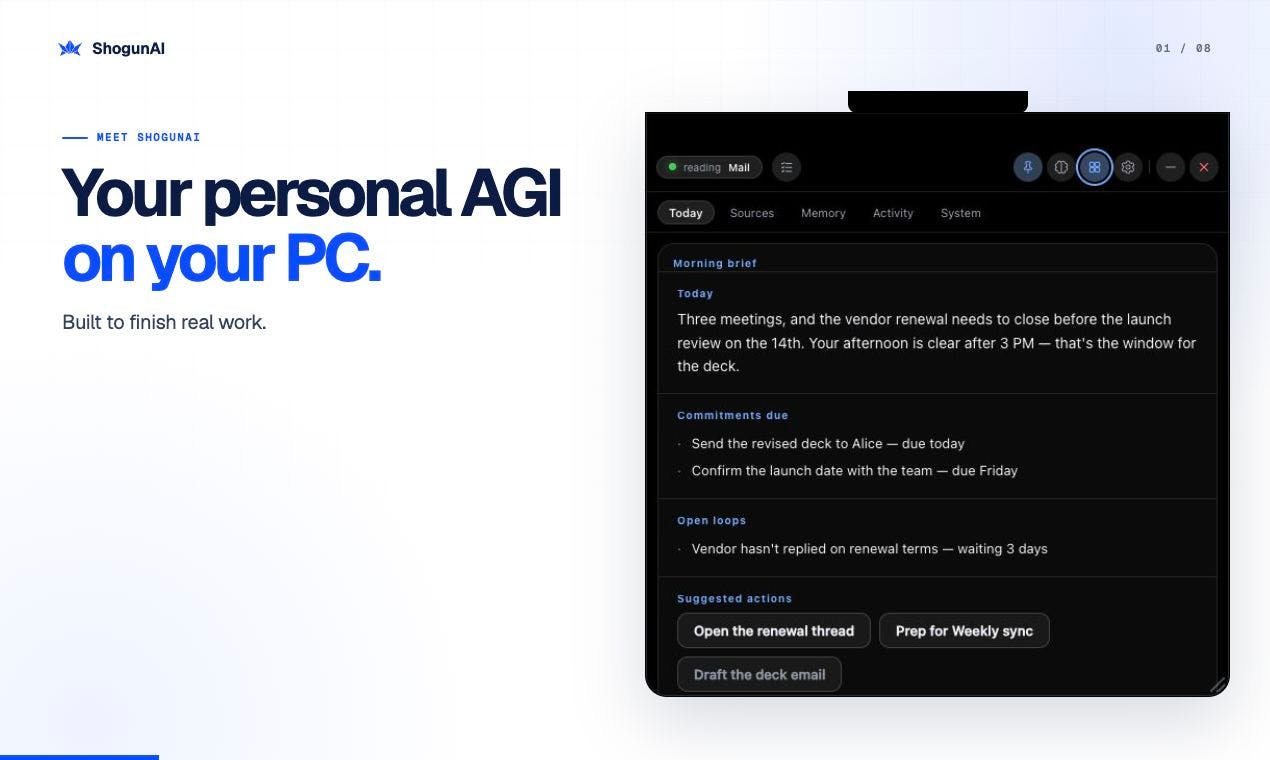
This positioning hits a real pain point in current AI applications — most tools are great at answering isolated questions but know nothing about the user's complete work context. ShogunAI aims to fill that gap.
ShogunAI's Core Philosophy: General Across Your Work, Not Narrow to One Task
ShogunAI emphasizes that it is "general across your work rather than narrow to one task." This is its most fundamental difference from traditional vertical AI tools.
From Task Tool to Work State Engine
Traditional AI tools are typically designed for specific scenarios: writing emails, summarizing documents, generating code. ShogunAI's ambition is to build a "state engine" that spans all dimensions of your work. It continuously builds this state graph as you work, understanding the complex relationships between people, projects, and commitments.
From a technical architecture perspective, this capability relies on one of the hottest paradigm shifts in AI — AI Agents. Unlike traditional "ask-and-answer" chatbots, AI Agents possess a complete capability loop encompassing environmental perception, autonomous planning, tool invocation, and action execution. Since 2023, open-source projects like AutoGPT and BabyAGI pioneered Agent architectures, followed by frameworks like Microsoft's AutoGen and LangChain's LangGraph that industrialized Agent development. A typical Agent system includes a memory module (short-term and long-term memory), a planning module (task decomposition and prioritization), a tool-calling module (API integration, file operations, etc.), and a reflection module (self-evaluation and error correction). What ShogunAI describes as "continuously building a work state graph" is a manifestation of Agent long-term memory — it doesn't start from scratch with each conversation but deepens its understanding of your complete work picture within a continuously accumulated context.
This means it doesn't just passively wait for instructions — it can proactively identify what needs follow-up, which commitments remain unfulfilled, and which projects are progressing, all based on its understanding of your full work picture. This shift from "tool" to "agent that knows you" is precisely where the concept of "personal AGI" finds its footing.
Local-First Architecture: Your Data Stays on Your Own PC
Another standout selling point of ShogunAI is "living inside your PC rather than someone else's cloud."
The Privacy vs. Local AI Trade-off
In an era where AI applications overwhelmingly rely on cloud computing, a local-first approach offers notable differentiation. For users handling sensitive work information, having an agent that knows "every person, every project, every commitment" carries enormous privacy risks — if all that data were uploaded to the cloud, the security concerns would be glaring.
ShogunAI chooses to run the agent locally on the user's machine, theoretically keeping these highly private work state data on the user's own device. This choice is supported by the rapid advancement of local AI technology over the past two years. Inference frameworks like llama.cpp have enabled large language models to run efficiently on consumer hardware, while quantization techniques (such as 4-bit/8-bit quantization in GGUF format) compress models with billions of parameters to sizes that can run on laptops with 16GB of RAM. Apple Silicon chips (M-series) have become an ideal platform for local AI inference thanks to their unified memory architecture (CPU and GPU sharing the same high-bandwidth memory pool) and built-in Neural Engine acceleration — which also explains, from a technical standpoint, why ShogunAI prioritized macOS. Take the M4 Pro chip as an example: it can achieve inference speeds of roughly 30-40 tokens per second when running a 7-billion-parameter model, which is generally sufficient for real-time interaction.
Of course, local deployment also means limited compute power. The most powerful cloud models (such as GPT-4o, Claude 3.5 Sonnet) have hundreds of billions of parameters and massive computational resources, while locally runnable models typically range from 7 billion to 34 billion parameters — a significant capability gap. How to support "general agent"-level capabilities on a local device will be a critical test of its real-world experience. ShogunAI may need to find some balance between local inference and cloud API calls, or compensate for model capability limitations through clever engineering.
Evidence Retention and Human-in-the-Loop Approval
Beyond generality and local-first design, ShogunAI embodies two more noteworthy principles: evidence retention and an approval mechanism.
Every AI Record Is Backed by Evidence
The official description mentions that ShogunAI "keeps the evidence behind every record." This is particularly important in AI applications — when an agent automatically generates assessments of work status, users need to be able to trace back to the underlying evidence.
AI Explainability is one of the core topics in AI governance today. The EU's AI Act officially came into effect in 2024, explicitly requiring high-risk AI systems to provide explainable decision rationale. In practical use cases, the "hallucination" problem — where AI generates content that seems plausible but is actually incorrect — is the biggest obstacle preventing AI tools from earning user trust. ShogunAI's evidence retention mechanism is essentially an extension of the RAG (Retrieval-Augmented Generation) approach: it doesn't just provide conclusions but also shows which original sources the conclusions came from (emails, meeting notes, chat messages, documents, etc.), allowing users to quickly verify the reliability of AI judgments. Without explainability, AI records easily become untrustworthy black boxes. The evidence retention mechanism lets users audit where every conclusion came from, building a "trustworthy AI" experience.
Reading Is Automatic; Sending Always Requires Your Approval
ShogunAI explicitly draws a boundary for automation: "Reading is automatic. Sending always waits for your approval."
This is a pragmatic and responsible design choice, belonging to the classic Human-in-the-Loop (HITL) design paradigm. Originating from the field of automation control, its core principle is to let machines handle information-intensive but lower-risk tasks (such as information collection, analysis, and organization), while reserving high-risk decision points for humans. In the AI Agent domain, this design is especially critical — in 2023, several autonomous Agent projects caused unintended actions due to lacking human approval steps (for example, early versions of AutoGPT attempted to register domain names and spend API credits on their own), sparking widespread industry discussion about Agent safety boundaries. Current mainstream Agent frameworks (such as CrewAI, AutoGen) have made HITL a recommended default configuration, not an optional feature.
The agent can automatically read, understand, and organize your work information, but any outbound action — sending emails, replying to messages, fulfilling commitments — must receive explicit user approval. This preserves the efficiency gains of automation while keeping ultimate control over irreversible actions firmly in the user's hands, preventing mistakes caused by an agent acting on its own.
Observations and Reflections: Is ShogunAI Worth Trying?
Based on its early reception on Product Hunt, ShogunAI's 76 upvotes and 3 comments represent a moderate performance — it attracted some attention but hasn't become a breakout hit. There's a noticeable gap between this reception and its grand "personal AGI" narrative.
What deserves recognition is that ShogunAI has identified a genuine need: AI tools urgently need to move from isolated tasks toward understanding the user's complete work context. Its local-first, evidence-retention, and send-approval designs also demonstrate a commitment to privacy and controllability.
However, the "personal AGI" label inevitably carries some marketing flair. It's currently closer to a "smart assistant that understands your work state" and remains quite far from true artificial general intelligence. Additionally, macOS-only support limits its reach. Whether such a product can ultimately deliver on its promise of "getting real work done" still needs to be validated through actual use — testing the accuracy of its state-building, the adequacy of local compute power, and its ability to handle complex workflows.
It's worth noting that ShogunAI is not alone in this space. Rewind AI (now rebranded as Limitless), Microsoft Recall, Notion AI, and other products are all exploring the direction of "understanding the user's complete work context," but each has chosen different technical paths and privacy strategies. ShogunAI's differentiation lies in combining Agent capabilities, local-first architecture, and full work state awareness — a combination that is indeed rare in the current market.
For Mac users who value privacy and need AI to deeply understand their work rhythm, ShogunAI offers a new direction worth exploring.
Related articles

Why Does the Tesla Roadster Need to Fly? A Deep Dive into Musk's Wild Demo
Tesla's Roadster launch showed wall-climbing, upside-down driving, and flying stunts—but The Vergecast notes the demo car may lack a battery, the Rocket version is invite-only and not street-legal, and the website terms don't guarantee delivery. After nine years of delays, why does this car still need to exist?

AI Is Not a Replacement: Human-AI Collaboration Through the Lens of Factory Root Cause Analysis
Starting from factory root cause analysis, this article explains how AI accelerates evidence chain construction rather than replacing human experts, exploring the pragmatic implementation logic and business value of 'AI supporting people rather than replacing them.'

AI Agent Decision Auditing: Building an Evidence Chain in Regulated Workflows
Starting from a Reddit discussion, this article analyzes three core issues in AI agent decision auditing within regulated workflows: what fields audit records should contain, how to handle feedback latency for erroneous decisions, and how to continuously calibrate LLM judge consistency with human judgment.