Should Open Source Projects Add Donation Links? A Complete Guide to Revenue Sharing Among Multiple Contributors

A practical guide to donation links and revenue sharing for multi-contributor open source projects.
When an open source project has multiple contributors, adding a donation link raises thorny questions about fairness and community spirit. This article examines four approaches — tip jars, multi-party split platforms, maintainer-keeps-all, and community reinvestment — analyzing the trade-offs of each and offering practical advice to help open source maintainers find a sustainable, community-aligned solution.
A Real Open Source Dilemma
A seemingly simple yet highly contentious question keeps resurfacing in the open source community: When an open source project has multiple contributors, should it add a "Buy Me a Coffee" donation link? And if donations come in, how should they be distributed?
This question once sparked a heated debate on Reddit. An open source project maintainer described their dilemma: they had done roughly 98% of the work, while a few other contributors had only fixed minor bugs. Faced with the decision of whether to add a donation link, they were torn.
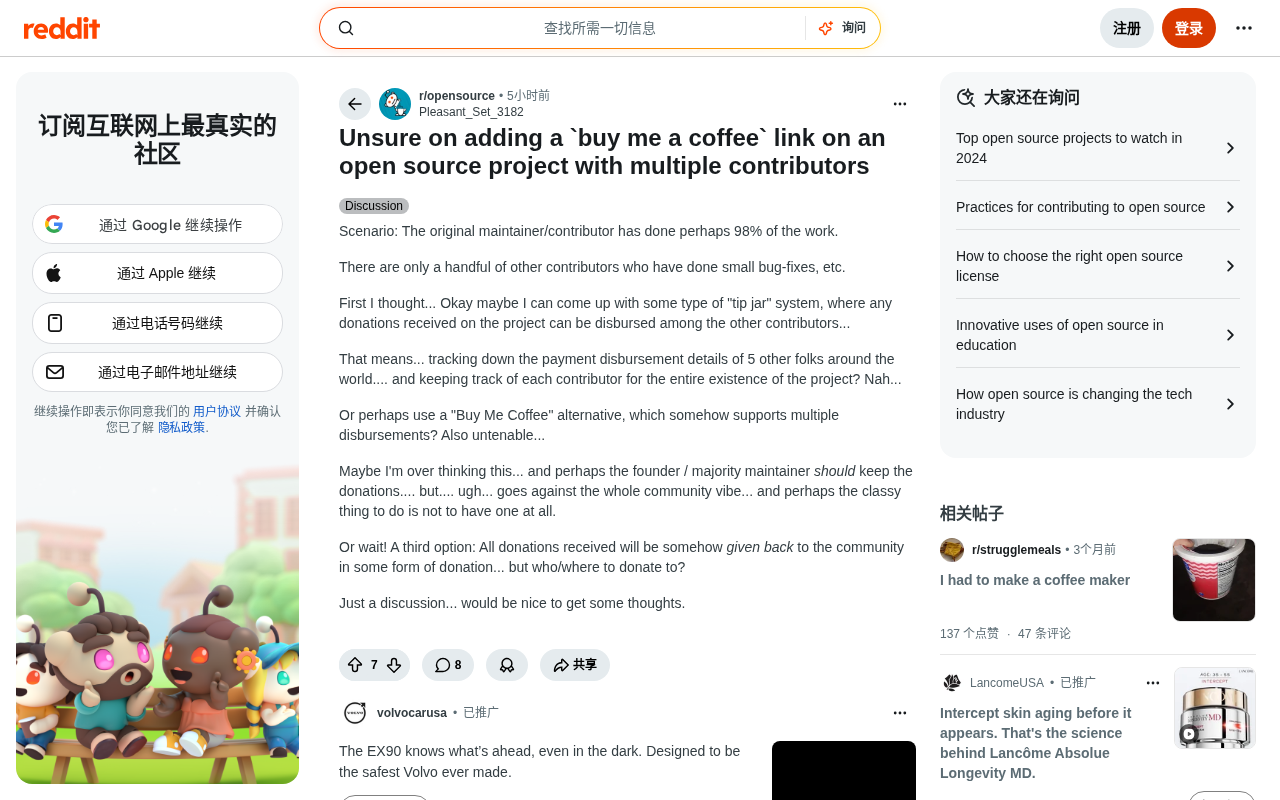
On the surface, this looks like a trivial question about adding a coffee link. But underneath, it touches on some of the most nuanced issues in the open source world: how to quantify the value of contributions, how to balance community spirit with personal compensation, and the practical challenges of distributing revenue.
It's worth noting that this discussion isn't an isolated phenomenon — it's a microcosm of the broader sustainability crisis across the open source ecosystem. The Log4Shell vulnerability in 2021 forced the entire industry to confront an uncomfortable truth: the critical global infrastructure that billions of people depend on is often maintained by a handful of unpaid volunteers. Volkan Yazıcı, one of the core maintainers of Apache Log4j, publicly stated after the vulnerability broke that he had been maintaining a library relied upon by billions of devices in his spare time without any compensation. This incident directly pushed organizations like the Linux Foundation and OpenSSF to invest more heavily in open source sustainability, and transformed "how should maintainers be fairly compensated" from a niche conversation into an industry-wide issue.
Four Approaches and Their Pitfalls
Option 1: Set Up a "Tip Jar" and Distribute by Contribution
The most idealistic approach is to set up a "tip jar" system that distributes donations proportionally among all contributors. It sounds fair — but practical obstacles emerge quickly:
"That means tracking payment info for 5 contributors across the globe... and continuously tracking every contributor over the entire lifetime of the project? Forget it."
Cross-border payments, tax compliance, contributor turnover, how to calculate proportions — each of these becomes an ongoing operational burden. For an open source project that was supposed to be passion-driven, introducing this kind of distribution mechanism could actually overwhelm maintainers.
The deeper difficulty here is that contribution levels are inherently hard to quantify objectively. GitHub's Contribution Graph only counts commit frequency and has been widely criticized as overly crude. More sophisticated approaches — such as the CHAOSS project (led by the Linux Foundation) — define dozens of contribution metrics covering code, documentation, community support, issue triage, and more. Some researchers have even proposed using "Code Survival Rate" to measure contribution quality — that is, the proportion of a contributor's submitted code that remains in later versions. However, none of these approaches can easily quantify "invisible contributions" like architectural decisions, code reviews, and community management, which are often the most critical sources of value in a project.
Option 2: Use Alternative Tools That Support Multi-Party Revenue Splitting
Tools that support multi-party revenue splitting do exist — Open Collective and the organizational features of GitHub Sponsors, for example. But even if the tools can split funds automatically, you still need to agree on distribution ratios in advance — and "distributing by contribution" is itself an impossible-to-precisely-quantify challenge. How do you weigh the core maintainer who wrote 98% of the code against a contributor who fixed a single typo?
Open Collective is a financial transparency platform specifically designed for open source communities. All income and expenses are fully public, and funds are held by a third-party Fiscal Host, so the project itself doesn't need to be a registered legal entity. This solves one of the most painful compliance headaches for small open source projects. GitHub Sponsors, by contrast, focuses more on direct support for individual maintainers, and only gradually introduced multi-person organizational splitting capabilities in 2022 — with less flexibility and transparency than Open Collective. The two platforms serve different niches: Open Collective is better suited for collaborative projects with multiple contributors, while GitHub Sponsors is better for individual maintainers building stable sponsorship relationships.
Option 3: Core Maintainer Keeps All Donations
From a contribution-equals-compensation perspective, it seems most logical for the maintainer who did the vast majority of the work to keep all donations. But this is precisely where open source culture's unique tensions surface:
"It goes against the whole spirit of the community..."
In commercial logic, it's completely natural for the biggest contributor to take the biggest share. But in open source communities, "selflessness," "collaboration," and "co-creation" are values baked into the cultural DNA. Even if it's entirely reasonable for the core maintainer to keep all revenue, it can be perceived as undermining the community's egalitarian spirit.
Option 4: Donate Proceeds Back to the Broader Community
Donating all received funds to other open source projects or nonprofits is morally the most "noble" option — but it immediately raises new questions: Who to donate to? Where to send it? Choosing beneficiaries is itself a decision-making process that requires consensus.
It's worth mentioning that some platforms have recently emerged to address this problem systematically. Tools like Stackaid and thanks.dev analyze project dependency trees and automatically route corporate donations to maintainers across the entire dependency chain, trying to fix the ecosystem imbalance where "only top-level projects receive donations while maintainers of underlying dependency libraries get nothing." This gives the "give back to the community" idea a more operationally viable technical path.
Why Is This Problem So Thorny?
Contribution Value Is Inherently Hard to Quantify
The most beautiful aspect of open source collaboration is also its most fragile point when it comes to distributing benefits. Lines of code don't equal value — a single critical architectural decision can be more meaningful than thousands of lines of boilerplate. Once money enters the picture, you're forced to confront the nearly unsolvable question of "how do you price a contribution?"
The Inherent Conflict Between Monetary Incentives and Community Spirit
Many contributors join open source projects not for compensation, but out of interest, learning, or reputation-building. Once monetary incentives are introduced, what was once a pure collaborative relationship can quietly shift — from "I want to help this project" to the transactional calculus of "I've done this much, so how much should I get?"
Operational Costs May Far Exceed the Revenue Itself
For most small to medium open source projects, donation income is often quite limited. Setting up cross-border payment tracking, tax processing, and ratio-negotiation mechanisms just to distribute what might be a few dozen or hundred dollars offers an extremely poor return on investment. A maintainer's instinct of "maybe I'm overthinking this" is actually quite accurate.
Practical Advice for Open Source Maintainers
1. Stay transparent and communicate upfront. Whatever approach you choose, the most important thing is to have an honest conversation with other contributors beforehand to avoid misunderstandings later. Transparency itself is an expression of the open source spirit.
2. Prioritize established revenue-splitting platforms. If you genuinely want to share revenue, Open Collective provides a publicly transparent financial ledger and distribution mechanism that dramatically reduces the burden of manual tracking — worth considering first. For maintainers who want a more formal relationship with enterprise users, Tidelift offers another path. Founded in 2018, the platform sells "open source subscription packages" to enterprises and distributes the income to maintainers, with both parties agreeing to explicit security response and maintenance standards. In essence, it establishes a quantifiable SLA (Service Level Agreement) relationship between open source maintainers and commercial users.
3. "No donation link" is also a dignified choice. When the complexity of a distribution mechanism far exceeds the revenue itself, keeping the project pure is actually the wiser move. As the original poster put it, "the most elegant solution might be to not set one up at all."
4. Define what the money is for, rather than fighting over who gets it. Instead of arguing about "who gets what," clarify "what it will be used for" — covering server costs, domain names, CI/CD, and other operational expenses. This gives donations a legitimate purpose while sidestepping the sensitive issue of personal distribution.
Conclusion
This seemingly trivial question reflects a long-standing sustainability challenge across the entire open source ecosystem: How can maintainers receive fair compensation without betraying the community spirit? There's no one-size-fits-all answer, but it's precisely these honest discussions that push the open source community to keep exploring healthier and more sustainable models for collaboration and incentives.
From the industry-wide soul-searching triggered by Log4Shell, to the emergence of tools like Open Collective, Tidelift, and thanks.dev, the entire ecosystem is evolving — slowly but genuinely. For every open source maintainer, perhaps the most important thing isn't finding the "perfect solution," but choosing an approach that both you and your community can genuinely accept. That, in itself, is the best expression of the open source spirit.
Related articles

Apple Launches HomePod Mini 2 and Apple TV 4K: Bluetooth 6 Steals the Show
Apple launches HomePod Mini 2 and fourth-gen Apple TV 4K. HomePod Mini 2 adds album artwork light sync, Mac direct connection, and pink/green/blue colors for $149; Apple TV 4K upgrades to Wi-Fi 7 and Bluetooth 6 with Siri remote finder for $299. Siri AI rollout timing differs between the two products.

Meta Rebalancer in Practice: Task Placement and Optimization Tutorial
A practical guide to Meta Rebalancer's task placement and optimization: learn its C++ core with Python bindings, data center modeling, constraint and objective priorities, and how local search compares to the HiGHS exact solver on public benchmarks.

Meta Releases Muse Wonder and Muse Wonder Full: A Comprehensive Breakdown of Million-Token Context Agent Models
Meta releases Muse Wonder and Muse Wonder Full, two million-context Agent models. Muse Wonder is available via Meta Model API at $4 per million input tokens and $20 per million output tokens; Muse Wonder Full is tied to the Muse Code plan and leads on DeepSWE and SWE-Marathon benchmarks.