Should PMs Edit Prompts Themselves? Which Parts Are Safe to Hand Over

Which Prompt editing rights should PMs get? Breaking down permission handover boundaries and pragmatic solutions.
The article discusses a common problem: PMs want to directly edit the customer service Agent's Prompt while engineering worries about risk. The core insight is that Prompt isn't monolithic—it's pure product content (tone, wording, few-shot examples, fallbacks) plus code-like content (tool descriptions, output format, guardrails, stop instructions), the latter causing silent behavioral drift. The pragmatic solution: separate content, gate on evaluations, isolate deployment.
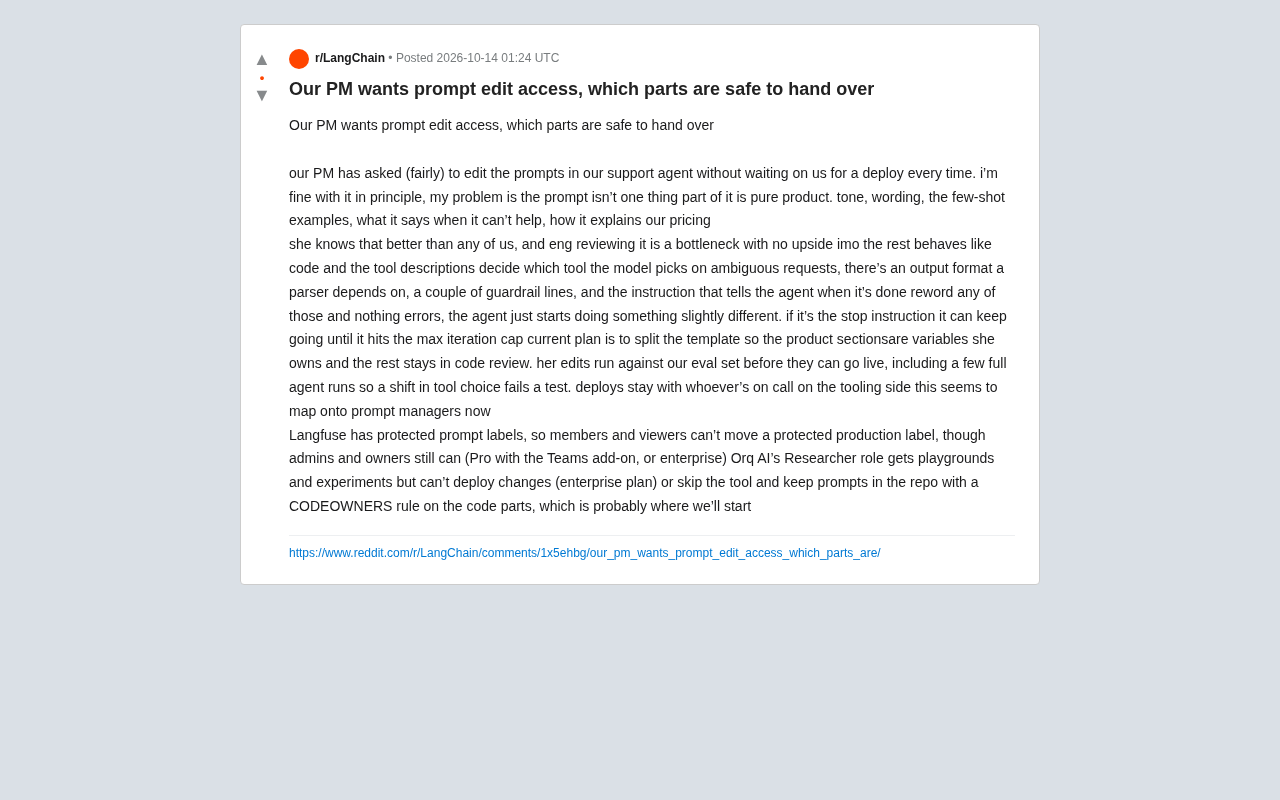
A product manager wants to bypass the engineering backlog and edit the customer service Agent's Prompt directly — this is a request almost every AI product team will eventually face. An engineer's dilemma shared on Reddit is quite representative: the PM's request is reasonable in itself, but a Prompt isn't a single monolithic thing. It contains both "pure product" content and "code-like" content, and handing over access wholesale creates hidden risks.
A Prompt Is Really Made of Two Things
The engineer broke the Prompt into two halves to think about it.
One half is pure product content: tone, wording, few-shot examples, fallback messaging when the Agent can't answer, and how to explain pricing to users. The PM understands this part better than any engineer, and having the engineering team review it line by line is pure bottleneck with near-zero benefit.
The other half is behavior logic that looks more like code. Tool descriptions determine which tool the model picks when faced with an ambiguous request; output formats are depended on by downstream parsers; there are also several guardrail instructions and a stop instruction telling the Agent "the task is done." Changing these doesn't throw an immediate error, but the Agent's behavior will quietly drift — the most dangerous case being the stop instruction getting altered, causing the Agent to keep running until it hits the max iterations ceiling.
Few-shot examples refer to sample input-output pairs given directly in the Prompt, letting the model mimic the format and style by example. It doesn't require fine-tuning the model — simply stuffing a few high-quality examples into the context can significantly stabilize output, which is why PMs often know better than engineers which examples to include.
Guardrail instructions are a type of prompt that explicitly constrains the boundaries of model behavior, such as "don't promise refunds," "don't reveal internal pricing logic," "escalate sensitive topics to a human." They don't produce functionality themselves — they pull the model back when it's about to cross a line. The more specific the guardrails, the clearer the edge cases covered, but too many guardrails also compress the model's normal expressive space.
Max iterations is a safety net set by the Agent's runtime framework: when the model, in its "think-call tool-observe result" loop, keeps failing to produce a termination signal, the runner forcibly interrupts after a specified number of rounds. It was originally meant to prevent infinite loops, but once the stop instruction is mistakenly changed, this safety net becomes the only backstop. That's why the stability of the stop instruction matters far more than it appears — it is essentially the Agent's ability to "know when to stop," and like tool selection and output format, it belongs to behavior logic, not copywriting.
Three Key Design Choices in the Current Approach
The team's plan is to split the template: product-related sections become PM-owned variables, while the rest stays in the code review process.
Two accompanying mechanisms in this plan are worth noting. First, the PM's changes must pass the evaluation set before going live, including several full Agent runs, so that any drift in tool selection will directly fail the tests. Second, deployment permissions remain on the on-call tooling side — the PM changes content but doesn't handle releases.
This combination of "content separation + evaluation gate + deployment isolation" splits editing rights from control rights, and is a relatively pragmatic solution to this kind of request today.
How Far Off-the-Shelf Tools Can Cover
The community mentioned two ready-made prompt management solutions with different capability boundaries.
Langfuse offers protected prompt labels: member and viewer roles cannot move protected production labels, but admin and owner still can. This capability lives in the Pro plus Teams add-on or Enterprise editions.
Orq AI's Researcher role can use playgrounds and experiments but cannot deploy changes — that capability belongs to enterprise plans.
Prompt labels are pointers used in prompt management platforms to mark a version's purpose, commonly production, staging, latest. A protected label means regular members can't point it to another version, preventing someone from making the online Agent switch to a new prompt without evaluation.
Playground and experiments refer, respectively, to the sandbox environment for directly test-running prompts on the platform, and the experimental feature for batch-comparing the effects of different prompt versions. They determine how much exploratory work a role can do, but they're a different matter from "can they deploy" — many platforms deliberately separate these two types of permissions, letting researchers experiment freely while being unable to directly affect production.
There's Also a Path That Doesn't Switch Tools
If you don't want to introduce a prompt management platform, you can simply keep the prompt in the repo and use CODEOWNERS rules to protect the code-related part. The original poster said this is probably where they'll start. For teams already using Git to manage everything and running evaluations in CI, this path has the lowest mental overhead.
Which approach to choose depends on how heavy a team is willing to make the evaluation gate. What tools can provide is isolation at the role and label level, but the question of "what changes will cause Agent behavior to drift" ultimately still has to be answered by the evaluation set.
CODEOWNERS is a Git platform mechanism: placing a CODEOWNERS file at the repo root or a specified path designates the people or teams who must approve specific files or directories. When someone submits changes touching those paths, the platform automatically requests review from the corresponding owner, and without approval, the merge can't go through. By storing the product sections and code sections of the prompt file separately and configuring different owners for different files, you can achieve permission separation within the repo — "PM edits copy, engineering reviews behavior logic" — without introducing an extra platform.
One-line Summary
Which Prompt editing rights should PMs get? This article breaks down the boundaries and pragmatic solutions for handing over permissions.
Paragraph Summary
The article discusses a common problem: product managers want to directly edit the customer service Agent's Prompt, while the engineering team worries about the risks. The core insight is that a Prompt isn't monolithic — it consists of pure product content (tone, wording, few-shot examples, fallback messaging) and code-like content (tool descriptions, output formats, guardrails, stop instructions). The latter's changes cause silent drift in Agent behavior, the most dangerous being a modified stop instruction that makes the Agent run until max iterations. The team's pragmatic solution is "content separation + evaluation gate + deployment isolation": product sections are managed by the PM, but must pass the evaluation set before going live, while deployment permissions stay on the on-call tooling side. Off-the-shelf tools include Langfuse protected labels and Orq AI's Researcher role, and CODEOWNERS can protect the code portion within the repo. Which to choose depends on how heavy a team wants its evaluation gate.
Related articles

A Single Prompt Triggers a Global PHP Security Storm: Is AI a Savior or a Hidden Risk?
A single AI prompt triggered a global PHP security crisis affecting Wikipedia and the Internet Archive. This article reviews the incident, analyzes the OpenAI-Amazon controversy, and explores the security paradox of lowered vulnerability discovery barriers in the AI era and developer response strategies.

When AI Is Taken Away: How Reliance on Shortcuts Undermines Your Problem-Solving Resilience
A study of 1,222 people found that after using AI to answer questions, once AI was removed, people gave up on more problems than a control group that never used AI. The article analyzes the impact of AI reliance on learning resilience and metacognition, and explores design implications for AI learning tools.

Carta and NewView Partner to Let Startup Employees Cash Out Equity Early
Carta and NewView Capital partner to simplify startup tender offers, helping employees sell equity early. Analysis of the mechanism, liquidity pain points, and impact.