Should You Feel Anxious About Staying at One Company for 4-5 Years? The Stability vs. Growth Dilemma

Staying 4-5 years isn't the problem—stagnating while staying is.
Feeling anxious about staying at one company for 4-5 years is often driven by social narratives rather than real career needs. The article provides three self-assessment questions to determine whether you're growing or stagnating, and offers practical advice on building transferable skills while maintaining market awareness.
A Common Career Anxiety
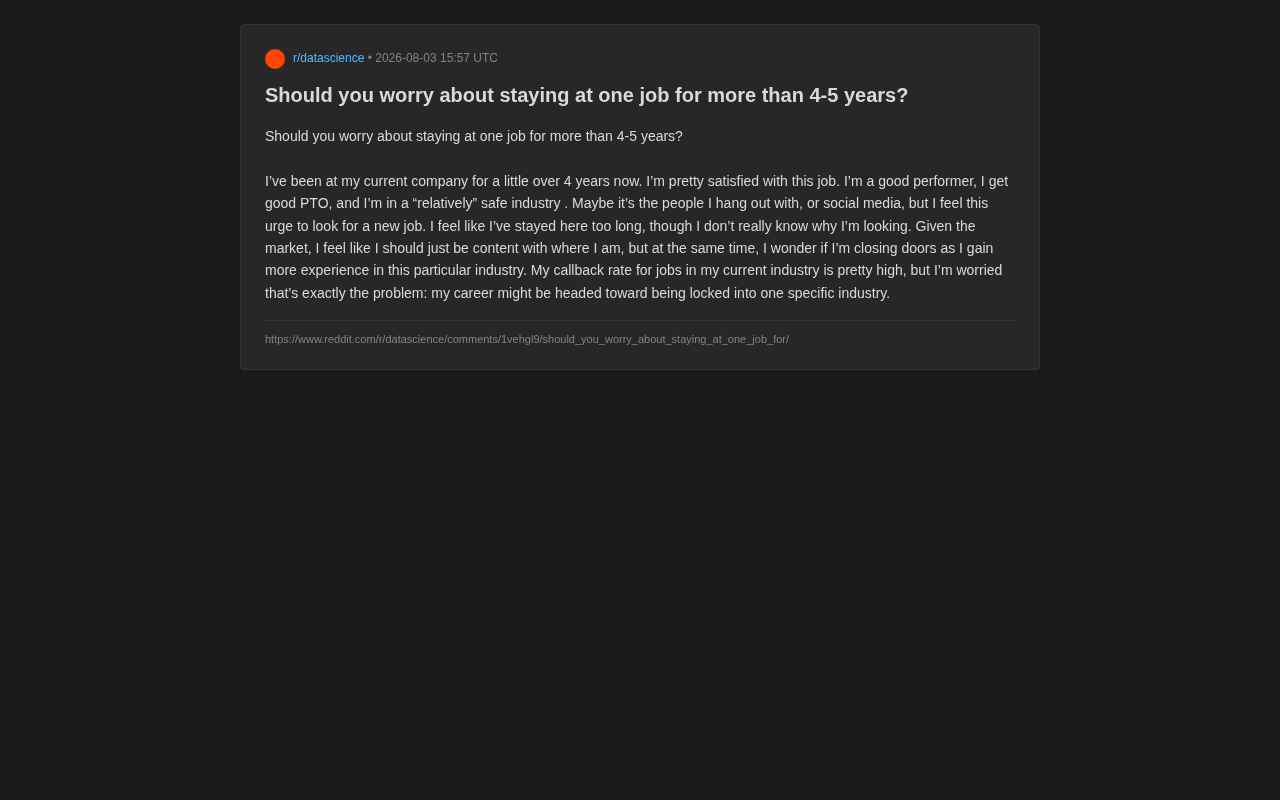
Recently, a professional on Reddit sparked a resonant discussion: should you feel anxious about staying at the same company for more than 4-5 years?
The poster's situation is quite typical: he's been at his current company for over four years and is fairly satisfied—good performance reviews, generous PTO, and a relatively stable industry. Yet he feels an inexplicable unease about "staying too long." In his own words: "Maybe it's friends around me, maybe it's social media, but I always have this urge to switch jobs, even though I don't really know what I'm looking for."
Behind this anxiety lies a deep contradiction in modern workplace culture: the tension between stability and growth.
The Real Source of Anxiety: Being Swept Up in Social Narratives
The poster astutely noted that this "time to jump ship" feeling likely stems from peers and social media rather than genuine career needs.
In recent years, narratives like "job-hop for raises," "switch every two years," and "staying means depreciating" have spread widely in career communities. These aren't entirely wrong—according to the U.S. Bureau of Labor Statistics and multiple compensation surveys, internal promotion raises typically average 3%-5% annually, while job-hopping can yield 10%-20% increases, even higher in tech. The root cause is structural constraints in corporate compensation systems: internal raises are limited by pay bands, budget allocation, and internal equity principles, while external hires often command market premiums.
But the problem is that these narratives get oversimplified and overgeneralized, causing even well-situated professionals to doubt themselves. Notably, this data suffers from survivorship bias—successful job-hoppers with big raises are more likely to share their stories on social media, while those who moved laterally, took pay cuts, or regretted their decisions due to cultural mismatch are rarely mentioned. The "job-hopping success stories" we see are filtered samples, not the complete picture.
Distinguishing "Real Needs" from "External Noise"
The key to deciding whether to switch jobs is identifying the source of your motivation. If the urge comes mainly from external pressure like "everyone else is jumping" or "staying too long looks unambitious," that anxiety deserves scrutiny. Conversely, if it stems from substantive reasons like long-term salary stagnation, lack of growth opportunities, or industry concerns, it warrants serious consideration.
The poster himself admitted he "doesn't really know what he's looking for"—a classic signal of externally-driven noise. Jumping ship in this state likely means leaving a satisfying position for unknown risks.
The Core Concern: Will You Get "Locked Into" an Industry?
The poster raised a deeper concern: as he accumulates more experience in a specific industry, his interview success rate in that field is high—but does this mean his career path is becoming "locked in"?
This deserves serious consideration. Career capital is double-edged:
- Positive: Deep industry expertise creates professional barriers that give you stronger bargaining power and irreplaceability;
- Negative: Over-specialization can make skills "industry-bound," reducing the transferable value of past experience if you want to pivot.
Georgetown University professor Cal Newport systematically articulated "Career Capital" theory in his book So Good They Can't Ignore You: career satisfaction doesn't come from "following your passion" but from accumulating scarce, valuable skills through deliberate practice, which grants autonomy, influence, and mission. Career capital accumulation requires time and depth—frequent job-hopping may keep skills at a surface level, never reaching true expertise. But when a role no longer offers learning and growth opportunities, staying actually depletes rather than builds career capital—this is the core criterion for deciding whether to stay or leave.
Deep Expertise vs. Cross-Industry Moves: No Standard Answer
Whether you'll get locked in largely depends on the type of skills you've accumulated. In HR management and career development theory, skills are typically categorized into three levels: industry-specific skills, job-specific skills, and transferable skills.
If you possess transferable general capabilities (management, communication, systems thinking, technical architecture), then deep industry experience actually strengthens your overall competitiveness. McKinsey research shows that with AI and automation advances, demand for social-emotional skills and advanced cognitive skills will increase by 24% and 8% respectively by 2030—all highly transferable abilities. But if your value is primarily built on industry-specific proprietary knowledge (compliance processes in a vertical domain, experience with specific systems), long-term tenure may indeed narrow your future options.
For those worried about getting locked in, the real solution isn't frequent job-hopping but consciously developing transferable abilities in your current role, or exploring new domains through projects and side work. Deliberately cultivating strategic thinking, project management, cross-functional collaboration, and data analysis in any role is essentially investing in future career flexibility.
Stability Isn't a Flaw—What Matters Is Whether You're Growing
In today's increasingly uncertain job market, the poster mentioned "considering market conditions, I feel I should be content with my situation"—a quite rational assessment.
Between 2023-2024, the global tech industry experienced massive layoffs, with Meta, Google, Amazon, Microsoft and other giants cutting over 400,000 jobs collectively. Meanwhile, rising interest rates increased corporate financing costs, leading many companies to tighten hiring budgets. LinkedIn Economic Graph data shows that average job search duration in 2024 was approximately 40% longer than in 2022. In this macro context, the "look while employed" strategy carries significantly lower risk, while quitting without a backup or impulsive job-hopping carries much higher risk.
It's worth emphasizing that staying at one company for 4-5 years isn't inherently a problem. The real question is: during those years, were you "growing" or "repeating"?
Three Self-Assessment Questions: Should You Stay or Go?
If you're facing a similar dilemma, ask yourself three questions:
- Have my capabilities meaningfully expanded in the past two years? If you're doing the same things every year, personal growth has stalled regardless of company stability.
- Are my salary and level out of sync with the market? Internal raises consistently lagging external offers is an objective signal to consider moving.
- What do I expect to gain from switching jobs? If you can't answer this, it's probably not time to move.
Only when "repetition exceeds growth," "salary is clearly below market," or "you have a clear new goal" does job-hopping have genuine justification.
Practical Advice for the Undecided
Overall, this poster's situation is actually quite healthy: good performance, solid benefits, stable industry, high interview success rate. What he faces isn't so much a career crisis as a psychological anxiety amplified by social narratives.
For professionals in similar situations, a more composed strategy works best:
- Don't jump for the sake of jumping: Don't abandon a satisfying role just because of a vague feeling of "staying too long";
- Maintain market awareness: Periodically apply, interview, and research the landscape—this validates your value and enables quick action when truly needed;
- Proactively build transferable skills: Rather than worrying about being locked in, deliberately accumulate universal skills in your current role to preserve future optionality;
- Let opportunities find you: Rather than anxiously seeking out moves, focus on building your strengths and wait for truly worthwhile opportunities.
Career development has never been about "how long you've stayed"—it's about "whether you're continuously becoming more valuable." Stability and growth aren't natural opposites—what truly demands vigilance is stagnation disguised as stability.
Key Takeaways
Related articles

Go Microservices in Practice: Detailed Architecture for E-Commerce, AI Agent, and IM System Integration
Deep dive into integrating e-commerce, AI Agent, and IM systems under Go microservices architecture, covering unified auth, gRPC, componentized Agent engines, and group chat bots.

X Platform's Recommendation Algorithm Caught Filtering Brazilian Election Content, Reigniting Algorithm Transparency Debate
X (formerly Twitter) was found filtering Brazilian election content in its For You feed, sparking debate over algorithm transparency and free speech.

Poison-Resistant Concept Anchoring: A New Approach to Defending Against AI Data Poisoning
Deep dive into Poison-Resistant Concept Anchoring, defending against data poisoning via signed anchors and bounded updates. Experiments show 62% poison isolation with 0% false rejection rate.