Should You Open Source Your Project? A Layered Open Source Strategy Using Project Replay as a Case Study

A practical guide to layered open source strategy for indie developers, using Project Replay as a case study.
This article examines whether indie developers should open source their projects, using Project Replay—a custom game achievement verification tool—as a real-world case study. It analyzes the decision across multiple dimensions including business model protection, community engagement, security trust, and anti-cheat concerns, ultimately recommending a layered open source strategy that opens peripheral components while keeping core verification logic closed source.
The Open Source Decision: An Indie Developer's Dilemma
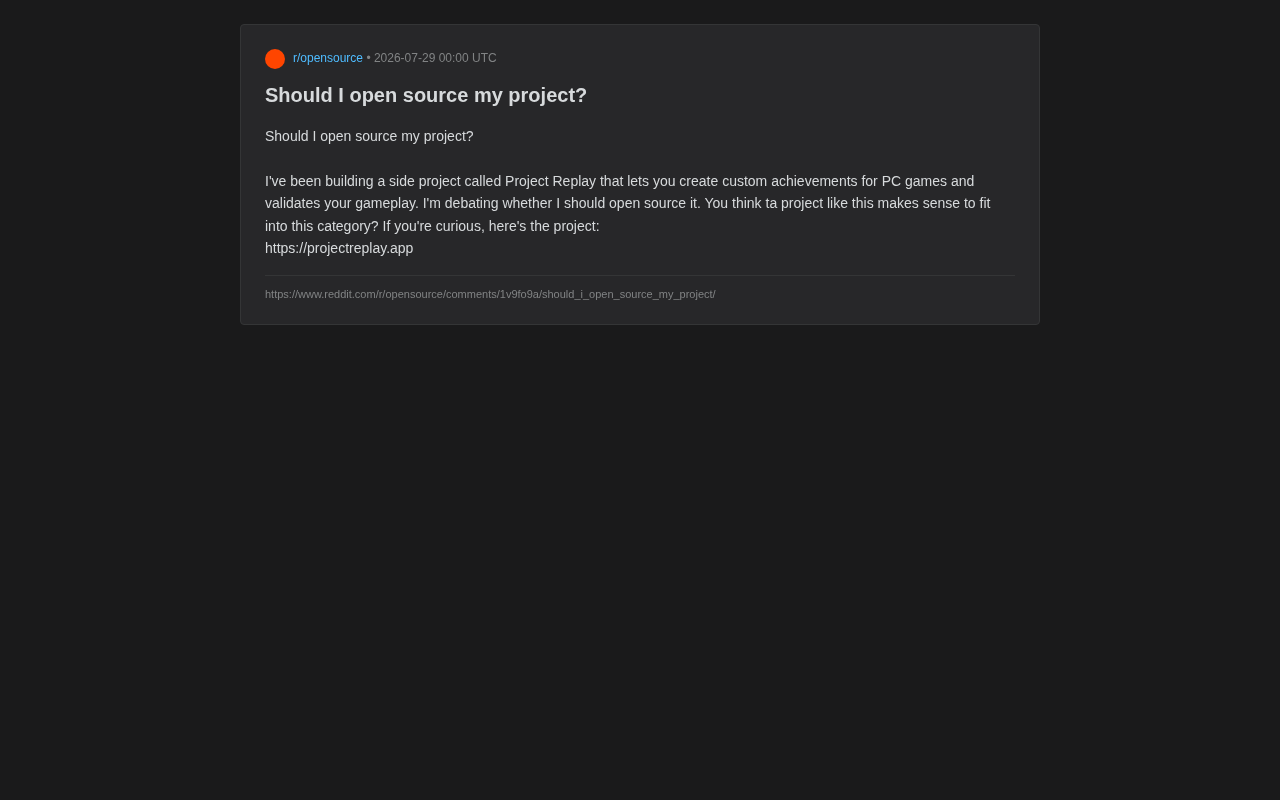
Recently on Reddit, an indie developer posed a question that many creators face: "Should I open source my project?"
This developer is building a side project called Project Replay. It's an intriguing tool that allows players to create Custom Achievements for PC games and uses technical means to verify players' actual gameplay. In other words, you can design unique challenge objectives for yourself or the community, and the system ensures these achievements were genuinely completed rather than cheated.
The concept of custom achievements isn't entirely new. The RetroAchievements project has long established a community-driven achievement system for retro games, proving the enormous demand players have for "custom challenges." While Steam offers an official achievement system, it's entirely controlled by developers—players can't create or modify achievements. Additionally, the Speedrunning Community has built a verification system based on video recording and timers through platforms like Speedrun.com. What makes Project Replay unique is its attempt to automate and standardize this verification process, eliminating the need for manual review.
This question seems simple on the surface, but it actually involves multiple considerations spanning technology, business, community, and even legal dimensions. This article will systematically examine the key factors in the open source decision using this real-world case.
Product Analysis of Project Replay
Core Value: "Derivative Creation" for Game Achievements
From the description, Project Replay fills an interesting gap. Traditional game achievement systems are pre-defined by publishers (like Steam or Xbox), and players can only passively complete them. Project Replay hands the power of achievement design back to players and communities, turning gameplay challenges like "speedrun a level without taking damage" or "complete a mission with a specific weapon" into formally recorded and verified achievements.
Technical Challenge: The Verification Mechanism
The most technically demanding and core component of this type of product is precisely the "verifying players' gameplay" aspect. How do you reliably determine that a player actually completed a custom challenge without intruding on the game or violating anti-cheat systems? This typically involves:
- Game screen/state recognition and analysis
- Reading game memory or log data
- Anti-cheat and anti-forgery mechanism design
From a technical implementation perspective, there are several approaches to gameplay verification: reading game memory (Memory Reading), similar to how Cheat Engine works, directly monitoring state changes in key game variables; parsing game log files, as many games output event logs for analysis; using Computer Vision (CV) technology for real-time recognition of game screens to determine game state; and hooking game API calls to capture events. Each approach has its limitations—memory reading may trigger anti-cheat systems (like EasyAntiCheat or BattlEye), screen recognition has false positive risks, and log parsing depends on whether the game provides sufficient output information.
This verification logic is the product's moat, and it directly influences the "whether to open source" decision.
Open Source or Not: Key Decision Dimensions
1. Business Model and Competitive Moat
If Project Replay plans to commercialize in the future, its verification engine is likely the competitive barrier. Once fully open sourced, competitors can easily replicate the core logic, and the moat disappears entirely.
A common compromise is the "Open Core + Commercial Add-ons" model: open sourcing peripheral components like the client, SDK, and achievement editor to attract community contributions, while keeping verification services, cloud sync, and other core services as closed-source commercial products. Well-known projects like GitLab and Sentry have adopted similar strategies.
The Open Core model is one of the most successful open source commercialization strategies today. Its core logic is: open source the product's foundational layer to attract a developer ecosystem and community contributions, while offering enterprise-grade features, hosted services, or premium capabilities as paid products. Typical examples include: GitLab's community edition is free and open source while the enterprise edition is paid; Sentry's error tracking core is open source but the hosted service is paid; Elastic's Elasticsearch is open source but advanced security and machine learning features require paid licenses. The key challenge of this model is drawing the line between free and paid—being too stingy loses the community, while being too generous makes monetization difficult. For Project Replay, the cloud-based portion of the verification service is naturally suited as a SaaS offering, while local tools and SDKs are better suited for open access.
2. The Value of Community Participation
For a "custom achievements" product, the content ecosystem is crucial. The product's vitality heavily depends on the quantity and quality of community-created achievements. Open source has a natural advantage here—it significantly lowers the barrier to community participation, encouraging developers to write adapters for more games and contribute verification plugins.
From this perspective, Project Replay belongs to the category of projects that "naturally benefit from openness due to their community-driven nature."
3. Security and Trust
Verification tools often need to read game process data, which raises player concerns about privacy and security—"What exactly is this software doing on my computer?" Open source builds trust precisely in this situation: publicly auditable code lets players confirm the tool won't steal account information or trigger game bans. For tools that need to run at the system level, transparency itself is a selling point.
4. The Anti-Cheat Dilemma
However, there's a sharp contradiction here: open sourcing verification logic is essentially publishing a cheat manual. If the verification mechanism's code is fully public, malicious users can reverse-engineer ways to bypass verification and forge achievements. For a product whose core selling point is "authenticity," this could be fatal.
The debate between "Security through Obscurity" and "Security through Transparency" in the anti-cheat field has a long history. The traditional view holds that hiding implementation details increases attack difficulty, but Kerckhoffs's principle in cryptography states that a system's security should not depend on the secrecy of its algorithm. In practice, Valve's VAC (Valve Anti-Cheat) system uses a closed-source strategy but is still frequently cracked; meanwhile, some approaches based on cryptographic signatures and server-side verification are hard to bypass even when the logic is public. For Project Replay, if verification logic relies entirely on client-side judgment, open sourcing would indeed expose weaknesses; but if a "client-side collection + server-side judgment" architecture is adopted, the core judgment logic remains secure even if the client code is public.
This is the biggest obstacle to open sourcing this type of project—the scales between security and transparency are hard to balance.
Practical Advice for Indie Developers
No Need for "All or Nothing": A Layered Open Source Strategy
Open source isn't a binary choice. For a project like Project Replay, a layered open source strategy is recommended:
- Can be open sourced: Achievement editor, UI frontend, community SDK, documentation and examples
- Open source with caution: Verification plugin framework (without specific anti-cheat logic)
- Recommend keeping closed source: Core verification engine, anti-cheat algorithms, server-side code
Clarify Your Goals Before Deciding
Before open sourcing, ask yourself three questions:
- What's my purpose for open sourcing? Is it to gain community contributions, build a personal brand, or purely to give back to the community?
- Do I plan to commercialize in the future? If you intend to make money from it, core technology needs protection.
- Do I have the energy to maintain an open source community? Open sourcing means handling issues, PRs, documentation, and user support—an ongoing hidden workload.
Regarding the third point, the maintenance cost of open source communities is often severely underestimated. According to GitHub's open source survey, Maintainer Burnout is one of the biggest challenges facing the open source ecosystem. Once an indie developer's open source project gains attention, they may face large volumes of Issues requiring triage and response, Pull Requests requiring code review, documentation requiring continuous updates, and Breaking Changes requiring migration guides. Notable cases include the core-js maintainer publicly expressing financial difficulties, and the event-stream incident where a maintainer transferred permissions to a malicious user due to lack of energy, leading to a supply chain attack. For side projects, it's recommended to establish clear contribution guidelines (CONTRIBUTING.md) and a Code of Conduct from the start, and to leverage automation tools like GitHub Actions to reduce maintenance burden.
Choose the Right Open Source License
If you decide to partially open source, license selection is equally important. If you want to prevent others from using your code in closed-source commercial products, consider AGPL or other Copyleft licenses; if you want to maximize distribution and adoption, MIT/Apache 2.0 is more appropriate.
Open source license selection is far from a formality—it determines the project's ecosystem direction. MIT and Apache 2.0 are Permissive Licenses that allow anyone to use the code in any way, including closed-source commercial use, maximizing adoption but unable to prevent "free-riding." GPL/AGPL are Copyleft licenses that require derivative works to be open sourced under the same license—AGPL goes further by treating network service provision as "distribution," requiring open sourcing as well. MongoDB switched from AGPL to the more restrictive SSPL (Server Side Public License) precisely because cloud providers (like AWS) were extensively using its open source code to offer hosted services without contributing back to the community. For Project Replay, if the client portion is open sourced under AGPL, it can effectively prevent competitors from directly integrating the code into closed-source products while still allowing individual users and the community to freely use and modify it.
Conclusion
Returning to the original question: Is a project like Project Replay suitable for open sourcing? The answer is—it's suitable for "partial open sourcing." This type of product can benefit from community ecosystem and trust through transparency, yet faces the risk of verification logic being exposed and exploited for cheating.
For indie developers, the most rational path is often not "whether to open source," but rather "which parts should be open sourced, and which parts should be kept proprietary." Think clearly about your business objectives and community strategy, then draw that boundary—that's the wise approach.
Related articles

130+ Open-Source Interactive Security Awareness Training: Reshaping Habit Formation Through 3D Office Scenarios
A project with 130+ free open-source interactive security awareness exercises using immersive 3D office scenarios to simulate phishing, vishing, MFA fatigue attacks and more, building employee security habits.

From Musk to Jefferson: Beware the Cognitive Trap of Cross-Domain Experts
Why do geniuses in one field often become overconfident in others? From Musk's controversial interview to Jefferson's blind spots, an exploration of cross-domain cognitive arrogance.

130+ Open-Source Interactive Security Awareness Training: 3D Office Scenarios Reshape Habit Formation
A project with 130+ free open-source interactive security awareness exercises using immersive 3D office scenarios to simulate phishing, vishing, MFA fatigue attacks, and more. Fully white-labeled.