Should You Take a Mathematical Proofs Course Before Your CV/ML PhD? Advice from Those Who've Been There

A practical guide on whether a math proofs course is worth taking before a CV/ML PhD.
A soon-to-be PhD student asks whether a semester-long course on predicate logic, set theory, and mathematical proofs is worth it before starting a CV/ML doctorate. This article analyzes the question from three angles: the thinking skills proof training builds, the specific math ML research actually demands (linear algebra, probability, optimization, information theory), and the opportunity cost. The verdict: take it if time allows for the reasoning skills it builds, but prioritize core ML math if your schedule is tight.
A Real Dilemma Facing a Soon-to-Be PhD Student
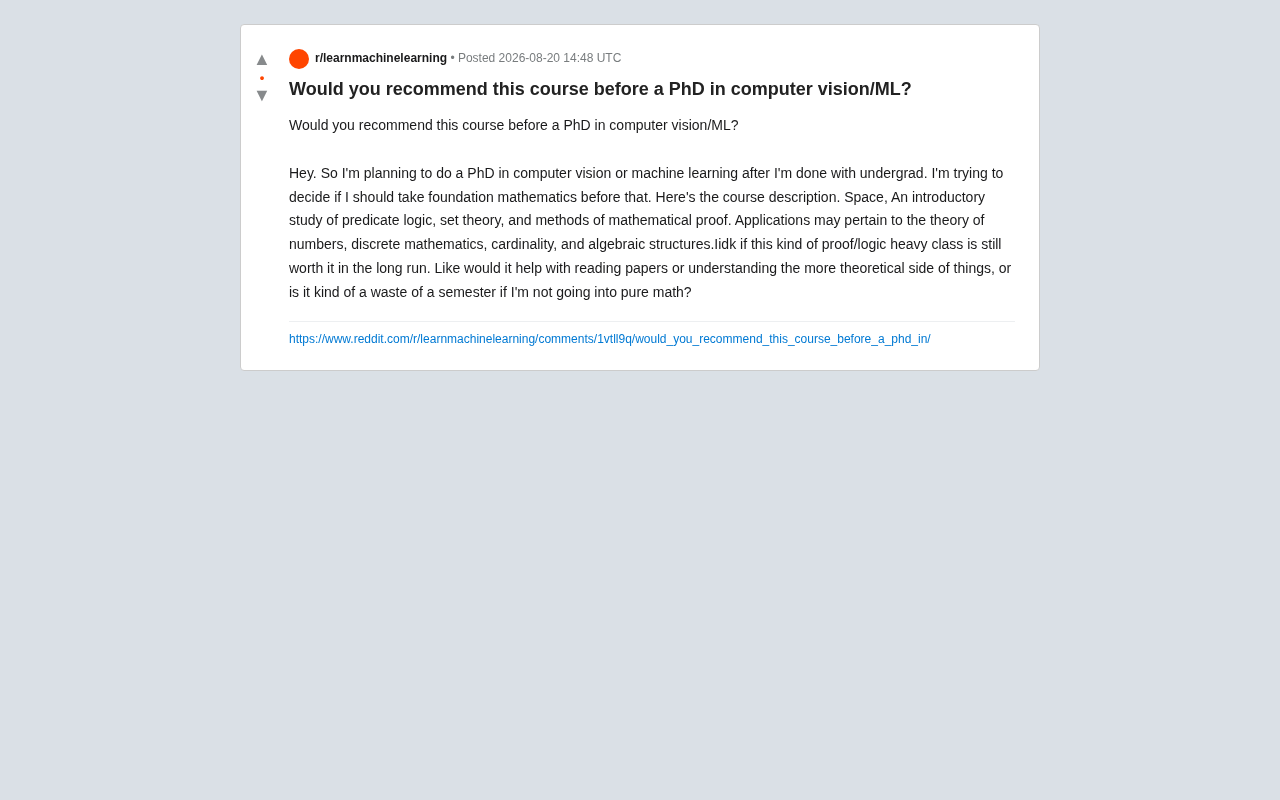
In Reddit's machine learning community, a student about to finish undergrad and planning to pursue a PhD in Computer Vision (CV) or Machine Learning (ML) raised a highly representative question: Before starting a PhD, is it worth spending a semester on a "foundations of mathematics" course centered on logic and proofs?
The course he described covers predicate logic, set theory, and methods of mathematical proof, with applications spanning number theory, discrete mathematics, cardinality theory, and algebraic structures.
Predicate logic is a core branch of mathematical logic, founded by Frege in the late 19th century. Building on propositional logic, it introduces universal quantifiers (∀) and existential quantifiers (∃), enabling us to precisely describe complex relationships between mathematical objects. Set theory was created by Cantor in the 1870s and later axiomatized by Zermelo-Fraenkel (the ZFC axiom system), becoming the accepted foundation for virtually all branches of modern mathematics — from topology to functional analysis, everything is built on the language of set theory. For ML researchers, while you won't directly manipulate ZFC axioms day-to-day, the set operations, function spaces, and mapping relationships that frequently appear in papers are all rooted in the basic framework of set theory.
The student's core concern was refreshingly direct: "I'm not planning to go down the pure math route. Is this kind of proof-heavy, logic-heavy course worth it in the long run? Will it help me read papers and understand more theoretical content, or is it just a waste of a semester?"
This question might seem like a personal course selection decision, but it actually touches on a deeper topic: In an era where deep learning is increasingly engineered and tool-driven, what does mathematical foundation really mean for a researcher?
The Real Value of Proof Training: It's Not About Formulas — It's About Thinking
Many people's first reaction to a "mathematical proofs course" is: I'll never use these theorems, so why bother? This understanding misses the point entirely.
The real output of a proof-based math course isn't how many theorems you memorize — it's training your ability to construct rigorous logical arguments. Predicate logic teaches you how to precisely express quantified propositions like "for all" and "there exists"; set theory and proof methods teach you how to derive airtight conclusions step by step from axioms.
This ability is everywhere in ML research yet often overlooked. When you read a paper on generalization bounds, the author writes a chain of inequality derivations with "with probability at least 1-δ"; when you study convergence proofs for optimization algorithms, the pages are filled with ε-δ language and inductive arguments. Without systematic proof training, you'll likely only remember conclusions without truly understanding why the argument holds, why the assumptions matter, or where the boundaries are.
Generalization bounds are one of the core results of statistical learning theory, attempting to answer a fundamental question: how well can a model that performs well on finite training data perform on unseen new data? Milestone results in this field include VC dimension theory proposed by Vapnik and Chervonenkis in 1971, as well as later Rademacher complexity methods and the PAC-Bayes framework. The common phrase "with probability at least 1-δ" in papers is standard language from PAC (Probably Approximately Correct) learning theory — it means the given error upper bound holds with probability at least 1-δ. Understanding such conclusions requires the reader to be capable of deriving probability inequalities (such as Hoeffding's inequality and McDiarmid's inequality), and these derivation processes themselves are textbook applications of proof training.
The Hidden Barrier When Reading Papers
Top-tier CV/ML conference papers (at NeurIPS, ICML, CVPR, etc.) increasingly include theoretical analysis sections. Even if your focus is on applications and experiments, understanding these theoretical components helps you assess a method's scope of applicability and potential weaknesses. Readers lacking proof foundations tend to "skip every paragraph with Greek letters" — which may be precisely the most valuable part of the paper.
NeurIPS (Conference on Neural Information Processing Systems), ICML (International Conference on Machine Learning), and CVPR (Conference on Computer Vision and Pattern Recognition) are the three premier academic conferences in machine learning and computer vision. In recent years, these venues have significantly raised the bar for theoretical rigor in papers. Taking NeurIPS as an example, since introducing mandatory reproducibility checklists in 2019, reviewers have also become stricter about verifying theoretical claims. Many top conference papers, even those primarily experimental, include theoretical sections such as convergence analysis, approximation error bounds, or sample complexity proofs. ICML in particular has long treated theoretical contributions as a key reviewing criterion. This means even experiment-focused researchers need the ability to read and evaluate theoretical arguments during the submission and review process.
But Distinguish Between "Essential" and "Nice-to-Have"
That said, we need to be objective. For a CV/ML researcher primarily focused on applications and experiments, most of the specific content listed in this course — number theory, cardinality theory, algebraic structures — won't directly appear in your day-to-day research.
The mathematics that's truly "high-frequency, must-have" for ML research includes:
- Linear Algebra: The foundation of nearly all deep learning operations. Linear algebra is considered the "lingua franca" of deep learning because almost every computational step in a neural network can be expressed as matrix operations. A fully connected layer's forward pass is essentially matrix multiplication plus bias (y=Wx+b); convolution operations can be reformulated as Toeplitz matrix multiplication; the core of the attention mechanism is the inner product operation among Query, Key, and Value matrices. Furthermore, Singular Value Decomposition (SVD) is widely used in dimensionality reduction and model compression, eigenvalue analysis is key to understanding the Hessian matrix (the geometric structure of the loss landscape), and a matrix's spectral norm directly relates to a neural network's Lipschitz constant and training stability.
- Probability and Statistics: The core of Bayesian inference, loss functions, and generative models
- Multivariable Calculus and Optimization Theory: The bedrock of backpropagation and gradient descent
- Information Theory: Concepts like cross-entropy, KL divergence, and mutual information. Information theory was founded by Claude Shannon in his 1948 landmark paper A Mathematical Theory of Communication, originally addressing coding and transmission problems in communication systems, but its core concepts have deeply permeated modern machine learning. Cross-entropy loss is the most commonly used objective function in classification tasks, measuring the difference between predicted and true distributions. KL divergence serves as a regularization term in Variational Autoencoders (VAEs), constraining the shape of the latent space distribution. Mutual information plays a central role in feature selection, contrastive learning (e.g., the InfoNCE objective), and information bottleneck theory. In recent years, the information bottleneck hypothesis proposed by Shwartz-Ziv and Tishby attempts to explain why deep learning works from the perspective of information compression, further bridging information theory and deep learning research.
By comparison, predicate logic and set theory are more like the "bedrock of mathematical literacy" rather than the "professional toolkit." Their value is indirect and long-term, not immediately actionable.
A Pragmatic Decision Framework
Whether to take this course can be weighed from several angles:
-
How strong is your math background? If you've never received any rigorous proof training (e.g., you haven't taken real analysis or abstract algebra), this introductory course can fill an important gap. Conversely, if you've already taken other proof-intensive courses, the marginal returns diminish.
-
Is your PhD research more theoretical or applied? If you lean toward optimization theory, learning theory, or statistical machine learning, proof ability is practically hard currency; if your focus is on engineered CV systems or applied deployment, it can be lower priority. It's worth adding that learning theory and optimization theory, while both foundational to ML theory, address fundamentally different questions. Learning theory studies the feasibility and efficiency of "learning" itself — given finite samples, can we, and how quickly can we, learn a good hypothesis? Its core tools include VC theory, Rademacher complexity, and the PAC learning framework. Optimization theory focuses on how to efficiently find the optimum of an objective function — does gradient descent converge? To a global or local optimum? In deep learning, the intersection of these two areas has produced many frontier questions, such as why over-parameterized neural networks easily converge to good solutions in optimization (Neural Tangent Kernel theory), and why solutions found by SGD tend to generalize well (implicit regularization theory). Rigorous proof training is virtually a prerequisite for research in these directions.
-
What's the opportunity cost? A semester is finite. If taking this course means you can't take a more directly relevant ML or statistics course, you need to weigh carefully.
Overall Recommendation: Worth Taking, But Know Its Place
All things considered, my view is: If time permits, this course is worth taking — but approach it with the right mindset.
Don't expect it to teach you specific ML skills. Instead, treat it as "mental gymnastics" — it trains your meta-abilities of rigorous reasoning, precise expression, and deconstructing complex arguments. These abilities will continuously pay dividends during your PhD when writing papers, reviewing work, and building theoretical frameworks.
But if your time is very tight and you already have some proof background, spending that semester sharpening your linear algebra, probability and statistics, and optimization theory may offer a higher return on investment. For CV/ML researchers, these are the "native languages" you'll use every single day.
One final reminder: a PhD itself is a process of continuous learning. Any math you didn't cover in undergrad can (and must) be self-taught when the need arises. What's truly scarce is never any single course — it's the ability to proactively learn and fill in your own gaps.
Related articles

Workbuddy for Absolute Beginners: How a Desktop AI Agent Fits Into Real Workflows
A beginner's guide to the Workbuddy desktop AI agent: installation, claiming credits, file management, and building automated workflows—compared with CodeX for fit and cost, helping professionals shift from AI question-askers to AI managers.

OpenAI's New Agent Stack: Computer Use, Decisions API, and Ultra-Fast Workflows
OpenAI Dev Day unveiled a new agent stack: Computer Use outperforms humans, Decisions API delivers ultra-low-latency classification via Luna, Agents API opens the same Computer Use capabilities, and GPT-6.1 Sol costs only one-seventh of Astra. Core updates, benchmark data, and developer insights.

Liang Wenfeng Open-Sources DeepInfo Inference Framework, Takes On U.S. Ban
DeepSeek open-sources its DeepInfo inference framework after its models, featuring GPU/CPU cross-pipelining, small-model prediction with large-model verification, and full Huawei Ascend and NVIDIA chip support—facing the U.S. federal ban head-on. This article analyzes its significance for AI deployment and open-source strategy.