Sierra's Valuation Doubles to $30 Billion in Six Months as AI Customer Service Demand Surges

Sierra completes a $1.75B Series F, doubling its valuation to $30B in six months.
Enterprise customer experience AI company Sierra announced the completion of a $1.75 billion Series F round, with its valuation doubling to $30 billion in about six months—a fundraising pace that is quite rare in the enterprise software market. The article argues that behind this valuation is an industry trend of AI customer service demand moving from pilots to scale: conversational AI naturally fits high-frequency customer service interactions, and the maturation of large models makes automated handling of complex inquiries possible. The founding team includes former Salesforce co-CEO Bret Taylor, whose enterprise software track record provides endorsement for both fundraising and customer trust. However, the article also notes that the $30 billion valuation faces competition from cloud providers, CRM giants, and native AI startups, and that unit economics and actual deployment results remain key to whether the valuation can hold.
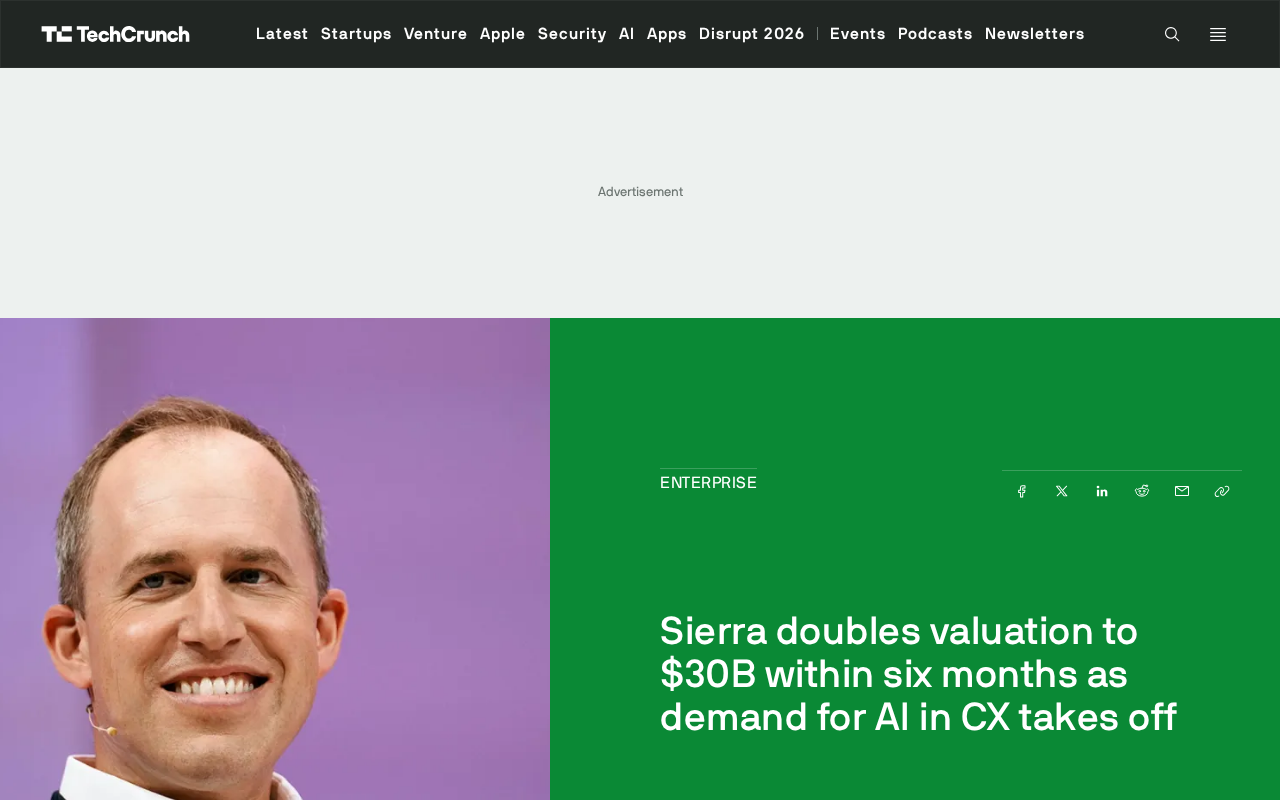
The AI customer service sector is staging a capital story that's turning heads. Sierra, an enterprise customer experience company co-founded by former Salesforce co-CEO Bret Taylor, announced on Monday the completion of a $1.75 billion Series F round. More striking still, this round comes just about six months after its previous valuation, and the company's valuation has now doubled to $30 billion.
Valuation Doubles in Six Months: Why Is Capital So Aggressive
Sierra's fundraising pace is unusual in today's enterprise software market. Six months ago, the $30 billion figure still seemed distant for an AI company in the customer experience (CX) space—now it's a reality. The $1.75 billion size of the Series F alone shows that investors aren't making small exploratory bets; they're wagering on a category that's rapidly taking shape.
There's a clear chain of logic behind this: enterprise customer service is one of the most direct scenarios for AI deployment. Conversational AI naturally fits high-frequency interaction tasks like support tickets, online inquiries, and after-sales support, and the maturation of large model capabilities has moved "AI handling complex inquiries in place of humans" from concept to viable reality. Demand taking off directly pushes up valuation expectations for platforms like Sierra.
Bret Taylor's Serial Entrepreneurship Credentials
Sierra's founder background is an indispensable part of this funding narrative. Bret Taylor served as Salesforce co-CEO and previously co-founded Quip, which was acquired by Salesforce, building deep industry resources and credibility in enterprise software and CRM.
This background brings not only fundraising appeal but also customer trust. When enterprises procure AI customer service systems, what they worry about most is often not model capability but whether the vendor can provide long-term service and understand complex business processes. A founding team with a mature enterprise software track record naturally reduces such concerns. It's fair to say that part of Sierra's valuation is a premium paid for "certainty."
Quip is a collaborative word processing and productivity application co-founded by Bret Taylor in 2012, focused on real-time multi-user collaborative editing of documents and spreadsheets. In 2016, Salesforce acquired Quip for approximately $750 million—a deal that brought Taylor into the Salesforce fold, where he ultimately rose to co-CEO. The significance of this track record is twofold: it proves Taylor has the ability to build enterprise-grade SaaS products from scratch, and it shows he deeply understands the sales organization and customer procurement logic of a CRM giant. For Sierra, this means the founding team not only understands technology but also knows how to sell products into large enterprises—precisely the most scarce capability in a high-ticket, long-sales-cycle category like AI customer service.
AI in CX: A Category Being Redefined
Customer experience (CX) has long been viewed as a cost center, with enterprise investment aimed at "reducing complaints and maintaining satisfaction." AI's involvement is changing this attribute—when AI can handle large volumes of inquiries at lower marginal cost while maintaining consistent response quality, CX begins to deliver both efficiency and experience value.
Sierra sits precisely at this turning point. The original article attributes this round to "demand taking off for AI in CX," a judgment consistent with industry observations: enterprise procurement of AI customer service is moving from pilots to scaled deployment, and budgets are shifting from innovation projects to core operating systems. The doubling of valuation is essentially pricing the slope of this demand curve.
CX (Customer Experience) refers to the sum total of all interactions between customers and a company, covering touchpoints such as pre-sales inquiries, ordering, fulfillment, after-sales support, and complaint handling. Traditionally, enterprises measure CX with metrics like NPS (Net Promoter Score) and CSAT (Customer Satisfaction), and treat customer service teams as cost centers. With AI's involvement, measurement dimensions are shifting toward operational metrics such as first-contact resolution rate, average handling time, and cost per interaction. Understanding this shift is critical: it means CX's budget source is gradually moving from "service cost" to "efficiency investment," and the latter typically enjoys higher priority and greater decision-making authority within enterprises—this is the underlying reason for the change in valuation logic across the AI customer service sector.
The Hard Questions Behind the High Valuation
A $30 billion valuation implies extremely high market expectations. What needs to be viewed coolly is that the AI customer service sector is not without competitors—major cloud providers, CRM giants, and a wave of native AI startups are all competing for the same pool of enterprise customers. Whether Sierra can convert its fundraising advantage into sustainable revenue growth and customer retention still depends on how its products perform in real business scenarios.
Another variable is deployment cost and effectiveness validation. Enterprise customers are increasingly focused on whether AI systems can truly reduce the pressure on human agents and handle industry-specific complex processes. Capital can accelerate customer acquisition, but what ultimately determines whether the valuation holds up is still the unit economics.
Unit Economics refers to the analytical framework that measures whether revenue and costs hold up on a per-customer or per-transaction basis. For AI customer service companies, core variables include: annual contract value per customer (ACV), inference and model invocation costs, implementation and customization labor input, and customer retention rate and lifetime value (LTV). Because large model inference costs rise with invocation volume, if the pricing model is per-seat or per-conversation, gross margins may be eroded at scale. The $30 billion valuation investors have assigned implies the assumption that Sierra can maintain healthy gross margins and net revenue retention (NRR) while expanding its customer base—this is also the key observable metric for judging whether the valuation can hold.
What This Signals for the Industry
Sierra's funding sends a clear signal: among enterprise AI applications, customer experience is one of the first directions to achieve scale. For practitioners focused on AI commercialization, what's worth tracking is not the valuation figure itself but where this capital will flow—product iteration, industry verticalization, or sales network expansion. These choices will reveal the competitive focus of AI customer service in its next phase.
This article is compiled based on funding news from a single source; specific product data and customer scale await official disclosure.
One-line Summary
Sierra completes a $1.75 billion Series F, with its valuation doubling to $30 billion in six months.
Paragraph Summary
Enterprise customer experience AI company Sierra announced the completion of a $1.75 billion Series F round, with its valuation doubling to $30 billion in about six months—a fundraising pace that is quite rare in the enterprise software market. The article argues that behind this valuation is an industry trend of AI customer service demand moving from pilots to scale: conversational AI naturally fits high-frequency customer service interactions, and the maturation of large models makes automated handling of complex inquiries possible. The founding team includes former Salesforce co-CEO Bret Taylor, whose enterprise software track record provides endorsement for both fundraising and customer trust. However, the article also notes that the $30 billion valuation faces competition from cloud providers, CRM giants, and native AI startups, and that unit economics and actual deployment results remain key to whether the valuation can hold.
Related articles

Jensen Huang Returns to Nvidia: The Power Game Behind an "Aggro Reset"
Nvidia's board reappointed Jensen Huang as CEO less than two weeks after his scandal-driven resignation. This analysis explores the board's decision-making, Trump's political intervention, media power failure, and market reaction behind the dramatic return.

Why Voice AI Can't Understand Kenyans' Everyday Conversations
Swahili speech recognition hits 3.24% error on read text, but everyday Kenyan speech mixes English, Sheng slang, and accents—leaving mainstream voice AI struggling.

Data Centers Build Their Own Natural Gas Plants: AI Compute's Breakout Around a Decade-Long Grid Wait
Grid interconnection approvals can take a decade, so xAI and others are building off-grid natural gas plants to power AI clusters. This article analyzes the drivers, costs, and impact of behind-the-meter generation on AI infrastructure.