Signal Blocks AI Screenshots: Gemini and Siri Shut Out of Privacy

Signal limits mobile screenshots to prevent system-level AI from reading decrypted chats, sparking a privacy vs. platform AI privilege battle.
Signal restricts screenshots on Android and iOS to stop OS-built-in AI agents like Gemini and Siri from reading decrypted messages via screen analysis. While E2EE secures transmission, messages are exposed in plaintext after rendering, and system-level AI can bypass app sandboxes to capture screen content, creating a "last mile" vulnerability. Signal's president says system AI is undermining its independent privacy protections, so it chose technical blocking over negotiation. This may affect users' screenshot sharing but prioritizes privacy. The event reveals a privilege battle between privacy apps and platform AI and could force OS vendors to design clearer isolation between AI features and third-party app permissions.
When AI Assistants Try to "See" Your Chat History
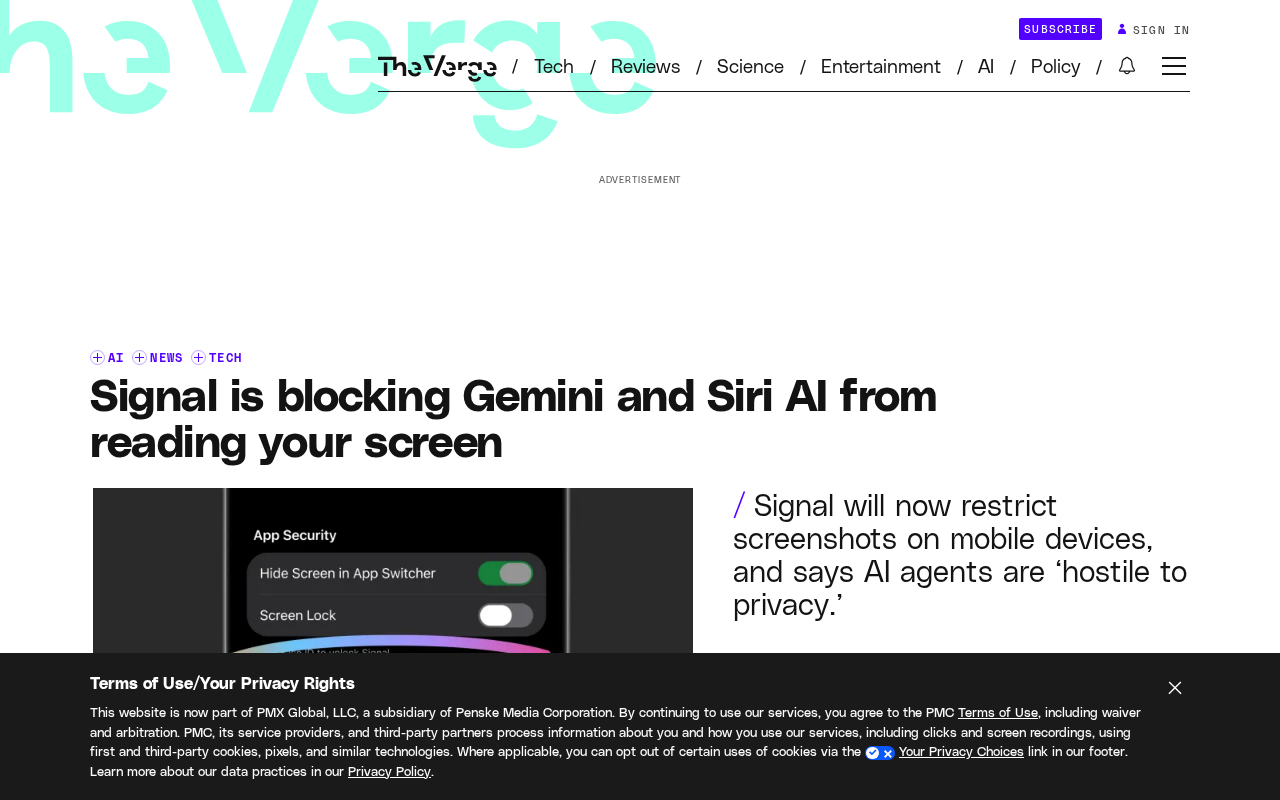
Signal is restricting screenshot capabilities on Android and iOS devices, aiming to prevent AI agents from reading user messages and other data. This move directly targets the operating system's built-in intelligent AI features—system-level assistants that analyze screen information to understand users are "undermining Signal's ability to independently guarantee privacy," according to Signal's president.
This is not an ordinary privacy update. It reveals a deeper conflict: when mobile operating systems begin using AI to "understand" screen content, the boundaries of end-to-end encryption are being redefined.
The Technical Logic Behind Screenshot Restrictions
The "Last Mile" Vulnerability of End-to-End Encryption
Signal's core promise is end-to-end encryption: messages are encrypted before leaving the sender's device, and only the recipient can decrypt them. But screenshots occur after messages are decrypted and rendered to the screen—at which point the data exists in plaintext in the screen buffer. If an operating system-level AI agent can read screen content, no matter how strong the encryption is during transmission, it cannot prevent AI from "seeing" everything at the display end.
Signal's restrictions are precisely meant to close this "last mile" vulnerability. By disabling screenshots, Signal seeks to ensure that decrypted messages cannot be captured by third-party AI in the form of screen pixels.
The threat model of end-to-end encryption (E2EE) typically assumes that devices at both ends of communication are trusted. However, screen-reading and accessibility APIs introduced by modern mobile operating systems (such as Android's Accessibility Service or iOS's ScreenCaptureKit) have higher privileges at the system level than ordinary apps. These APIs were originally designed for accessibility assistance, but can be used by system-level AI to capture the foreground app interface. ScreenCaptureKit allows apps to capture screen content, and system AI can bypass app sandboxes to directly obtain rendered pixel data. This means that even if Signal has complete encryption at the transport layer, the decrypted plaintext in the screen buffer may still be captured by platform AI, creating a side channel not covered by the E2EE threat model.
The "God's-Eye View" of Operating System AI
System-level AI assistants such as Gemini and Siri have the ability to analyze screen information, which is intended to provide smarter services—for example, offering suggestions based on the current page content. But a side effect of this capability is that AI assistants logically have a channel to bypass app sandboxes and directly read the displayed content of any foreground app. For an app like Signal that is built on privacy, this is equivalent to installing a "lawful interception" interface at the end of the encryption pipeline.
The app sandbox is the basic mechanism by which mobile operating systems isolate app data. Each app runs in an independent sandbox and cannot directly read data from other apps. However, system-level AI assistants (such as Gemini and Siri) usually run as system services or privileged processes and have permission to read screen content across apps. For example, Android's Gemini can obtain information about the current foreground app interface through the Assistant API, and iOS's Siri can also leverage screen awareness capabilities. Although this design improves AI assistants' contextual understanding, it also breaks the sandbox isolation boundary, making platform AI logically a "lawful interceptor" of app data—which is exactly the privilege asymmetry Signal is concerned about.
The Privilege Game Between Privacy Apps and Platform AI
Signal's move brings an industry-wide issue to the surface: when operating system vendors also act as AI service providers, how can app developers ensure that user data is not "incidentally" read by platform-level AI?
From Signal's perspective, restricting screenshots is a defensive design—rather than trusting the operating system to handle screen data properly, it is better to prohibit screenshot behavior at the source. This may affect some users' normal usage habits (such as sharing chat records via screenshots), but Signal clearly believes that privacy protection has higher priority.
According to the original report, Signal's president explicitly regards the operating system's built-in intelligent AI capabilities as "undermining" privacy protection. This statement suggests that Signal does not believe the issue can be resolved through negotiation with platforms, and instead has chosen technical blocking.
Impact on Users and the Industry
For ordinary users, the most direct change is that Signal's screenshot experience on mobile may be restricted. The deeper impact is that this sets a precedent for the privilege game between privacy apps and platform AI. If more privacy-sensitive apps follow suit, operating system vendors will face greater pressure to make clearer isolation designs between AI features and third-party app permissions.
From an industry trend perspective, the conflict between end-to-end encrypted apps and system-level AI may be just beginning. As AI assistants increasingly rely on screen context to provide services, "in-app data not being read by platform AI" will become a new selling point for privacy apps, and may also become a compliance issue that platform vendors must address.
Related articles

Nothing CMF Buds 2A Drops to $17.89 on Black Friday: A New Low for ANC Earbuds
Nothing CMF Buds 2A wireless earbuds Black Friday deal: just $17.89 on Amazon, about $11 off retail and a record low. ANC earbuds at an entry-level price.

When AI Creation Gets Accused of "Spitting": Hacker News Heats Up Over the Glaude Controversy
A Hacker News post, "Spitting in the Face of Glaude," sparks debate on AI creation transparency and attribution ethics. This analysis examines the blurred creator identity behind the controversy and offers practical advice for AI content production.

Akai Embraces Custom Firmware: MPC Sample 1.4 Lets Users AI-Program Their Sampler
Akai embraces the modding community with MPC Sample 1.4 firmware, supporting vibe-coded custom firmware and effects. We analyze the impact of this open strategy on music hardware and AI-assisted programming.