Silent Dictation via On-Device Lip Reading: A New Trick for Claude Code

A Show HN project uses on-device lip reading to give Claude Code silent dictation, exploring a new direction for on-device multimodal input.
A Show HN project on Hacker News uses on-device lip reading to provide silent dictation for Claude Code: a camera captures lip movements, a local model converts them to text, and the text is fed to the AI coding assistant. It requires no speech and runs fully locally, keeping lip-movement video on-device for lower privacy risk in quiet settings like open offices or late-night work. The pipeline is roughly visual feature extraction, lip-reading decoding, and Claude Code integration. The article notes accuracy challenges in coding scenarios, especially variable names and symbols, and that the project has limited HN discussion with no third-party validation—more a directional exploration than a mature product.
Talking to your screen in an open office or a quiet library can feel a little awkward. A newly surfaced Show HN project on Hacker News offers a rather futuristic solution: using on-device lip reading to give Claude Code silent dictation.
Project Overview: When Lip Reading Meets an AI Coding Assistant
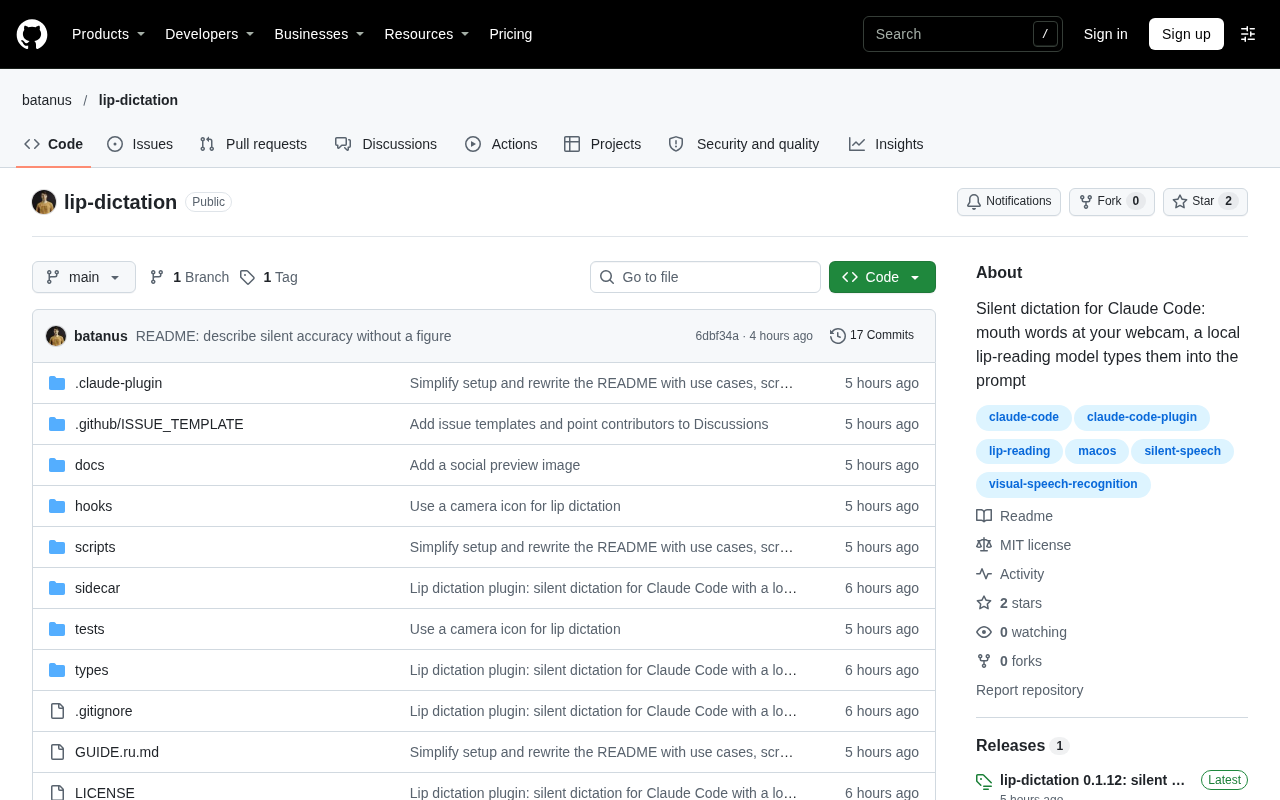
The core idea is not complicated: a camera captures the user's lip movements, an on-device lip-reading model converts the sequence of lip movements into text, and that text is then fed into Claude Code—completing the dictation workflow that would otherwise require voice input.
Compared with typical speech recognition approaches, the biggest difference is the "silence"—the user doesn't need to make a sound; lip movements alone are enough to complete the input. For open-plan offices, late-night work from home, or situations that need to stay quiet, this offers a new interaction possibility.
You may not have noticed that the project emphasizes "on-device," meaning the lip-reading model runs entirely on the local device without relying on cloud inference. This is quite important for privacy-sensitive users: lip-movement video data does not need to leave the machine, which by design reduces the risk of video streams leaking.
The Technical Pipeline: Three Steps from Lip Movements to Code
Although the original post doesn't dive into technical details, the description "on-device lip reading" suggests roughly the following workflow:
The first step is visual input and lip feature extraction. The camera captures video of the user's face, and the model locates the lip region and extracts temporal features. The lip-reading field commonly uses CNN- or ViT-style visual backbones to process each frame, combined with temporal models to capture changes in lip movements.
The second step is decoding lip movements into text. This is the hardest part of the whole pipeline. Compared with speech recognition, lip reading lacks an audio signal, and many phonemes look highly similar in lip movements (for example, p and b), so the error rate is naturally higher. To run in real time on-device, the model also needs to trade off between accuracy and size.
The third step is integration with Claude Code. The recognized text is fed into Claude Code as part of the user's input. This layer determines whether silent dictation can truly fit into a programming workflow rather than being an isolated demo.
The Role of Visual Backbones (CNN / ViT) in Lip Reading
The first step of a lip-reading model usually relies on a convolutional neural network (CNN) or a vision Transformer (ViT) to extract lip features from each frame. CNNs are good at capturing local texture and edge information and are sensitive to changes in lip contours; ViTs model global dependencies through self-attention and often perform better when there is enough data. Since lip reading is inherently a temporal task, single-frame features also need to be fed into a temporal model (such as an RNN, TCN, or Transformer) to capture the dynamics of lip movements over time. For on-device deployment, model parameter count and compute are strictly constrained; a common approach is to use a lightweight backbone (such as a MobileNet variant) or to prune and quantize a ViT to strike a balance between real-time performance and accuracy.
Phoneme Confusion and the Inherent Ambiguity of Lip Reading
The fundamental difference between lip reading and speech recognition is the absence of an audio signal. Many phonemes are almost indistinguishable in lip movements—for example, the bilabial sounds p, b, and m look highly similar visually, differing only subtly in whether there is aspiration; f and v are distinguished only by the degree of lip-tooth contact. This "visual homophone" phenomenon makes pure lip reading inherently far more ambiguous than speech recognition, and models must rely on language models (such as context prediction) for disambiguation. In programming scenarios, variable names and symbols lack the statistical regularities of natural language, so the compensating effect of language models is greatly diminished—an important reason why accuracy drops when lip reading is used to input code.
Why It's Worth Paying Attention To: Three Levels of Significance
Expanding the Boundaries of Input Methods
Beyond keyboard and voice, lip reading offers a new input channel. It may not replace existing methods, but it fills in a piece of the puzzle for specific scenarios (quiet environments, users with limited mobility, situations that require hands-free operation).
Privacy-First Local Inference
The word "on-device" is deliberately emphasized in the project title, reflecting the developer's attention to privacy. Keeping sensitive biometric data (lip-movement video) local is a typical narrative for on-device AI deployment and fits users' current concerns about data sovereignty.
On-Device AI and Data Sovereignty
"On-device" refers to inference that runs entirely on the user's local device (phone, PC, edge device) without uploading raw data to the cloud. This architecture has clear advantages in privacy-sensitive scenarios: once biometric data (such as facial video or lip movements) leaves the device, there is a risk of interception, misuse, or leakage; local inference cuts off this link by design. In recent years, with the maturation of techniques such as model compression, quantization, and knowledge distillation, the scope of on-device AI deployment has continued to expand, extending from voice wake-up and image recognition to more complex multimodal tasks. For applications involving cameras such as lip reading, on-device operation is not only a privacy narrative but also reduces network latency and bandwidth dependence, making interaction more immediate.
The Evolution of Interaction with AI Coding Assistants
Tools like Claude Code have already changed the way developers interact with code, and innovation at the input layer could further lower the barrier to use. Silent dictation makes "talking to your computer" less conspicuous in social settings and could improve acceptance of such tools in open offices.
A Measured View: Real Challenges Remain
It should be noted objectively that lip-reading technology is still far from mature. Public research generally shows that pure visual lip reading in natural settings is still significantly less accurate than speech recognition, and performance drops further when speaking speed varies, when there is occlusion, or when lighting is poor. For programming scenarios, recognizing variable names, symbols, abbreviations, and similar content is even harder—yet these are exactly the elements that appear frequently in code input.
In addition, the original post's discussion on Hacker News is limited (Points 6, Comments 1), meaning the sample of community feedback is very small, and the project's actual usability, latency performance, and recognition accuracy still lack third-party validation. As a Show HN project, it demonstrates more of a directional exploration than a ready-to-use mature product.
Conclusion
Using lip reading to give Claude Code silent dictation is an attempt that combines technical imagination with real-world constraints. Its value is not in immediately replacing voice input, but in proving the possibility of combining on-device multimodal input with AI programming tools. If future progress can be made in recognition accuracy and adaptation to coding scenarios, such approaches may become an interesting addition to developers' toolboxes.
One-line Summary
A Show HN project uses on-device lip reading to give Claude Code silent dictation, exploring a new direction for on-device multimodal input.
Paragraph Summary
A Show HN project on Hacker News uses on-device lip-reading technology to provide silent dictation for Claude Code: a camera captures lip movements, a local model converts the sequence of lip movements into text, and the text is then fed into the AI coding assistant. Its biggest features are that no speech is required and the model runs entirely locally—lip-movement video never leaves the device, lowering privacy risk and making it suitable for quiet scenarios such as open offices and late-night work from home. The technical pipeline is roughly three steps: visual feature extraction, lip-reading decoding, and integration with Claude Code. The article notes that lip reading faces accuracy challenges in programming scenarios, where recognizing variable names and symbols is difficult, and that the project has limited discussion on HN, with actual usability still lacking third-party validation—making it more of a directional exploration than a mature product.
Related articles

Nothing CMF Buds 2A Drops to $17.89 on Black Friday: A New Low for ANC Earbuds
Nothing CMF Buds 2A wireless earbuds Black Friday deal: just $17.89 on Amazon, about $11 off retail and a record low. ANC earbuds at an entry-level price.

When AI Creation Gets Accused of "Spitting": Hacker News Heats Up Over the Glaude Controversy
A Hacker News post, "Spitting in the Face of Glaude," sparks debate on AI creation transparency and attribution ethics. This analysis examines the blurred creator identity behind the controversy and offers practical advice for AI content production.

Akai Embraces Custom Firmware: MPC Sample 1.4 Lets Users AI-Program Their Sampler
Akai embraces the modding community with MPC Sample 1.4 firmware, supporting vibe-coded custom firmware and effects. We analyze the impact of this open strategy on music hardware and AI-assisted programming.