SiliconFlow Free Token Tutorial: Connect Claude Code to Chinese LLMs

Get free SiliconFlow credits to access Chinese LLMs like DeepSeek and Qwen through Claude Code
SiliconFlow is a Chinese LLM API aggregation platform offering 16 RMB in free credits after registration and identity verification, supporting models like Qwen, DeepSeek, Kimi, and MiniMax. By configuring your API key and model name through CitySwitch, you can seamlessly integrate Chinese LLMs into AI coding tools like Claude Code. Use the free credits to compare models and choose the best fit for your specific use case.
Introduction
Following the Xiaomi Mimo promotion offering 700 million free Tokens, here's another opportunity to access top-tier Chinese LLMs for free. The SiliconFlow platform currently offers free credit vouchers, supporting access to mainstream Chinese open-source models like Qwen, DeepSeek, Kimi, and MiniMax — and it integrates seamlessly with AI coding tools like Claude Code. This article covers the complete workflow from registration to getting everything up and running.
SiliconFlow Platform Overview & Registration
SiliconFlow is a Chinese LLM API aggregation platform. Its biggest selling point is that one platform gives you access to multiple top-tier Chinese open-source models — Qwen (Tongyi Qianwen), DeepSeek, Kimi, and MiniMax are all available. For developers, this means no more jumping between platforms; a unified API interface lets you test and use different models with minimal hassle.
Industry Context: Why Are Aggregation Platforms Becoming Important? As China's LLM ecosystem rapidly expands, API aggregation platforms have emerged to fill a critical need. Their core value lies in abstracting away interface differences between model providers. Developers only need to integrate with one standardized API (typically compatible with OpenAI's interface specification) to call models from different vendors. This model is similar to multi-cloud management platforms in cloud computing — it reduces vendor lock-in risk and significantly cuts the operational overhead of managing keys, billing, and documentation across multiple platforms.
The registration process is straightforward:
- Go to the SiliconFlow official website and create an account
- Complete identity verification (video verification) in the dashboard
- Once verified, claim your 16 RMB credit voucher
- For each new user you successfully invite, you receive an additional voucher
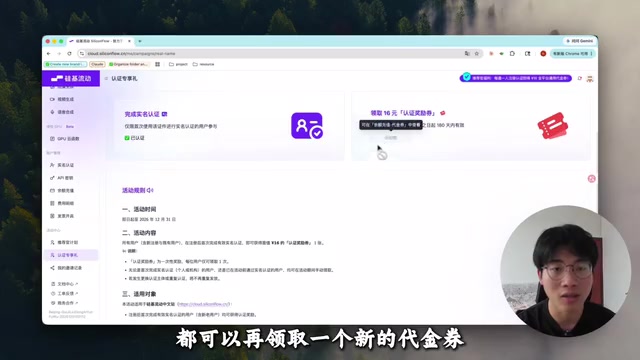
A quick note: this voucher can be used directly for model API calls — it's not one of those coupons loaded with restrictions. While 16 RMB might not sound like much, Chinese open-source models have extremely low per-Token pricing, so it actually supports a substantial amount of testing and light daily use.
What Are Tokens? Why Does 16 RMB Last So Long? Tokens are the basic billing unit for LLMs — think of them as the smallest semantic fragments of text. For Chinese, 1 Token corresponds to roughly 0.5 to 1 Chinese character; in English, 1 Token equals approximately 0.75 words. Model APIs typically charge separately for input Tokens and output Tokens, with output Tokens generally priced higher. Chinese open-source models have per-Token pricing far below closed-source models like GPT-4, with some models costing less than 1 RMB per million Tokens. This is why the 16 RMB voucher delivers far more usable capacity than you might expect.
Configuration Steps: From API Key Creation to Claude Code Integration
Step 1: Create an API Key
Log into the SiliconFlow dashboard, find the "API Keys" option in the left sidebar, and create a new key. You'll need this key later for authentication in your AI coding tools.
Step 2: Configure Models Using CitySwitch
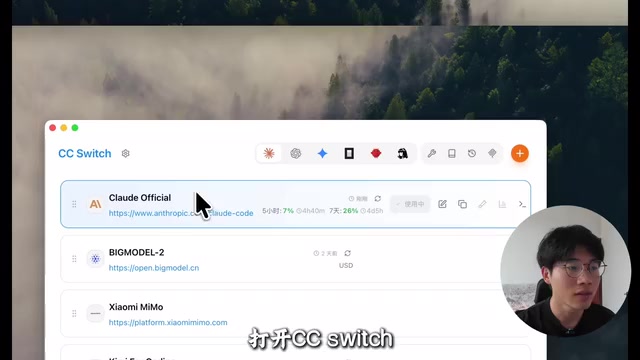
CitySwitch is a tool for managing multiple AI model configurations, making it easy to switch between different model providers. Essentially, it's a Model Router — it wraps your configured model providers into a local proxy service that exposes OpenAI-compatible API endpoints. AI coding tools like Claude Code only need to point their API Base URL to CitySwitch's local address, without needing to know anything about the underlying model differences. This architecture achieves decoupling between the model layer and the application layer — if a model provider experiences a service outage or price adjustment, you only need to switch configurations at the CitySwitch layer, with zero changes to upstream application code.
Here's how to set it up:
- Open CitySwitch and click the plus icon in the top right corner
- Select "SiliconFlow" from the provider list
- Enter the API Key you created earlier
Step 3: Configure the Model Name
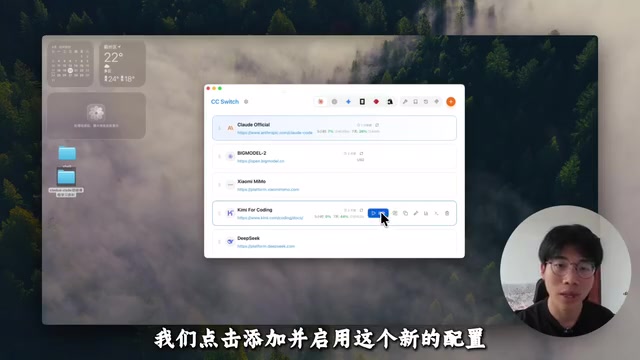
This step is crucial. Go back to SiliconFlow's Model Plaza, browse and select the model you want to use. Click on the target model, copy its full model name (in a format like deepseek-ai/DeepSeek-V3), then return to CitySwitch and paste the model name into the corresponding configuration field.
Once filled in, click "Add and Enable" to complete the configuration.
Step 4: Verify Through Claude Code
After configuration is complete, open a Claude Code session using WebLaunch or a similar tool, and send a test task to verify everything works. If all goes well, you can now call Chinese LLMs directly from within Claude Code.
How to Choose the Right Chinese LLM
Many people struggle with this question: which Chinese LLM should I actually use?
Honestly, no single model is the best at everything. Each model has its strengths, and understanding the technical background helps make more informed decisions:
- DeepSeek: Developed by DeepSeek AI, the V3 version uses a Mixture of Experts (MoE) architecture, achieving world-class performance in code generation and mathematical reasoning, with open-source weights available for local deployment. Excels at code generation and reasoning tasks with exceptional cost-effectiveness.
- Qwen (Tongyi Qianwen): Alibaba Cloud's flagship model series, covering multiple parameter scales from 7B to 72B, thoroughly trained on Chinese corpora. Well-balanced overall capabilities with strong Chinese comprehension, stable performance in multilingual understanding and instruction following.
- Kimi: Developed by Moonshot AI, initially known for supporting ultra-long context (up to 200K Tokens). Excellent at long-text processing, ideal for document analysis, contract review, and other scenarios requiring processing large volumes of text.
- MiniMax: Continuously focused on multimodal and role-playing dialogue, with its ABAB series models offering unique advantages in conversation and creative writing.
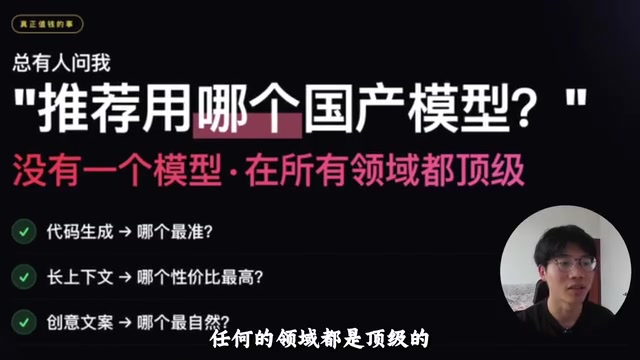
This is precisely where SiliconFlow's value lies — you can use the free voucher to test different models one by one against your actual business scenarios on a single platform, then choose the best fit based on results. This is far more reliable than blindly following someone else's recommendation.
Engineering-Oriented Selection Advice In real engineering scenarios, model selection shouldn't rely solely on benchmark leaderboards but should be built around evaluation criteria for specific tasks. We recommend extracting 20 to 50 representative samples from your actual business as a test set, designing clear scoring criteria (such as accuracy, format compliance, response latency), then batch-testing candidate models with the same Prompt template and making decisions based on quantitative data rather than subjective impressions. For latency-sensitive scenarios, also pay attention to performance metrics like Time to First Token (TTFT) and Tokens Per Second (TPS).
Practical Tips
- Define your use case first: Is it code generation, text summarization, translation, or data analysis? Different scenarios have vastly different model requirements
- Use free credits for comparative testing: Run the same Prompt through 2-3 models and directly compare output quality
- Leverage the referral program: Each new user you invite earns you additional vouchers for ongoing free usage
- Combine with AI coding tools: Through tools like CitySwitch, you can seamlessly switch between different models in Claude Code, maximizing development efficiency
Conclusion
SiliconFlow provides developers with a low-barrier entry point to experience top-tier Chinese LLMs. The 16 RMB free voucher plus the referral reward system supports a substantial period of model testing and light usage. More importantly, with CitySwitch and Claude Code integration, putting Chinese models into practical use becomes remarkably smooth. If you're looking for a Chinese LLM that fits your business scenario, this is a great place to start.
Related articles
 Tutorials
ChatGPT Plus Subscription Guide: Are GPT-5.5, image-2, and Codex Worth the Upgrade?
A detailed look at ChatGPT Plus features — GPT-5.5, image-2, and Codex — with a Plus vs Pro comparison and a complete step-by-step subscription guide for users outside the US.
 Tutorials
Harness AI Engineering in Practice: Using Claude Code to Master Enterprise-Level E-Commerce Development
Deep dive into Harness AI Engineering: master enterprise e-commerce development with Claude Code using the Rules, Skills, Wiki, and Changes framework.
 Tutorials
Cursor + Codex Dual-IDE Collaboration: A Practical Methodology for Open-Source Project Customization
A complete methodology for open-source project customization based on real-world experience, detailing the Cursor+Codex dual-IDE workflow, seven-stage process, MVP validation, and AI source code reading techniques.