Simha Digital: The AI SEO Workbench That Tells You What to Fix

Simha Digital is a next-gen SEO workbench combining AI citation monitoring with prioritized fix plans.
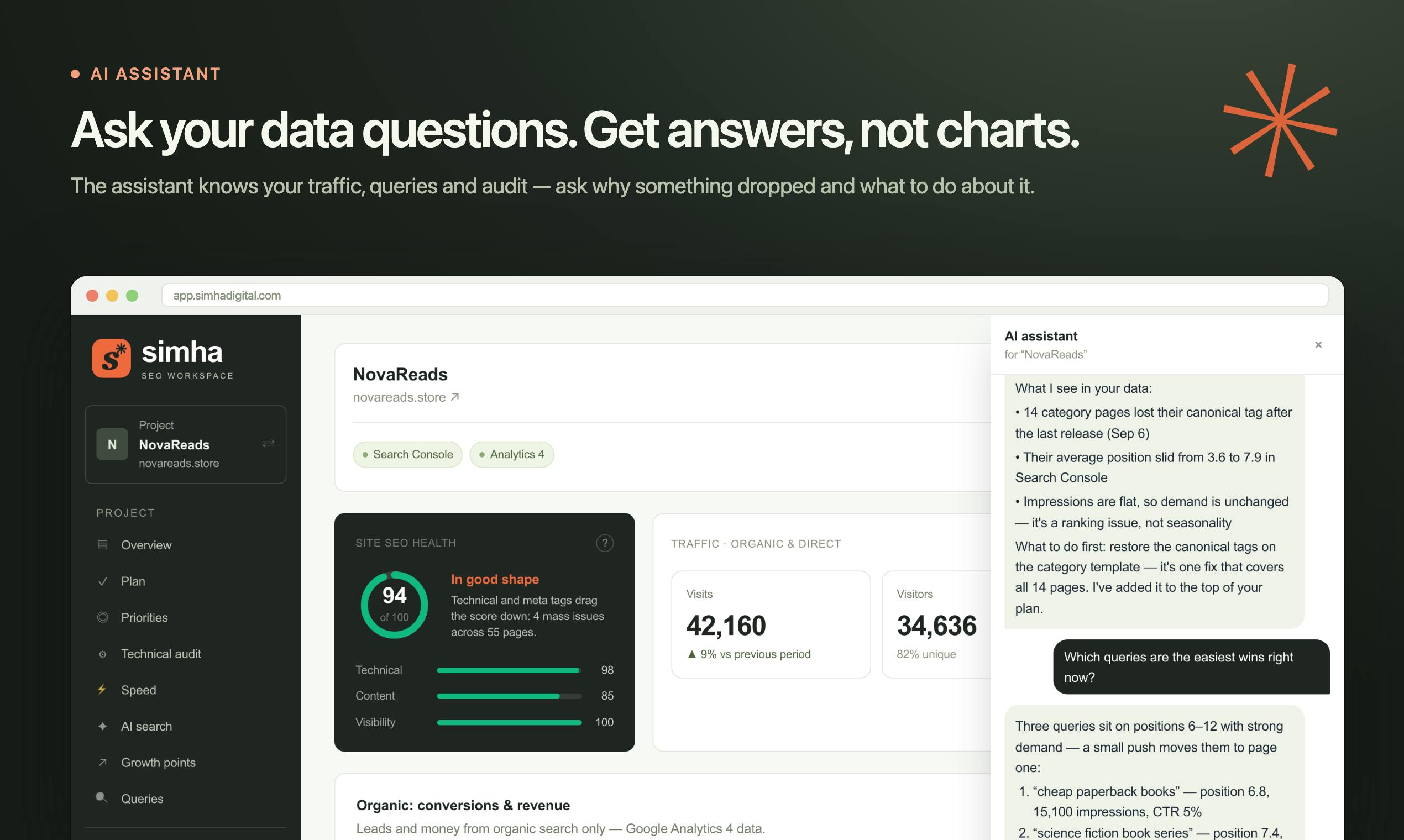
Simha Digital is a newly launched SEO tool on Product Hunt that goes beyond listing problems — it delivers actionable fix plans ranked by potential traffic loss. It connects Google Search Console and Analytics, crawls your site, and outputs a unified health score, prioritized fix list, and AI-generated change summaries. Its standout feature monitors whether AI search tools like ChatGPT cite your site and whether competitors are stealing those citation spots, directly targeting the emerging GEO (Generative Engine Optimization) space. It also integrates Core Web Vitals monitoring and a cross-source AI assistant. The positioning is sharp and on-trend, but its health score algorithm, traffic ranking accuracy, and citation detection reliability still await real-world validation.
In a crowded SEO tools market, most products are good at telling you what's wrong with your site — but few explain what to fix first, and why. Simha Digital, which just launched on Product Hunt and landed at #19 on the day's leaderboard, is trying to fill exactly that gap. It positions itself as an "SEO workbench that gives you an action plan," rather than yet another diagnostic tool that spits out an endless error checklist.
From "Spotting Problems" to "Giving You a Plan"
Simha's core promise is straightforward: tell you what to fix, not just what's wrong. This directly addresses a common frustration with SEO tools — technical audit reports often dump dozens or even hundreds of to-do items at once, with no prioritization, leaving operators overwhelmed and unsure where to start.
To address this, Simha asks users to connect Google Search Console and Analytics, then crawls their site. The output is three things: a unified health score, a fix plan sorted by "potential traffic loss," and an AI-generated change summary explaining what changed on the site and why.
Ranking issues by traffic impact rather than technical severity is a pragmatic design choice that sets it apart from traditional tools. For small teams with limited time, tackling the issues with the greatest traffic impact first delivers far more practical value than methodically clearing low-priority technical nitpicks one by one.
AI Search Citation Monitoring
What truly differentiates Simha is a feature it claims "other tools don't have": querying AI search engines with users' target queries, then showing whether AI answers from tools like ChatGPT are citing your site — and if not, who is being cited instead.
This feature targets a structural shift underway in the SEO industry. As generative search tools like ChatGPT and Perplexity change how users find information, "getting cited in AI answers" is becoming a new front in the traffic competition. The industry has started using the term GEO (Generative Engine Optimization) to describe this emerging discipline. Traditional ranking metrics no longer capture a site's visibility in the AI era, and tools that can directly detect "is the AI citing you, and are competitors stealing your citation spots" remain scarce.
If Simha can make this monitoring reliable and consistent, it becomes more than an SEO audit tool — it evolves into a dual-track visibility platform covering both traditional and AI search.
What is GEO (Generative Engine Optimization)? GEO is a concept that emerged in contrast to traditional SEO. While traditional SEO focuses on ranking high in blue-link results on Google and similar search engines, GEO is concerned with whether AI tools like ChatGPT, Perplexity, or Gemini cite your content when users ask questions — including whether traceable links or mentions appear in the response. The underlying logic differs significantly: traditional search relies on keyword matching and PageRank-style algorithms, while GEO depends more on content authority, structural clarity, and semantic relevance to the query. Best practices for GEO are still emerging in both academic and industry circles, but there's broad consensus that structured content, citations from credible sources, and writing that directly answers specific questions all improve the odds of being cited by AI. This is precisely why monitoring AI citation status has standalone value — it helps content teams assess whether their current strategy is actually working in AI-driven search contexts.
An AI Assistant That "Knows Your Data"
Beyond health scores and AI citation monitoring, Simha also offers Growth Points, Core Web Vitals monitoring, and an AI assistant designed to "understand your data." The significance of this assistant lies in connecting the dots between data scattered across Search Console, Analytics, and crawl results — users can ask it questions directly, without constantly switching between dashboards and manually cross-referencing reports.
Bringing data integration, diagnostics, priority ranking, and natural language Q&A into a single workbench reflects a broader design philosophy shared by this new generation of SEO products: lower the barrier to entry so operators without deep technical backgrounds can understand and act on optimization opportunities.
What are Core Web Vitals? Core Web Vitals is a set of user experience metrics introduced by Google in 2020. They currently include three core indicators: LCP (Largest Contentful Paint), which measures how quickly a page's main content loads; FID/INP (interaction responsiveness), which measures how quickly the page responds to user input; and CLS (Cumulative Layout Shift), which measures whether page elements shift unexpectedly during loading. Since 2021, these three metrics have been incorporated into Google's page experience ranking signals and directly affect search rankings. For operators with limited technical backgrounds, Core Web Vitals data is often scattered across Google Search Console's "Page Experience" report and PageSpeed Insights, requiring cross-tool comparison to pinpoint specific issues. Consolidating this data into a unified workbench can significantly reduce the effort involved in diagnosis and ongoing tracking.
Worth Watching, But Still Needs Validation
Simha Digital is built by Denis Klimin and currently offers a 7-day free trial. On its launch day, it received 79 upvotes and 5 comments. As a freshly launched product, its narrative is clear and its positioning is sharp — particularly the AI search citation monitoring, which squarely targets an emerging industry trend.
That said, the Product Hunt page stays largely at the level of product claims, and actual performance remains to be verified. Key questions include: how transparent is the health score algorithm, how accurate is the traffic-impact ranking, and what's the coverage and refresh frequency of the AI citation detection? These are the factors that will determine whether Simha can move from concept to genuinely useful tool. For teams looking for SEO tools built for the AI era, Simha is worth adding to your watchlist — but before drawing conclusions, it's best to run your own site data through the free trial first.
Related articles

AgentCore in Practice: Connecting Custom Tools and MCP Servers to Agents
DebuggerCafe tutorial shows how to connect custom tools and MCP servers to Amazon Bedrock AgentCore agents, covering tool contract design, MCP reuse, and production concerns.

816B Parameters Scores Only 39? The Real Cost-Effectiveness of the Open-Source LLM Parameter Race
Meta's 816B Muse Spark Open scores just 39 on Artificial Analysis, while 180B Qwen3.8-Flash-Next scores 40. This article analyzes 11 open-weight models' parameters vs. scores, exploring the real impact of activated parameters, quantized size, and deployment cost.

Aerial Manipulators: The Next Step for Drones from 'Seeing' to 'Changing'
Starting from a Reddit discussion, this article analyzes the technical challenges, potential applications, and deployment bottlenecks of aerial manipulators, exploring the key challenges for drones moving from environmental perception to physical manipulation.