Simon Willison's September Paid Newsletter: AI Price Wars and Mathematical Breakthroughs

Simon Willison's September paid newsletter covers LLM price wars, math breakthroughs, and rising AI security risks.
Developer Simon Willison's September sponsors-only newsletter ($10/month, free version released one month later) delivers sharp observations on the LLM ecosystem. Key topics include a fierce API pricing war reshaping developer tool choices, LLM breakthroughs in mathematical reasoning, a surge in "accidental cyberattacks" from AI tool misuse, and security vulnerabilities hitting his own Datasette project. The issue also covers AI in 3D graphics and pixel art, personal toolchain picks, and open-source project updates.
Prominent developer and AI commentator Simon Willison has published his September sponsors-only newsletter. This monthly paid publication covers a range of cutting-edge topics in the large language model (LLM) space — from model pricing competition and AI breakthroughs in mathematics to the growing frequency of security vulnerabilities — offering a compelling snapshot of the current AI technology landscape.
What's in This Issue
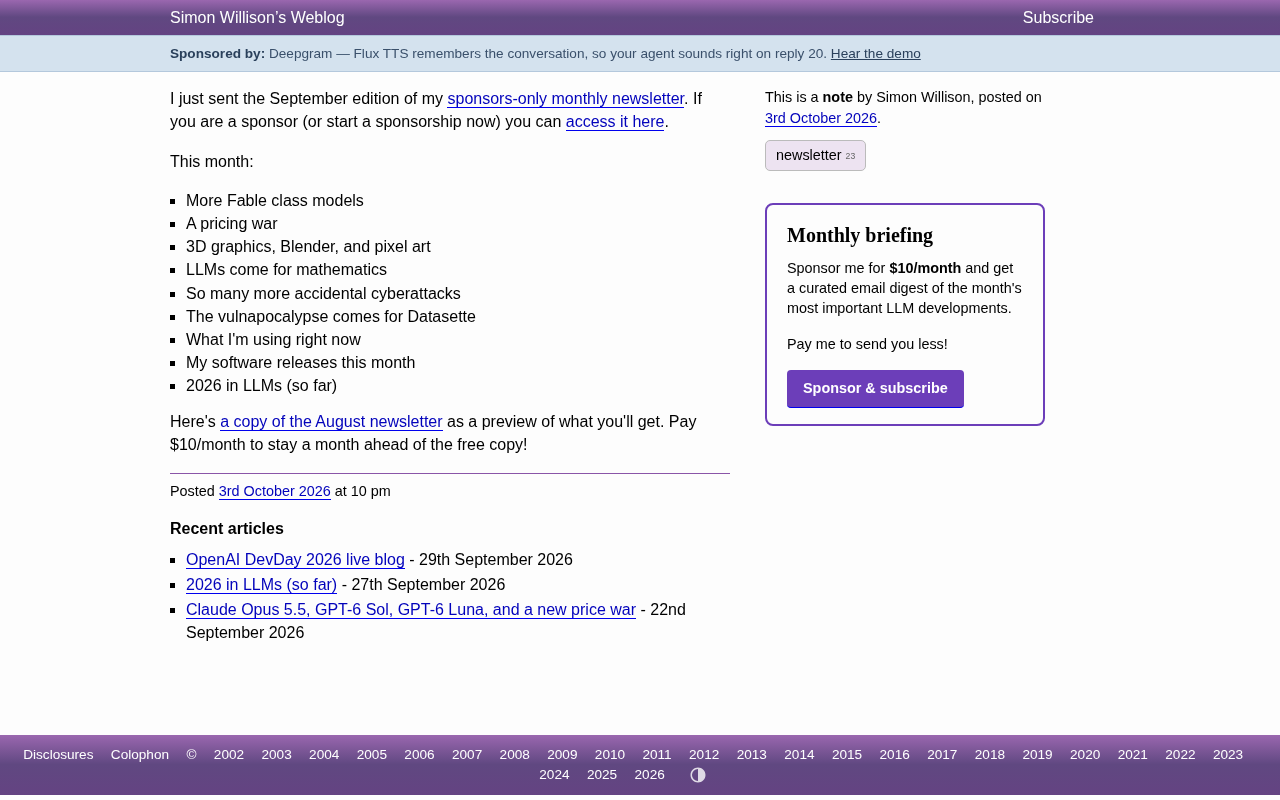
Based on the publicly available table of contents, the September newsletter covers the following key topics:
- More Fable class models: Continuing coverage of a new wave of high-capability model releases and their performance.
- A pricing war: Fierce competition among major model vendors over API pricing — one of the most closely watched trends in the LLM market recently.
- 3D graphics, Blender, and pixel art: Exploring AI's progress in creative and generative graphics applications.
- LLMs come for mathematics: Advances in large models' ability to reason through and prove mathematical problems.
- Accidental cyberattacks: Security risks arising from the misuse or unintended misapplication of AI tools.
- The vulnapocalypse comes for Datasette: Simon's own open-source project, Datasette, faces its own security challenges.
- What I'm using right now: A look at the author's personal toolchain.
- Software releases this month: Updates to Simon's open-source projects.
- 2026 in LLMs so far: A mid-year review of LLM developments through the current year.
The Pricing War: Model Market Competition Heats Up
The "pricing war" is one of the most representative themes in this issue. As multiple vendors release models with increasingly comparable capabilities, API pricing has become a key battleground for winning developers and enterprise customers. Continuously falling prices lower the barrier to AI adoption, but also raise serious questions about commercial sustainability for vendors.
For developers building applications on top of LLMs, pricing shifts directly affect technology choices and cost structures. As a long-time commentator focused on the practical side of LLMs, Simon's observations on pricing trends often provide a valuable first-hand perspective.
The broader context: this pricing war was ignited by a wave of model launches from 2024 onward, with OpenAI, Anthropic, Google, Meta, and players like ByteDance and Alibaba all releasing flagship or mid-tier models in rapid succession. The resulting commoditization pressure has pushed prices down sharply. GPT-4o's API price, for instance, was cut multiple times within a single year, with some lightweight models now costing less than one dollar per million input tokens. This "compute deflation" is a significant boon for independent developers and startups, but it's squeezing profit margins for leading vendors — sparking widespread debate about who can ultimately achieve profitability at scale.
When AI Meets Math and Security Risks
"LLMs come for mathematics" reflects the continued expansion of large model capabilities. Mathematical reasoning has long been considered a rigorous benchmark for testing genuine model comprehension, making progress in this area worth watching closely.
The newsletter also doesn't shy away from AI's downsides. The topics of "accidental cyberattacks" and "the vulnapocalypse comes for Datasette" serve as a reminder that the same powerful AI tools can be misused — or cause unintended harm — even affecting the author's own open-source projects. This candid documentation of security issues in his own work is a hallmark of Simon's characteristically pragmatic approach.
The phrase "accidental cyberattacks" deserves special attention. Here, "accidental" doesn't refer to traditional deliberate intrusions, but rather to situations where AI coding assistants or automated agents, while executing tasks, either interpret instructions too literally or get hijacked by maliciously crafted prompt injections — inadvertently triggering vulnerability scans, data leaks, or even service outages. Prompt injection is currently one of the most closely watched attack surfaces in LLM application security: attackers can embed malicious instructions in web pages, documents, or user inputs to trick an agent into performing unintended actions. As a widely used open-source database browser, Datasette's security challenges are a reasonably representative example of this broader problem.
The Value of a Paid Subscription Model
Simon uses an interesting content distribution strategy: sponsors pay $10 per month to read the newsletter a full month early, while a free version is published later. He also makes the August newsletter publicly available as a preview, giving potential subscribers a sense of the content quality.
This "early access" model is gaining traction among technical content creators — it supports independent developers through GitHub Sponsors while avoiding a full hard paywall, striking a balance between sustainability and openness. For practitioners who want to stay current with the LLM ecosystem, this kind of monthly digest curated by an experienced practitioner offers high information density and genuine reference value.
GitHub Sponsors, launched by GitHub in 2019, is a creator sponsorship platform that allows individuals or organizations to pay recurring monthly fees or one-time donations directly to open-source maintainers, with funds delivered in full after platform fees. For a highly prolific independent developer like Simon Willison — who maintains multiple open-source projects including the LLM CLI tool and Datasette — Sponsors income provides a stable revenue stream distinct from advertising or corporate sponsorship, while preserving editorial independence. This model is increasingly becoming a mainstream path for technical bloggers and open-source maintainers seeking a balance between monetization and the open-source ethos.
Wrapping Up
This newsletter is, at its core, a content publication announcement — but its table of contents clearly maps out several defining threads in the current AI landscape: intensifying model competition, capability expansion into hard domains like mathematics, and a parallel rise in security risks. Readers who want to dive deeper can subscribe for full access, or wait for the free version to be published.
Related articles

A Single Prompt Triggers a Global PHP Security Storm: Is AI a Savior or a Hidden Risk?
A single AI prompt triggered a global PHP security crisis affecting Wikipedia and the Internet Archive. This article reviews the incident, analyzes the OpenAI-Amazon controversy, and explores the security paradox of lowered vulnerability discovery barriers in the AI era and developer response strategies.

When AI Is Taken Away: How Reliance on Shortcuts Undermines Your Problem-Solving Resilience
A study of 1,222 people found that after using AI to answer questions, once AI was removed, people gave up on more problems than a control group that never used AI. The article analyzes the impact of AI reliance on learning resilience and metacognition, and explores design implications for AI learning tools.

Carta and NewView Partner to Let Startup Employees Cash Out Equity Early
Carta and NewView Capital partner to simplify startup tender offers, helping employees sell equity early. Analysis of the mechanism, liquidity pain points, and impact.