Singapore's Government-Run Matchmaking Service: How the State Steps Into Romance

Singapore runs a government matchmaking platform to combat low birth rates, sparking global debate on privacy and state overreach.
Singapore has integrated matchmaking into its demographic policy toolkit, using an official platform with real-name matching, offline event subsidies, and algorithmic pairing to reduce "matching costs" for young singles amid a persistent fertility crisis. Unlike commercial dating apps optimized for user retention, the government service is explicitly designed to produce marriages — a fundamentally different objective function. The approach recently ignited a polarized debate on Hacker News with nearly 290 comments: supporters see it as pragmatic upstream intervention, while critics worry about the state holding citizens' sensitive romantic data and the erosion of personal autonomy. The case offers a revealing lens on how algorithmic tools get embedded in public governance, and on the deep divergence between Western and Asian societies over where the line between state and individual should be drawn.
A Topic That Sparked Heated Debate
An article introducing Singapore's government-operated matchmaking service recently hit the front page of Hacker News, drawing 230 points and nearly 290 comments. The piece, published by Singapore Samizdat, offers a detailed breakdown of how Singapore's official matchmaking mechanism works — and sparked a wide-ranging debate in the international tech community about whether governments should be involved in people's romantic lives at all.
Since the original material is primarily presented through links and community discussion metrics, this article draws on publicly available context to piece together the key threads of this phenomenon.
Why Is the Government Concerned About Young People's Love Lives?
Singapore has long grappled with two compounding pressures: low birth rates and an aging population. With its total fertility rate (TFR) consistently below replacement level, encouraging marriage and childbirth has become a national policy priority. Against this backdrop, government-led or government-funded matchmaking services emerged — not as a commercial dating app, but as one component in a broader demographic policy toolkit.
This approach differs sharply from countries that leave romance entirely to the market. Singapore's logic goes: if low marriage rates directly threaten the country's long-term competitiveness and social structure, then the government has an incentive to reduce the "matching costs" for single people through public services.
Singapore's TFR currently sits at roughly 0.97–1.1, far below the replacement threshold of 2.1 — making it one of the lowest in the world. To counter this trend, the Singapore government established the Social Development Unit (SDU) as far back as 1984, specifically to provide matchmaking services for highly educated singles. Dubbed a "government matchmaker" by observers, this was one of the first state-run matchmaking programs anywhere in the world. The agency has since been restructured multiple times, evolving into today's Social Development Network (SDN), which now supports private matchmaking agencies through accreditation and subsidies — a hybrid model where the government sets the direction and the market delivers the services. The fact that this mechanism has never truly been dismantled over 40 years speaks for itself: Singapore treats its demographic problem not as a short-term policy experiment, but as a structural challenge requiring sustained intervention.
How Does the Service Actually Work?
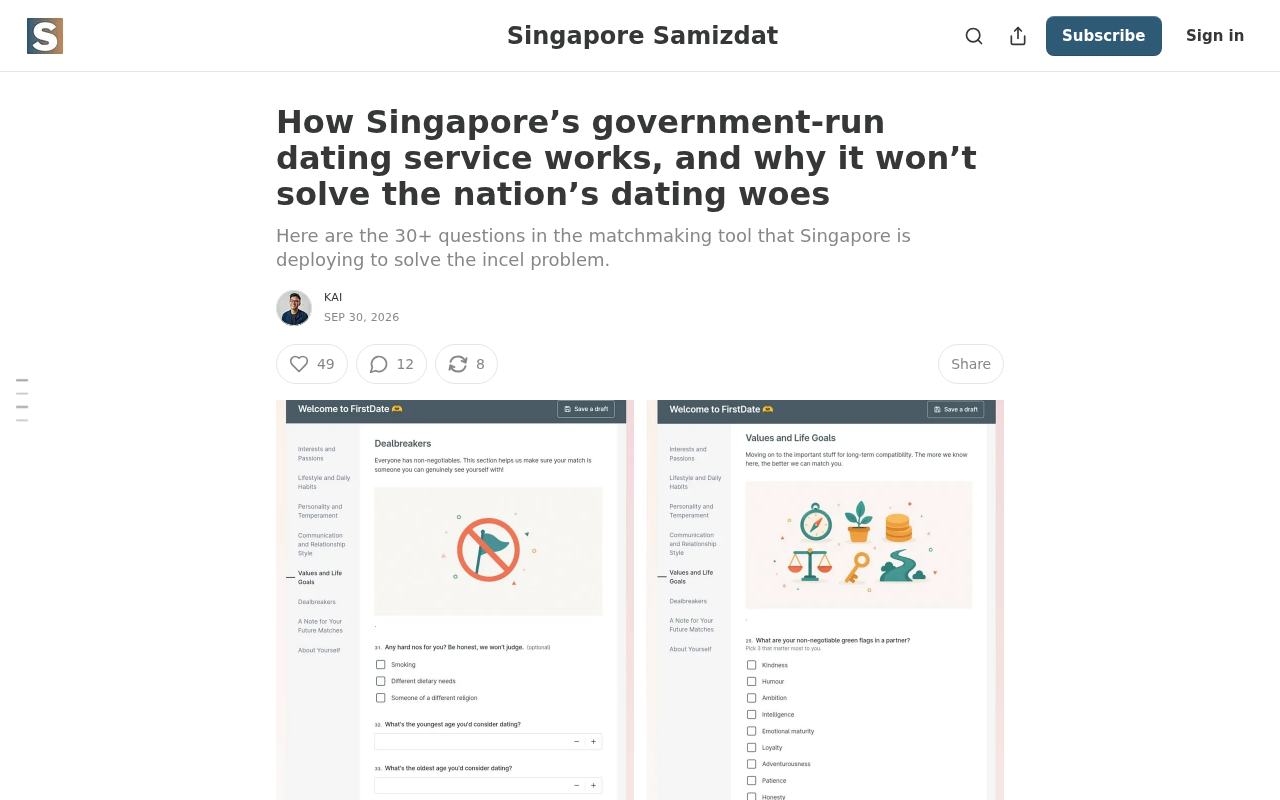
According to the article, these official matchmaking platforms typically offer a structured process rather than simple free-swiping. The mechanism usually involves several key elements: real-name registration and eligibility screening, a matching algorithm based on interests and background, and a combination of offline events and subsidized dates.
Compared to purely algorithm-driven commercial products, government services place greater emphasis on genuine in-person meetings and long-term relationship building over short-term socializing. Some services also use subsidies to lower the threshold for users to attend offline events, effectively deploying public funds to nudge private decisions.
This raises a genuinely interesting product design question: when the matching objective shifts from "user retention" to "producing marriages," the entire incentive structure and algorithmic objective function has to be rewritten. Commercial dating apps often have little interest in users finding a match too quickly — that would hurt engagement metrics. Government services have precisely the opposite KPI.
A Divided International Community
Among the nearly 290 comments on Hacker News, the debate split sharply along two lines.
One camp viewed this as pragmatic public policy. Faced with a serious demographic problem, the government uses a gentle approach to provide matchmaking services — non-coercive, and genuinely helpful to young people who are too busy with work to maintain an active social circle. Compared to direct financial incentives for having children, this kind of "upstream intervention" is arguably more targeted.
The other camp expressed unease about privacy and overreach. The government holding highly sensitive data on citizens' romantic preferences and dating histories is itself a potential risk. The deeper concern: should the state be involved in such personal life choices at all? And when the results disappoint, services like these quickly become objects of ridicule.
It's worth noting that Hacker News, as a community oriented toward programmers and tech entrepreneurs, carries a particular cultural lens — most participants come from the United States and other Western liberal democracies, where there is an ingrained wariness toward government power expansion and data collection. This makes privacy and boundary concerns far more prominent in that forum than they would be in a local Singaporean context. By contrast, in Singapore itself, deep government involvement in personal life has a much longer history of social acceptance — from public housing allocation to school selection mechanisms, the use of public resources to shape private decisions has long been a fact of daily life. The strong reaction from the international tech community, then, reflects a deeper divergence in underlying values about the proper boundary between state and individual — not just a judgment on one specific policy.
The Intersection of Technology and Governance
Setting cultural differences aside, this case offers useful food for thought for anyone interested in technology governance. It illustrates how algorithmic recommendation and data matching techniques can be embedded into public policy goals — and it exposes the inherent tensions: the more precise the data, the greater the privacy concerns; the more proactively the system matches people, the blurrier the boundaries of personal autonomy.
As governments around the world increasingly apply algorithms to public services, Singapore's matchmaking platform can be seen as a micro-case study. It reminds us that technology itself is neutral — what ultimately determines its social meaning is the institutional design and value orientation behind it.
Conclusion
Singapore's government-run matchmaking service is a unique experiment that blends demographic policy, public service, and algorithmic matchmaking into one. The intense international debate it has sparked is, at its core, about an age-old question: how far should government intrude into personal life? This time, algorithms and data have simply become the new footnotes. Whether other societies should take inspiration from it — the answer, for different contexts, is far from simple.
Related articles

A Single Prompt Triggers a Global PHP Security Storm: Is AI a Savior or a Hidden Risk?
A single AI prompt triggered a global PHP security crisis affecting Wikipedia and the Internet Archive. This article reviews the incident, analyzes the OpenAI-Amazon controversy, and explores the security paradox of lowered vulnerability discovery barriers in the AI era and developer response strategies.

When AI Is Taken Away: How Reliance on Shortcuts Undermines Your Problem-Solving Resilience
A study of 1,222 people found that after using AI to answer questions, once AI was removed, people gave up on more problems than a control group that never used AI. The article analyzes the impact of AI reliance on learning resilience and metacognition, and explores design implications for AI learning tools.

Carta and NewView Partner to Let Startup Employees Cash Out Equity Early
Carta and NewView Capital partner to simplify startup tender offers, helping employees sell equity early. Analysis of the mechanism, liquidity pain points, and impact.