SIP Outbound Calling Now Fully Open: Lowering the Barrier to Enterprise Communications

SIP outbound calling is now open to all organizations, marking voice's shift from carrier service to programmable API.
The article discusses what it means that SIP outbound calling is now open to all organizations. The author notes this is more than a permissions change — it reflects a broader equalization of enterprise communications infrastructure, with voice shifting from an exclusive capability of large enterprises to a programmable interface that smaller teams can adopt with a low barrier. The article reviews the API-ification of voice communications, arguing that messaging, email, and video have already been standardized and voice is the last piece. Customer service notifications and sales outreach benefit most directly, but the opening also delegates number compliance, user consent, and nuisance-call governance to users. Technically, it reminds adopters to plan number resources, network quality, and integration approaches in advance, and to weigh API versus SIP trunk paths.
From Early Adopter Curiosity to Standard Feature: What SIP Outbound Calling Going Open Means
SIP outbound calling, once reserved mainly for large enterprises or technical teams, is now officially open to all organizations. At first glance this may look like a simple permissions change, but it actually reflects a broader equalization underway in enterprise communications infrastructure — voice capabilities are no longer the exclusive domain of big players, and smaller teams can now connect to the programmable telephone network with a much lower barrier to entry.
SIP (Session Initiation Protocol) is the foundational protocol of VoIP, enabling voice calls to be orchestrated by software just like data. Opening up outbound calling means organizations can embed automated phone outreach into their own business processes without building a complex voice gateway from scratch.
SIP (Session Initiation Protocol) is a signaling protocol standardized by the IETF in the late 1990s, originally designed to establish, modify, and terminate multimedia sessions (such as voice and video calls). Its core idea borrows from HTTP's request-response model: the initiation, answering, and hanging up of every call can be expressed as a set of text-based SIP messages. As a result, SIP calls can be parsed and orchestrated directly by software systems without relying on a carrier's black-box switch. In enterprise VoIP architectures, SIP typically works alongside RTP (Real-time Transport Protocol, which carries the actual voice data stream) — SIP handles "connecting" while RTP handles "speaking." This separation of signaling and media is the technical root that makes voice capabilities API-able.
Behind the Opening: Voice Is Becoming a Programmable, General-Purpose Capability
From a technical evolution standpoint, fully opening SIP outbound calling sends a clear signal: voice communications are shifting from "a service provided by carriers" to "an interface developers can call."
In the past, enterprises that wanted outbound calling typically had to connect to the traditional telephone network, purchase hardware, and handle number-resource compliance — a lengthy process with opaque costs. Programmable outbound calling based on SIP abstracts these steps into API calls, so organizations only need to focus on the business logic itself. The maturation of this abstraction layer is the precondition for opening voice capabilities to all organizations.
This trend aligns with the broader API-ification of the communications industry: messaging, email, and video have all followed similar paths, and voice is the last piece of the puzzle to be standardized.
Practical Impact on Organizations: Who Benefits Most
Once outbound calling is fully open, the most direct beneficiaries are teams with clear outreach needs but no communications infrastructure.
Customer service and notification scenarios are a typical example. Order confirmations, appointment reminders, and anomaly alerts demand high timeliness; SMS is easily ignored, and voice outbound calls often achieve better reach rates. Open SIP outbound calling lets such features be adopted on demand without being tied to long-term contracts.
Sales and marketing teams benefit as well. Programmable outbound calling allows batch outreach, call routing, and call-record analysis to be integrated into CRM systems, forming a closed loop. For small and mid-sized organizations, this means gaining capabilities that were once available only to call centers, at something close to a software-subscription model.
You may not have noticed, but the opening also delegates compliance responsibility downward. Outbound calling involves regulatory requirements around number standards, user consent, and nuisance-call governance. Organizations gain the capability, but must establish corresponding compliance mechanisms themselves.
The "user consent" mentioned in the article is a concept with clear legal meaning in outbound-calling compliance. Represented by the U.S. Telephone Consumer Protection Act (TCPA) and the EU General Data Protection Regulation (GDPR), most jurisdictions require businesses to obtain the called party's explicit consent before making automated voice outbound calls and to retain consent records. China's "Provisions on the Administration of Short Messaging and Voice Calling Services" likewise imposes constraints on commercial outbound calling. This means that after adopting SIP outbound calling, organizations often need to embed consent collection, Do-Not-Call (DNC) list checks, and caller-ID authentication into their business processes, rather than simply calling a dialing interface. Compliance cost is therefore the most easily underestimated element once outbound calling capability is "pushed down" to users.
Technical Perspective: What to Think Through Before Connecting
For organizations preparing to adopt SIP outbound calling, several technical decision points are worth mapping out in advance.
First is number-resource planning. SIP outbound calling depends on available numbers or trunk resources, and number availability and compliance requirements vary significantly by region, so planning must be done in advance based on business coverage.
Second is call quality and network environment. SIP transmits voice over IP networks and is sensitive to jitter and packet loss. Organizations need to assess their own network conditions and, when necessary, use dedicated lines or optimized routing to ensure call quality.
Third is the integration approach with existing systems. SIP outbound calling is typically provided via API or SIP trunk, and organizations must decide whether to connect directly to their own PBX or route through a cloud communications platform. This directly affects operational complexity and cost structure going forward.
SIP trunk is a key concept for understanding connection approaches. It is essentially a logical channel based on the SIP protocol that connects an enterprise's PBX (private branch exchange) or calling platform to the traditional telephone network (PSTN), enabling the enterprise to make and receive external calls without laying physical telephone lines. Compared with the "API calls" in my original description, SIP trunk is more low-level: the API approach has the cloud communications platform encapsulate signaling, numbers, billing, and recording, offering fast onboarding but limited customization; SIP trunk hands signaling control to the enterprise's own systems, offering high flexibility but requiring the enterprise to handle SIP servers, codec negotiation (such as G.711 and Opus), NAT traversal, and other operational details itself. Which form to choose often depends on whether the team already has PBX infrastructure and how granularly it needs to control the call flow.
Conclusion
Opening SIP outbound calling to all organizations is one milestone in the API-ification of voice communications. It lowers the barrier for enterprises to adopt programmable voice, while shifting more compliance and operational responsibility to users. For teams with clear outreach needs, this means a new option; for the communications industry, it means competition in voice capabilities will shift from resource monopoly to a contest of service and integration.
Related articles
 Tech Frontiers
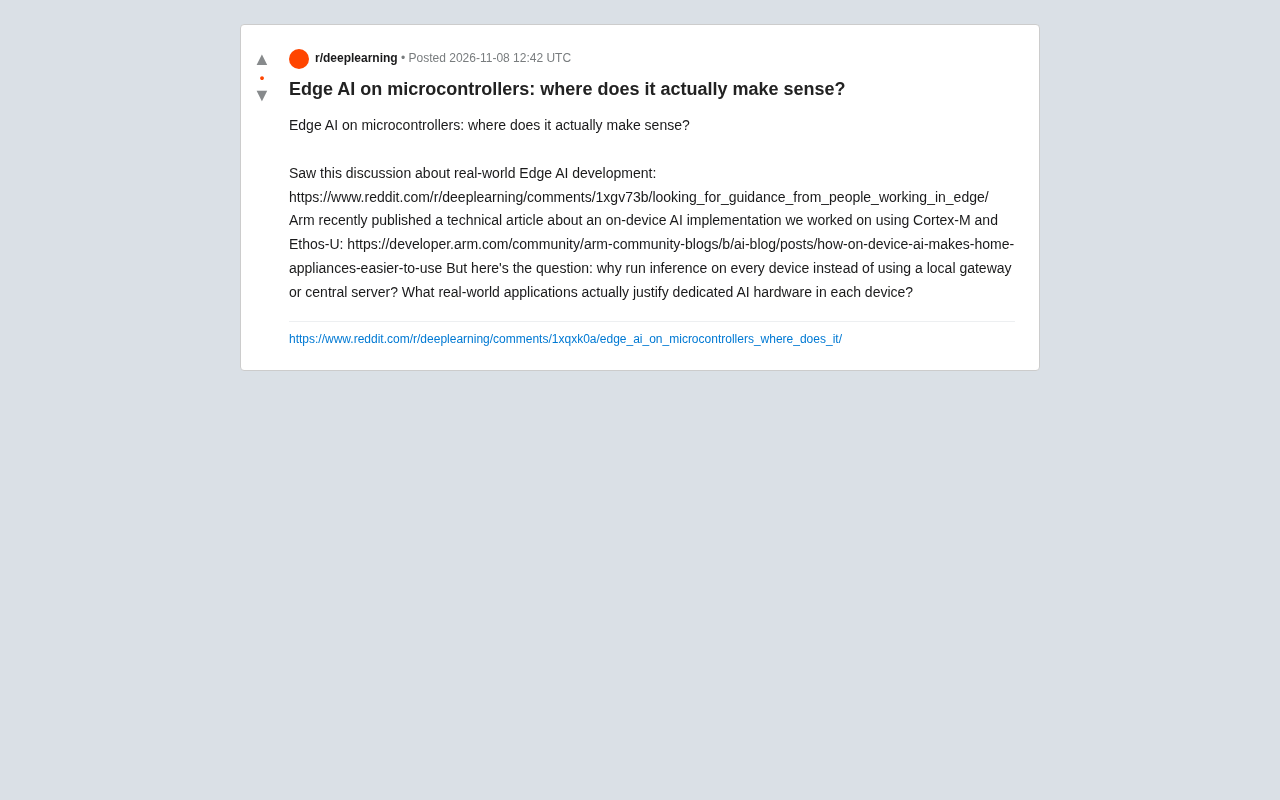
Edge AI on Microcontrollers: When Is It Actually Worth Deploying?
Drawing on Reddit discussions and Arm case studies, this article analyzes the real-world use cases for edge AI on microcontrollers: when each device needs independent inference, when a gateway or cloud is more reasonable, and the costs and boundaries of specialized hardware.
 Tech Frontiers
Pushing the Limits of Extreme Sudoku on a 16GB GPU: Insights from Depth and Flow Matching
A researcher trained a 16.54M-parameter model on a 16GB GPU to solve extreme Sudoku, finding effective depth breaks the 60% plateau and flow matching with improved sampling pushes accuracy past 99% with ~50× lower layer-evaluation budget.
 Tech Frontiers
AI Agent Approval Workflows: Why Human Confirmations Always Get Mindlessly Clicked
Why do AI agent approval workflows always get mindlessly clicked? A Reddit discussion shows that separating rules from keys, low-frequency high-risk approvals, and GitHub Environments-style gates are the keys to effective approvals.