Siteprint: Measure Any Website's Design and Generate AI Coding Prompts in One Click

Siteprint turns any webpage's design specs into structured AI coding prompts in one click.
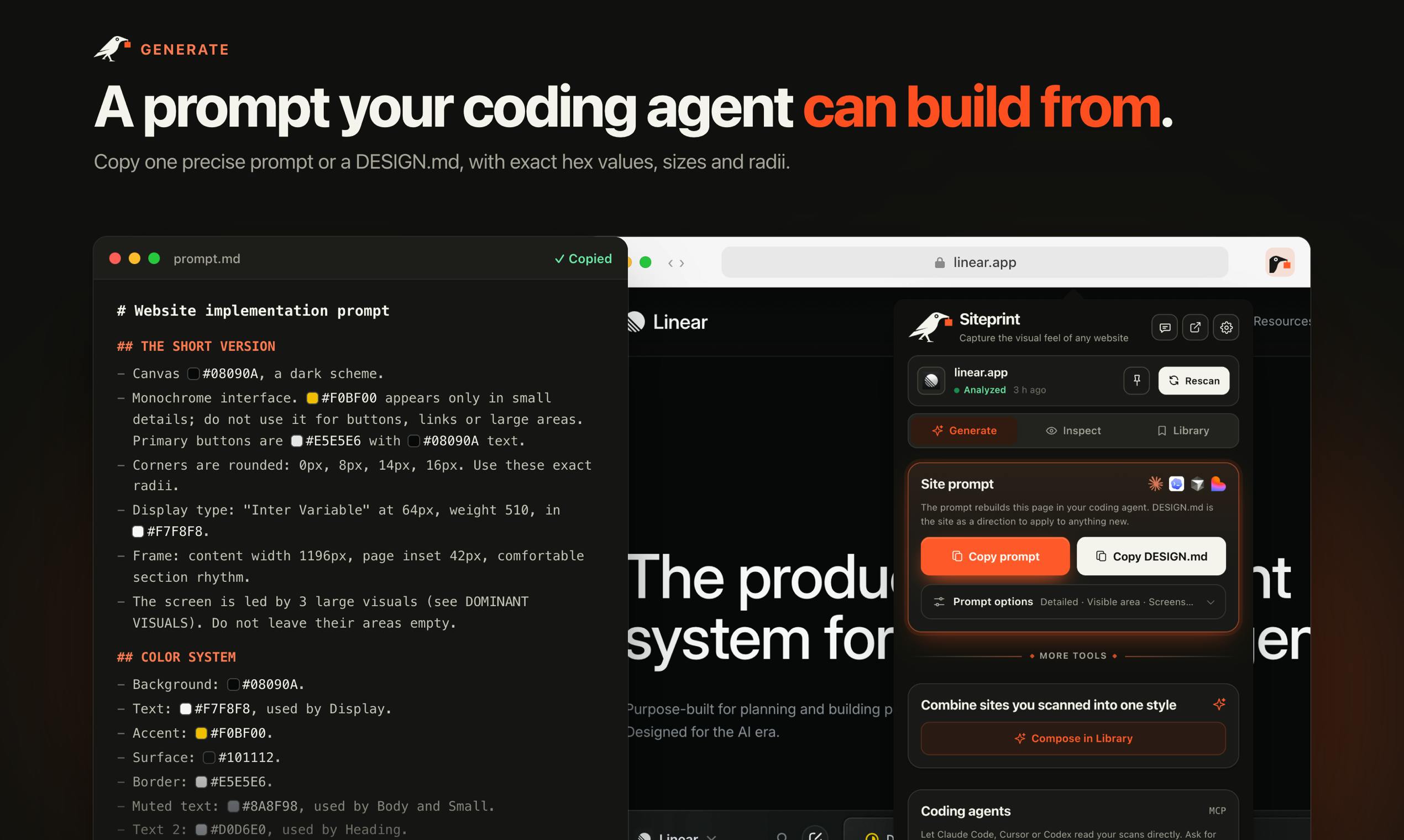
Siteprint is a Mac Safari browser extension built for AI-assisted frontend development. It automatically measures the colors (with semantic roles), type scale, spacing, border radius, and layout of any webpage, then converts these details into structured prompts for AI coding tools like Claude Code, Cursor, and Codex. Its core value is bridging the gap between "visual reference" and reusable design spec — filling the weak link of manual description in the design-to-code workflow. It runs locally, costs a one-time $9.99, and represents the emerging category of "prompt preprocessing" tools in the AI era. Currently limited to Mac and Safari; accuracy on complex dynamic pages remains to be validated.
When Design Analysis Meets AI Coding
Replicating a beautiful webpage's design has always been one of the most time-consuming and error-prone steps in frontend development and design handoff. Developers typically need to manually inspect color values, measure spacing, infer font size hierarchies, and then relay all of that information to a design team or into their own code. Siteprint compresses this entire process into a single click.
Siteprint is a Safari browser extension for Mac that measures the design details of any webpage — including colors and their roles in the interface, type scale, spacing, border radius, and overall layout — then organizes all of this into a precise prompt ready to hand directly to AI coding tools like Claude Code, Cursor, or Codex.
The product was built by indie developer Filip Papic. It earned 83 upvotes and 7 comments on Product Hunt, ranking 9th, and is categorized under Design Tools, Developer Tools, and Artificial Intelligence.
What Problem Does It Actually Solve
As AI-assisted coding tools have become mainstream, more and more developers have grown accustomed to describing requirements in natural language and letting AI generate the code. But in UI replication scenarios, the quality of AI output depends heavily on the precision of the input prompt. If you simply say "make a card layout similar to that website," AI will struggle to produce pixel-accurate results.
Siteprint's core value lies in transforming vague "visual references" into structured, quantifiable design specifications. It goes far beyond extracting hex color values — it identifies the role each color plays within the design system, distinguishing primary colors from background colors from text accent colors. This semantic description is precisely the kind of context AI needs to generate high-quality code.
Measurement Dimensions Cover the Core Elements of a Design System
According to the official description, Siteprint covers several key dimensions that make up a modern design system:
- Colors and roles: Captures color values and annotates their functional purpose
- Type scale: Reconstructs the typographic hierarchy of the page
- Spacing: Measures the whitespace patterns between elements
- Border radius: Captures details like corner curvature
- Layout: Understands the overall structural arrangement
Together, these dimensions essentially constitute a reusable design specification — not a collection of scattered data points.
A Design System is the systematized set of standards modern product teams use to maintain visual and interaction consistency. It typically includes color tokens, type scales, spacing grids, and component libraries. Type scale specifically refers to the proportional relationships between various text sizes on a page — headings, body text, captions, and so on — often following a modular scale progression such as 1.25× or 1.333×. Spacing follows similar logic: well-designed pages typically define whitespace using integer multiples of a base unit (such as 4px or 8px) rather than arbitrary values. Siteprint attempts to identify and reconstruct these patterns hidden beneath the raw pixel data, rather than simply listing measurements. This makes its generated prompts closer to a designer's language than a plain numerical report.
Local Processing and a One-Time Purchase
Siteprint takes a relatively restrained approach to privacy and pricing. The entire tool runs locally on the user's Mac, meaning page data doesn't need to be uploaded to a cloud server — a definite plus for developers who care about data security.
On pricing, Siteprint uses a one-time payment of $9.99 with no subscription. At a time when a large number of productivity tools are shifting to monthly subscriptions, this buy-once model is far more accessible for individual developers and designers, lowering the barrier to entry.
Positioned as Part of the AI Coding Workflow
Notably, Siteprint explicitly positions itself as one component of an AI coding workflow, rather than a standalone design analysis tool. It directly integrates with mainstream AI coding assistants — Claude Code, Cursor, and Codex — and its output format is optimized for prompts these tools can use effectively.
This positioning reflects a broader trend: AI coding tools are giving rise to a category of "prompt preprocessing" auxiliary products. These tools don't generate code themselves; instead, they focus on converting real-world information (design mockups, documents, data) into structured inputs that AI can process efficiently, thereby improving the quality of AI output.
Claude Code, Cursor, and Codex are currently the leading AI-assisted coding tools, each with its own strengths. Claude Code is Anthropic's command-line AI coding assistant, known for understanding complex context and executing multi-step coding tasks. Cursor is a deeply modified VS Code-based AI code editor that offers inline code completion and conversational edits. Codex is OpenAI's code generation model and the underlying technology behind GitHub Copilot. What all three have in common is that the quality of the input prompt directly determines the accuracy of the code output. By optimizing its output format specifically for these tools, Siteprint produces prompts whose structure and terminology better match what these AI models "expect" — rather than leaving users to figure out on their own how to describe design details.
Who It's For — and Where Its Limits Lie
Siteprint's most direct audience is individual developers who frequently use AI tools for frontend work, independent designers, and small teams that need to quickly replicate reference designs. For the scenario of "I saw a website I love and want to rapidly clone its visual style," it can significantly shorten the path from observation to implementation.
That said, it's worth being realistic about its boundaries. As a Safari extension, it's currently limited to the Mac platform and Safari ecosystem — Chrome or Windows users can't use it for now. It's also worth verifying in practice how accurately automatic measurement can interpret the design intent of complex pages (such as responsive layout breakpoints or dynamic component states). Design replication is inherently a subjective craft; tools can provide a data foundation, but the final aesthetic judgment and fine-tuning still requires a human touch.
Overall, Siteprint represents a type of small-but-focused vertical tool that fits the AI era well: rather than trying to do everything, it precisely targets a specific point of friction in a particular workflow, addressing a real pain point with a low price, local processing, and sharp focus.
Related articles

Gemini 4 Argon Hands-On: AI Builds Board Games, Constructs Temples, and Trains Robots Autonomously
Gemini 4 Argon hands-on roundup: AI autonomously builds a desk racetrack and temple in Blender, writes a ray tracing engine, trains a humanoid robot to sink 7 shots, plus API pricing and developer access.

The Magic Octagonal Coin: Why Only 9% of People Can Predict Its Flip?
Only 9% of people can correctly predict the Magic Octagon coin flip. This article explains its spatial rotation mechanism, common cognitive pitfalls, and a new hypothesis based on Relevance Theory, exploring the limits of human spatial reasoning.

Sam Altman: AI Is Entering the Era of Scientific Discovery — Math Breakthroughs Will Replicate in Biology and Energy
Sam Altman says AI is entering the era of scientific discovery — math breakthroughs will replicate in biology, materials science, and energy to help develop new drugs and energy sources.