Sixteen Years After Deepwater Horizon, Deep-Sea Ecosystems Still Haven't Recovered
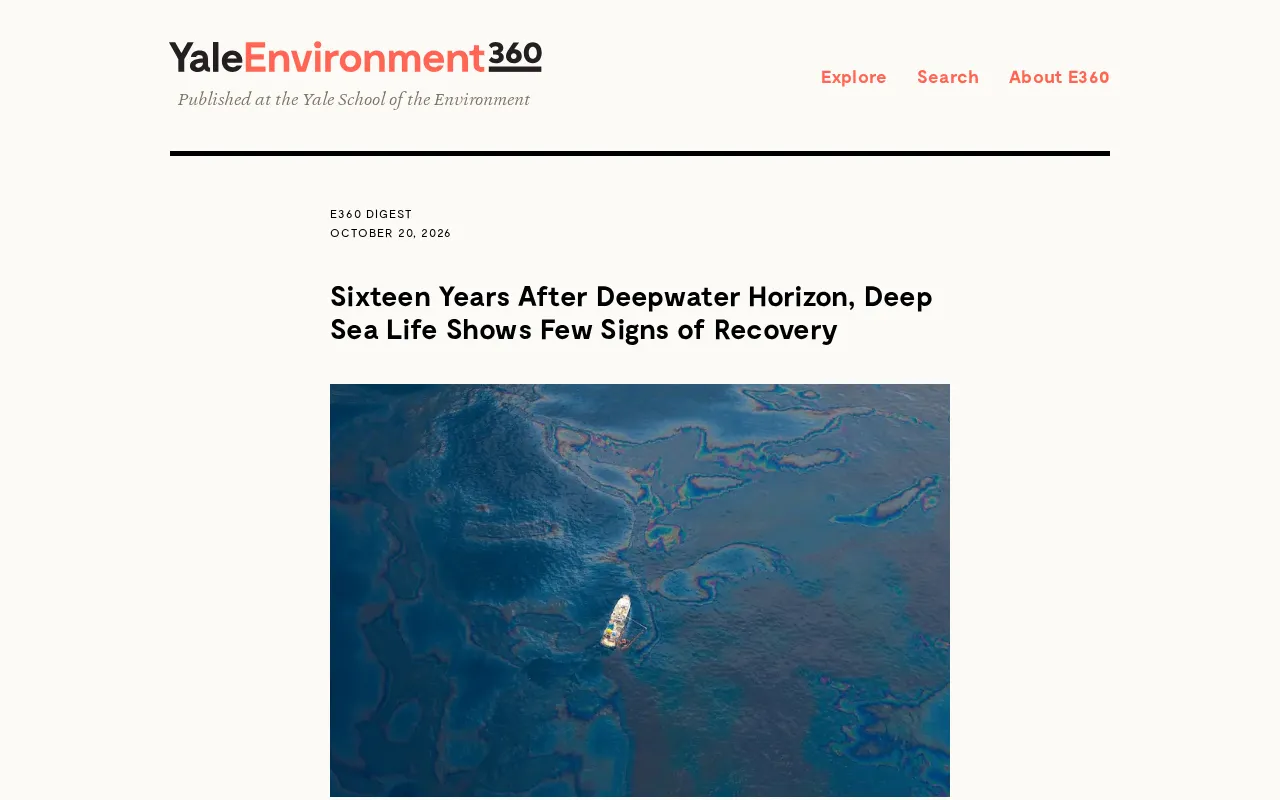
Sixteen years after the Deepwater Horizon spill, deep-sea ecosystems remain far from recovered.
In 2010, the Deepwater Horizon rig explosion released about 210 million gallons of crude oil and roughly 1.8 million gallons of chemical dispersants. A Yale e360 review finds that sixteen years later, deep-sea coral coverage remains significantly below control levels, benthic diversity and biomass are low, and petroleum metabolites persist in deep-sea fish and crustaceans. Slow microbial degradation, dispersants pushing oil into the food chain, and slow life-history traits explain the delayed recovery, warning that risk assessments for deep-sea oil, gas, and mining must span decades.
The 2010 explosion of the Deepwater Horizon drilling rig in the Gulf of Mexico became one of the worst environmental disasters in the history of the offshore oil industry. Sixteen years later, a review by Yale e360 notes that deep-sea ecosystems have barely emerged from the shadow. The topic drew nearly 300 points and 166 comments on Hacker News, showing that public concern about long-term environmental impacts has not faded.
The Scale of the Spill and the Fragility of Deep-Sea Ecosystems
The Deepwater Horizon incident lasted 87 days, releasing roughly 210 million gallons of crude oil into the Gulf of Mexico while also using about 1.8 million gallons of chemical dispersants. Unlike shallow-water spills, the crude oil and dispersants formed subsea plumes in the high-pressure, low-temperature deep-sea environment, with contaminants settling into continental slope sediments and directly affecting benthic organisms.
Deep-sea organisms have extremely slow growth and reproduction cycles. Deep-sea corals grow only a few millimeters per year, and deep-sea fish can live for decades or even centuries. This "slow-paced" ecology means that the toxicological effects of contaminants will persist for decades, and recovery timelines far exceed those of shallow-water systems.
Subsea plumes are a key physical phenomenon that distinguishes deep-sea oil spills from shallow-water ones. When crude oil erupts from a wellhead at a depth of about 1,500 meters under high pressure and low temperature (around 4°C), light components do not readily vaporize due to the high pressure; instead, they mix with seawater to form neutrally or negatively buoyant suspensions of oil droplets, gas, and water that can spread horizontally for tens of kilometers and span hundreds of meters vertically. Observations in 2010 confirmed that the Deepwater Horizon spill formed multiple layers of extensive subsea oil plumes, some of whose fine oil droplets remained in the mid-water column for long periods because their buoyancy was insufficient to carry them to the surface. This matters: conventional emergency response mainly targets surface oil slicks, but subsea plumes mean contaminants spread directly through deep-sea ecosystems, bypassing standard countermeasures such as surface containment booms and in-situ burning. It also explains why exposure of benthic and mid-water organisms far exceeded initial estimates.
Chemical dispersants (such as Corexit 9500) work by using surfactants to lower the interfacial tension between oil and water, breaking oil slicks into micron-scale droplets. This increases the contact area between oil and water, promotes microbial degradation, and prevents slicks from reaching the coast. But injecting dispersants directly into the deep sea has two consequences: first, it forms more stable tiny oil droplets that remain suspended in the water column rather than rising; second, it increases the probability that oil will be ingested by zooplankton, allowing toxic components such as polycyclic aromatic hydrocarbons to enter the food chain. Dispersants themselves are also somewhat toxic, and long-term data on their combined toxicity with crude oil are still lacking. This is precisely the focus of regulatory controversy—dispersants "transfer" pollution from the surface to the deep sea rather than eliminating it.
Monitoring Evidence Sixteen Years Later
Multiple long-term monitoring programs have provided ongoing evidence. Surveys of deep-sea coral communities show that coral coverage in contaminated areas remains significantly lower than in control areas, with regeneration rates that are nearly negligible. The biomass and diversity of benthic invertebrates at some sites remain low.
More insidious effects appear in the food chain. Petroleum hydrocarbon metabolites continue to be detected in deep-sea fish and crustaceans, and the reproductive success of some species has declined. Oil that sinks to the seafloor mixes with sediment to form persistent contaminated layers, and any disturbance can reintroduce pollutants into the water column.
Mechanistic Explanations for Slow Recovery
Deep-sea ecological recovery faces three obstacles. First, the low-temperature, high-pressure, lightless deep-sea environment makes microbial oil degradation far slower than in surface seawater. Second, dispersants break oil into tiny droplets that, while reducing surface slicks, make oil more readily ingested by zooplankton and transferred along the food chain. Third, the life-history traits of deep-sea organisms—late maturity, low reproductive rates, and long lifespans—mean that any population loss takes an extremely long time to compensate for.
The "life-history traits" of deep-sea organisms refer to a species' overall pattern of growth, maturation, reproduction, and lifespan. In the deep sea, where food is scarce, temperatures are low, and there is no light, organisms have generally evolved "slow" strategies: late sexual maturity (many deep-sea fish require more than ten years), low reproductive rates, small clutch sizes, and long lifespans (e.g., orange roughy can live for over a century). This strategy is adaptive in stable environments but lacks resilience in the face of sudden mortality events—once a population is reduced, the rate at which new individuals can be recruited is extremely slow. In addition, benthic organisms such as deep-sea corals rely on asexual fragmentation for reproduction, with limited dispersal distances, making it difficult for contaminated patches to naturally reseed from nearby healthy areas. Together, these traits determine that the timescale for deep-sea ecological recovery is decades to centuries, far exceeding the duration of any conventional monitoring program.
Implications for Deep-Sea Oil and Gas Development
These long-term tracking results have direct reference value for regions currently advancing deep-sea drilling. Ecological risk assessments for deep-sea oil and gas development are often based on short-term experiments, but the lesson of Deepwater Horizon shows that assessment timescales need to be extended to decades. In the absence of effective deep-sea remediation technologies, preventive regulation is the only reliable line of defense.
At the same time, emerging activities such as deep-sea mining face similar risks: once deep-sea ecosystems are damaged, the cost and technical difficulty of restoration may exceed current imagination.
Conclusion
The long-term ecological data from Deepwater Horizon remind us that the deep sea is not a buffer zone that can quickly heal itself. Sixteen years is not enough for a deep-sea coral community to return to its original state, and humanity's footprint in the deep sea continues to expand. Aligning monitoring cycles with ecological recovery cycles—rather than with policy cycles—is the core lesson left by this event.
One-line Summary
Sixteen years after the Deepwater Horizon spill, deep-sea ecosystems remain far from recovered.
Paragraph Summary
In 2010, the explosion of the Deepwater Horizon drilling rig in the Gulf of Mexico released about 210 million gallons of crude oil and used roughly 1.8 million gallons of chemical dispersants. A review by Yale e360 notes that sixteen years later, deep-sea coral coverage remains significantly lower than in control areas, benthic biodiversity and biomass remain low, and petroleum hydrocarbon metabolites continue to be detected in deep-sea fish and crustaceans. The article explains this through three aspects—the scale of the spill, monitoring evidence, and recovery mechanisms: low temperatures and high pressure in the deep sea make microbial degradation extremely slow; dispersants break oil into microdroplets and push it into the food chain; and the late maturity, low reproductive rates, and long lifespans of deep-sea organisms mean that any population loss takes an extremely long time to compensate for. The author therefore warns that ecological risk assessments for deep-sea oil and gas development and deep-sea mining must be extended to decadal scales, and that preventive regulation is the only reliable line of defense.
Related articles

Nvidia CEO Removal Saga: Trump Intervenes Over the Weekend, Jensen Huang Reinstated Monday
Vergecast podcast reveals Nvidia CEO drama: earnings call said he wouldn't return and a new CEO was being sought; Trump intervened over the weekend, with J.D. Vance brokering a security guarantee to the board; Jensen Huang reinstated at 9 a.m. Monday.

Semantic Caching Explained: Reusing the Same Answer for Similar Questions
Semantic caching uses embeddings to judge whether queries are similar in meaning and reuses cached results for similar prompts. This article explains how it works, the difficulty of threshold tuning (such as the risk of misjudging negations), and its applicable boundaries.

How Did Trump Personally Turn Nvidia into the "Twelfth Board Member"?
A YouTube political commentary offers a sharp view: behind Nvidia's market cap milestone, Trump's deep involvement earns him the title of "twelfth board member." The article breaks down the commentator's logic on stock market achievements, the break from small-government tradition, and power display.