Skilldocs: A Real-Time Collaborative Markdown Editor That Bridges AI Agent Workflows

Skilldocs brings Figma-like real-time Markdown collaboration with built-in AI Agent handoff.
Skilldocs is a real-time collaborative Markdown editor that lets multiple users edit simultaneously with live cursors, inline comments, and instant rendering. Its standout feature is deep AI Agent integration—teams can package their collaborative discussions and diffs to hand off context-rich tasks directly to AI agents, bridging the gap between human intent and AI execution.
When Markdown Meets Real-Time Collaboration
In the world of document collaboration, Google Docs and Figma have each defined the real-time collaboration paradigm for text and design, respectively. Now, a new tool called Skilldocs is bringing that same experience to the Markdown world that developers know and love. Debuting on Product Hunt under the tagline "Figma for markdown," it quickly racked up 118 upvotes and landed at #6 on the daily product leaderboard.
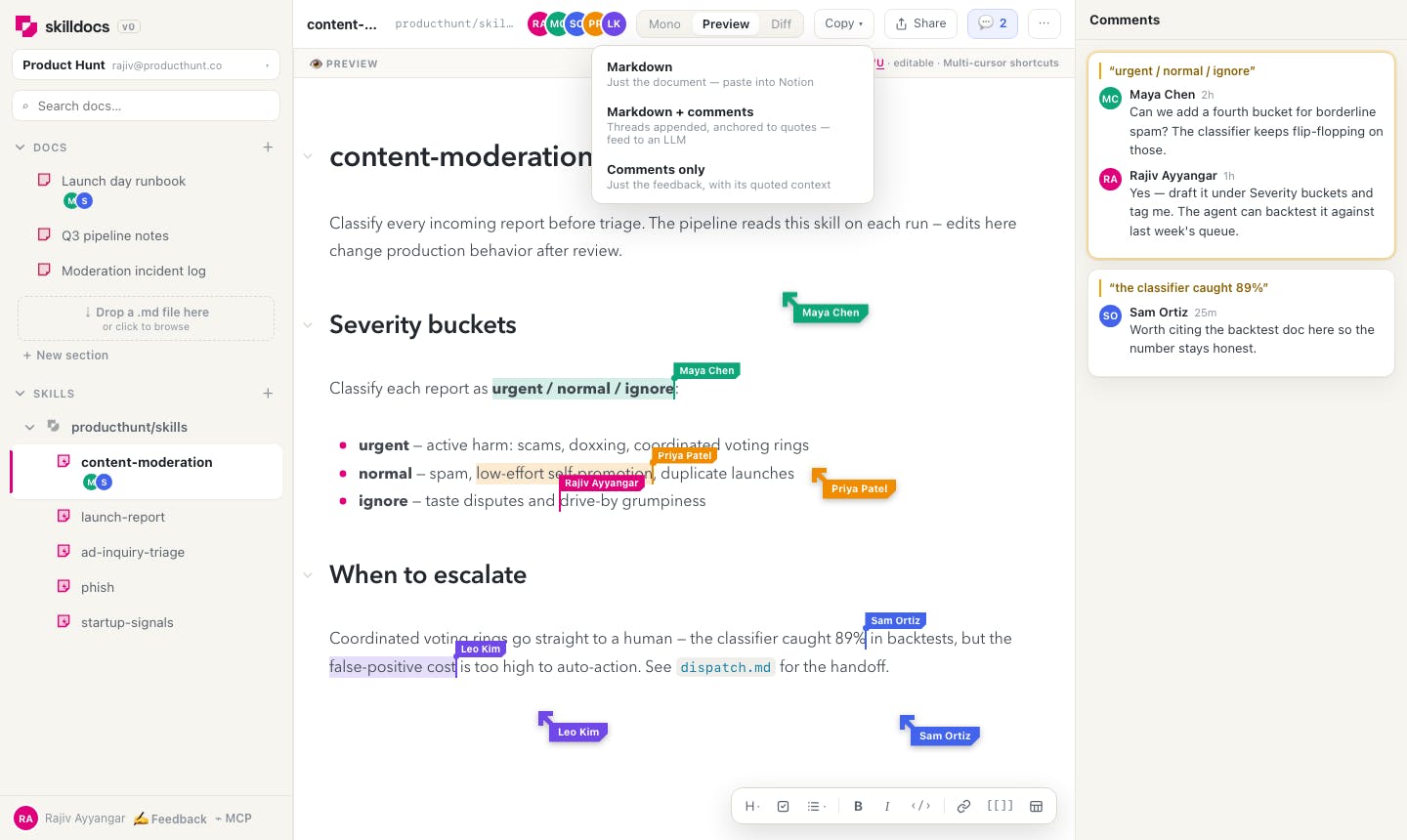
Skilldocs' core value proposition is straightforward: open a skill document, and all collaborators can jump in simultaneously—you can see each other's real cursor positions, add inline comments at any time, and the editor renders content in real time as you type. This combination effectively transplants Figma's smooth "multi-user, WYSIWYG" experience onto plain text documents.
Behind this real-time collaboration experience, the core technology typically relies on CRDT (Conflict-free Replicated Data Type) or OT (Operational Transformation). OT is the classic approach used by Google Docs, which ensures consistency by transforming concurrent operations on the server side. CRDT, on the other hand, is a more decentralized approach that has gained traction in recent years—Figma itself uses a CRDT variant to power its smooth multi-user collaboration. CRDT's advantage lies in its mathematical guarantee of eventual consistency for concurrent edits, without needing a central server to arbitrate conflicts. This results in lower latency and makes offline editing possible. In the open-source community, Yjs and Automerge are the two leading CRDT implementation libraries, and many next-generation collaborative editors are built on top of them.
It's worth noting that Markdown's role as the entry point for tools like this is deeply tied to its foundational position in the developer ecosystem. Created by John Gruber in 2004, Markdown started as a lightweight markup language for converting plain text to HTML. But after nearly two decades of evolution, it has become the de facto standard in the developer world: GitHub READMEs, technical blogs, API documentation, and knowledge base systems are almost universally built on Markdown. Its core strength lies in the portability of plain text—Markdown files can be tracked by Git version control, opened in any text editor, and parsed and processed by automation tools. CommonMark and GitHub Flavored Markdown (GFM) are the two most widely adopted specifications today. It's precisely because of Markdown's central role in developer workflows that building real-time collaboration capabilities for it carries genuine market significance.
How Skilldocs Achieves Deep AI Agent Integration
If Skilldocs were just another real-time Markdown editor, its value would be limited. What truly sets it apart from traditional tools is its deep integration with AI Agent workflows.
According to the official description, Skilldocs allows users to finish a round of collaborative discussion and document editing, then hand "the entire conversation + diff back to the agent". This means a human team can thoroughly refine content and ideas in a visual, commentable, collaborative interface, and then pass the results—complete with full context—directly to an AI agent for the next step of execution.
Diff (difference comparison) is one of the most fundamental and important concepts in software engineering, originating from the diff tool in the 1974 Unix system. In Git version control, every commit is essentially a diff—recording the precise changes from one file state to another. The core workflow of Code Review revolves around diffs: reviewers examine the specific changes, add inline comments, and discuss modifications. Skilldocs' design of packaging "conversation + diff" for handoff to AI Agents effectively generalizes the human team's code review process to all types of document collaboration, allowing AI to understand not just the final result, but also "why changes were made this way" and "what alternatives the team discussed."
The Product Logic Behind the "Skill" Naming
Interestingly, the product calls its document units "skills" rather than ordinary "docs." This naming isn't arbitrary—in the current AI context, "skill" typically refers to a capability module or instruction set that an agent can invoke. This suggests that Skilldocs isn't positioned merely as documents for humans to read, but as structured instruction carriers that humans and AI co-author, review, and that AI ultimately consumes and executes.
Specifically, in today's AI Agent technology ecosystem, "skill" has a clear technical meaning. In Microsoft's Semantic Kernel framework, a skill refers to a set of functions or plugins that AI can call; in OpenAI's GPTs ecosystem, the analogous concept is called Actions; in orchestration frameworks like LangChain, it corresponds to Tools. These skills/tools typically consist of two parts: a natural language description (telling the AI when and how to use it) and the concrete execution logic. By naming document units "skills," Skilldocs implies that each document is essentially a capability definition or task description for an AI Agent—not only meant for human reading, but also an executable node in an AI Agent workflow.
In other words, it's trying to become a "collaborative buffer zone" between human intent and AI action: humans align on consensus here, and AI receives clear tasks with full discussion context.
Product Positioning and Target User Profile
On Product Hunt, Skilldocs is categorized under three tags: Productivity, Developer Tools, and Artificial Intelligence. This cross-category positioning precisely outlines its target user profile—development teams that both rely on Markdown for technical documentation and have started incorporating AI Agents into their daily workflows.
The product was built by Rajiv Ayyangar. Judging by its launch performance, the 118 upvotes indicate it has touched on a real pain point: as AI coding assistants and autonomous agents become more prevalent, how humans can efficiently "feed" AI high-quality, context-rich instructions is becoming a new efficiency bottleneck.
Why the Human-AI Collaborative Document Space Deserves Attention
In the past, discussions about AI collaboration focused on "how AI helps humans write code." Skilldocs represents the reverse approach—how to help humans better organize their intent before handing it off to AI. When the discussions, comments, and revision history generated through team collaboration can be fully preserved and transmitted, what the AI receives is no longer an isolated prompt, but a context-rich "work briefing."
This shift in thinking reflects a widely discussed evolutionary direction in AI applications—the leap from Prompt Engineering to Context Engineering. Early AI interactions relied mainly on carefully crafted single prompts, but as task complexity increased, people discovered that AI needs more than just a good instruction—it needs rich background context: project history, team consensus, decision logic, constraints, and more. Companies like Anthropic and OpenAI have been continuously expanding model context windows (from an initial 4K to today's 200K tokens), but window size only solves the problem of "how much information can fit." "How to organize and deliver high-quality context" remains an unsolved challenge. Skilldocs' model of packaging collaborative discussions + diffs is a structured context organization approach—rather than simply stuffing more text into a prompt, it presents information through discussion threads, change records, and comment annotations in a structured way, enabling AI to distinguish between "final decisions" and "discussion processes."
This "conversation + diff packaged handoff" pattern may well become a standard paradigm in future human-AI collaborative workflows.
Limitations and Considerations for an Early-Stage Product
As a product that just debuted on Product Hunt, publicly available information about Skilldocs is still relatively limited—with only 2 reviews and no large-scale real-world usage feedback yet. The vision of "real-time collaboration + AI handoff" is compelling, but the actual rendering performance, conflict handling in multi-user collaboration, and compatibility with mainstream AI Agent platforms all remain to be validated.
Regarding conflict handling in multi-user collaboration, even with advanced technologies like CRDT, numerous engineering challenges persist. For example, when two users simultaneously edit different positions within the same paragraph, does the final merged result match both users' expectations? When large-scale document restructuring (such as paragraph moves or heading hierarchy adjustments) occurs concurrently with local edits, how do you ensure semantic-level consistency? These are chasms that need to be crossed between "technically correct" and "experientially correct"—areas that Google Docs and Figma have gradually optimized through years of iteration.
Additionally, while the "Figma for markdown" analogy is eye-catching, Markdown itself is linear text, fundamentally different from Figma's two-dimensional design canvas. The technical challenges and experience requirements for real-time collaboration are quite different between the two. The tagline is more about conveying the sentiment of "smooth multi-user simultaneous experience" rather than a strict feature-to-feature comparison.
Conclusion: The Human-AI Convergence Trend in Developer Tools
Skilldocs is a signal reflecting how developer tools are converging from two separate tracks—"human-to-human collaboration" and "human-to-AI collaboration"—into one. It stitches together mature real-time collaboration experiences with emerging AI Agent workflows, attempting to solve an increasingly prominent problem: how to efficiently transmit a team's collective intelligence in a way that AI can understand.
For teams exploring AI-native workflows, tools like this are worth keeping an eye on. Whether it can truly deliver on its promises still needs time and more user feedback to verify—but the direction it points to is undoubtedly one of the most thought-provoking product trends of our time.
Related articles

How Does Claude Call Tools It Has Never Seen? MCP and AI Agent Principles Explained
How does Claude call tools it was never trained on? This article breaks down the AI Agent tool-calling loop, Anthropic's three-layer MCP architecture, context bloat and context rot, and production-grade Agent safety design principles including timeout retries, prompt injection, and idempotency keys.

OpenAI Cracks Math Problems, Why Are Mathematicians Losing Sleep?
OpenAI claims to solve math problems — why are mathematicians anxious? Vergecast reveals the Eye of Sauron dilemma and the tension between AI answers and human understanding.

CSS Conditional Border-Radius Trick: Auto-Square Corners When Elements Touch the Edge
Pure CSS conditional border-radius: auto-square corners when elements touch the edge, rounded while floating. Use calc(100vw-100%) with clamp() to kill the transition band, and container query units cqi for non-fullscreen containers, plus a scrollbar offset workaround.