Skills Mechanism Explained: Engineering Practices for AI On-Demand Capability Loading

Skills are a lazy-loading mechanism that lets AI models load temporary capabilities on demand
Skills are a mechanism that lets models temporarily gain new capabilities when needed. Unlike MCP's full-tool protocol, they use progressive disclosure and lazy loading: only skill names and descriptions are exposed normally, with full execution rules loaded only when the model actually needs them—saving context window space, reducing costs, and avoiding attention dilution.
What Are Skills? A Clear One-Sentence Explanation
Skills have been frequently mentioned in AI development circles recently, but many people don't fully understand what they are. Some think they're an upgraded version of prompts, others see them as a variant of tool calling, and some consider them a plugin system.
Precise definition: Skills are a mechanism that allows models to temporarily learn a new capability at the right moment.
There are three key concepts to understand here:
- At the right moment — Triggered precisely only when needed, without wasting computational resources or consuming excessive Tokens
- Temporary capability — Called on demand, discarded after use
- Breaking native limitations — Giving models capabilities they don't inherently possess, such as PDF parsing and script execution
Here's a simple example: when you ask a bare model to read a PDF file, it will tell you it can't. This isn't because the model's parameters aren't powerful enough—it's because models inherently only understand and generate text, and don't know what a PDF's structure looks like.
Technical background on model native capability boundaries: The essence of large language models is a probability prediction system trained on massive text data, with native capability boundaries determined by the modality and format of training data. Standard LLMs input and output pure text Token sequences, which means they inherently cannot process binary file formats (such as PDF, DOCX, XLSX), execute system commands, access real-time networks, or manipulate file systems. PDF format is particularly representative—its internal structure is a page description language based on PostScript, containing complex metadata like font embedding, layers, and encryption, requiring specialized parsing libraries (such as PyMuPDF, pdfplumber) to extract readable text. Skills allow models to dynamically generate and execute Python scripts to call these parsing libraries, essentially packaging "code generation + code execution" as a reusable capability unit, thereby elegantly bypassing the model's native limitations.
Skills were created precisely to solve this type of problem.
Skills vs MCP: Engineering Thinking Meets Protocol Thinking
In the past, there were mainly three ways to solve the problem of limited model capabilities: stuffing rules into prompts, writing external code to return results to the model, and using the MCP full-tool protocol. Skills take a fourth path.
Technical positioning of the MCP protocol: MCP (Model Context Protocol) is an open standard protocol released by Anthropic in late 2024, designed to unify the interaction between AI models and external tools and data sources. Its design philosophy is similar to interface specifications in programming languages: through standardized JSON-RPC communication format, it enables models to invoke external capabilities such as file systems, databases, and web services. MCP's advantage lies in ecosystem standardization—developers only need to write a tool once according to the protocol, and it can be reused by all MCP-supporting models. However, its full-loading design philosophy leans more toward a "toolbox exposure" model. When the number of tools grows to dozens or even hundreds, every conversation requires injecting all tools' Schema descriptions into the context, which creates significant performance bottlenecks in large-scale engineering scenarios.
The Core Design of Skills: Progressive Disclosure
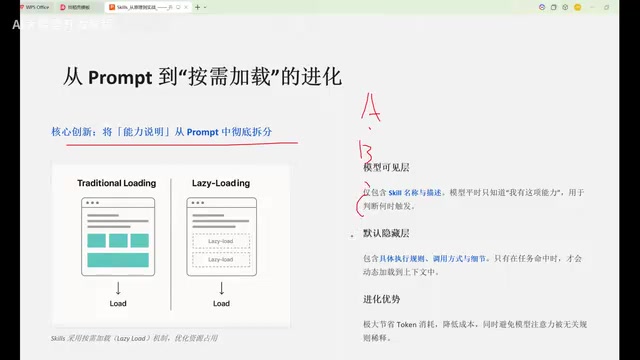
Skills separate capability descriptions from prompts. The previous approach was to tell the model through prompts or MCP: "You can now do A, B, C, and here's how each one works and what the rules are," followed by extensive explanations.
The problem is: Whether you use them or not, all these rules must be fed to the model with every conversation. This leads to three serious consequences:
- The context window becomes increasingly crowded
- Usage costs keep rising
- The model's attention is dispersed across numerous rules, unable to focus on core tasks
Technical background on context windows and Token consumption: A large language model's context window refers to the maximum text length the model can process in a single inference, typically measured in Token count. Tokens are the basic units models use to process text—one Chinese character corresponds to approximately 1-2 Tokens, and one English word corresponds to approximately 1-1.5 Tokens. Mainstream models' context windows have grown from early 4K Tokens to today's 128K or even million-level Tokens, but a larger context doesn't mean you can pile in unlimited information—Token consumption directly affects API call costs, and research shows that models exhibit "attention dilution" in ultra-long contexts, meaning that when useful information is buried under large amounts of irrelevant content, the model's reasoning accuracy drops significantly. This is precisely the core motivation behind Skills' lazy loading design.
Skills take the opposite approach: normally, the model is only told a skill's name and description (when it can be used), while the specific execution rules and operational details remain hidden. Only when the model genuinely needs a certain skill during task execution is the full content loaded.
This is what's known as on-demand loading (lazy loading).
Engineering principles of lazy loading: Lazy loading is a classic performance optimization strategy in software engineering, with the core idea of "deferred initialization"—resources or data are only loaded into memory when actually needed, rather than pre-loaded entirely at system startup. This pattern is widely used in frontend development (image lazy loading), database ORMs (on-demand querying of associated objects), operating systems (virtual memory paging), and other domains. Skills introduce this engineering concept into AI prompt management: the system maintains a skill index (containing only names and summary descriptions), the model determines whether a skill is needed based on task semantics, and only after triggering does it inject the complete execution specification into the current context. This "two-stage loading
Related articles
 Tutorials
ChatGPT Plus Subscription Guide: Are GPT-5.5, image-2, and Codex Worth the Upgrade?
A detailed look at ChatGPT Plus features — GPT-5.5, image-2, and Codex — with a Plus vs Pro comparison and a complete step-by-step subscription guide for users outside the US.
 Tutorials
Harness AI Engineering in Practice: Using Claude Code to Master Enterprise-Level E-Commerce Development
Deep dive into Harness AI Engineering: master enterprise e-commerce development with Claude Code using the Rules, Skills, Wiki, and Changes framework.
 Tutorials
Cursor + Codex Dual-IDE Collaboration: A Practical Methodology for Open-Source Project Customization
A complete methodology for open-source project customization based on real-world experience, detailing the Cursor+Codex dual-IDE workflow, seven-stage process, MVP validation, and AI source code reading techniques.